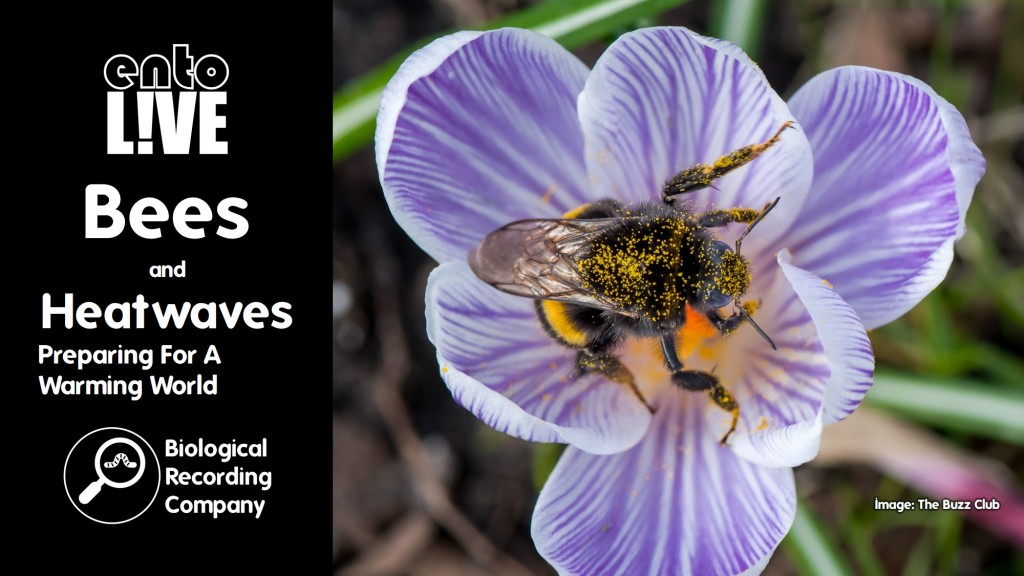
Combining historical specimens and modern-day research allows wildlife of the past to inform conservation of the future. In this talk, Matt Hayes will discuss research currently being carried out on Wildlife Trust reserves in the UK, monitoring the impact of climate change, and investigating if artificial butterfly banks can help protect species from extreme weather events. He will then discuss another area of his research, looking at historical butterfly specimens from the University Museum of Zoology in Cambridge, which can extend records of change 200 years back in time.
Matt Hayes is a Zoology PhD student interested in how we can manage nature reserves to protect invertebrates from climate change. His PhD project is made possible by a longstanding partnership between the Wildlife Trust for Bedfordshire, Cambridgeshire and Northamptonshire, and the Insect Ecology Group at the University of Cambridge.
Q&A with Matt Hayes
What were the butterfly banks made of? For this site, we brought a digger in to scrape off the top layer of vegetation, dig about a foot down and put that earth on the banks themself. In the presentation you will see a square area – this was sunk with the soil used to build the banks.
How did you decide how high the banks would be? We wanted them to be significant structures and aimed to get them to two metres tall. However, we found that the chalk wouldn’t settle above a certain height and we couldn’t build them physically taller than they were. This was a consequence of the material that we used, so it would be possible to make the banks bigger if the material used allowed it.
What type of vegetation colonised the banks? We found that it was different from what was present in the field that the banks were located in. We didn’t plant anything, so the seeds must have been present and there was a huge amount of successional species, such as thistles and poppies. Our focus for this part of the experiment was the structure of the banks, and it would be really interesting to look at the vegetation and seeding the banks next – or even keep some of the bank surface as bare earth.
Was there any specific bank feature that provided the biggest benefit to butterflies? I think it is most likely the combination and variation of features. Anecdotally, I have seen butterflies using the south banks in the morning to heat up and the north-facing banks in extreme heat to cool down.
Where would you advise conservationists to site butterfly banks on their reserves? We specifically targeted sites that had a low baseline in terms of topographic variation (essentially flat parts of the study sites). We were investigating how to improve sites so we needed sites where you would be able to detect improvements! However, I believe that most sites would benefit from these structures due to the fact that they add in variation. You don’t need to create structures as big as we did and what you build should be appropriate to the size of the site. You can find more guidance from the Creating a Butterfly Bank factsheet by Butterfly Conservation.
Are you planning on sending your data to biological recording organisations? The first step is for me to process all for the data and get it ready for use within my PhD. this includes getting the specimen collection digitised and made available through the museum website. Following that, I’m keen to get the data used by as many sources as possible and will be looking at how it can be shared with data holders such as Cambridgeshire & Peterborough Environmental Records Centre, Butterflies for the New Millenium and/or the NBN Atlas.
How many cataloguing hours do you think that you’ve put in? I started working on the cataloguing of the UK butterflies around 2019 and I’ve put in many hours since then – probably thousands. I haven’t actually kept a record of this.
What is the next part of your research? I’m hoping to look at general heterogeneity of nature reserves and how that impacts butterflies’ ability to regulate their body temperature. My research group has been working with the Wildlife Trust since 2006 and we have thousands of butterfly data points where we have both temperature and GPS data so we can figure out on nature reserves what habitat is around them, and see how that impacts their temperature. The question is “If we have more varied nature reserves as a whole, does that help species maintain optimum body temperature?”.
Hayes et al (2024) Heatwave predicts a shady future for insects: impacts of an extreme weather event on a chalk grassland in Bedfordshire, UK: https://doi.org/10.1007/s10841-024-00556-5
entoLIVE webinars feature guest invertebrate researchers delving into their own invertebrate research. All events are free to attend and are suitable for adults of all abilities – a passion for invertebrates is all that’s required!
entoLIVE is delivered by the Biological Recording Company in partnership with the British Entomological & Natural History Society, Royal Entomological Society and Amateur Entomologists’ Society, with support from Buglife.
The entoLIVE programme is delivered by Biological Recording Company and receives sponsorship from the following organisations:
Cover crops are used in arable rotations to protect the soil between cash crops (e.g. wheat, barley). Cover crops need to be removed before cash crops can be planted, and this is commonly done by spraying environmentally-harmful herbicides. Here, we conducted a large-scale field trial to test whether using cover crops that die naturally in the frost is better for earthworms, spiders, and beetles, and associated ecosystem functions (e.g. soil compaction). The aim is to design and test the ecological benefits of cover crop mixes that can be removed with minimal herbicide use. This experiment was co-designed with 15 farmers, LEAF, and Oakbank.
Dr Amelia (Millie) Hood is a postdoctoral researcher at the University of Reading. She’s interested in co-designing sustainable farming solutions with farmers in the UK, and using large ecological experiments to test them.
Q&A Dr Amelia Hood
Did you use existing survey methods for the groups that you monitored? The methods used were not new, scientists have previously used quadrants to study plants, vortices to study beetles and spiders and soil monoliths to study earthworms. The Showcase project designed protocols using these sampling methods that were used to ensure that the way the sampling was done was consistent across all of the sampling within the Showcase project. For example, with vortice sampling this means standardising factors such as number of seconds the vortice is used, the size of the area sampled and the distance between sample points.
Do you know what percentage of farms are already using cover crops? This is information that would be really valuable but, unfortunately, I don’t have access to this information. This would be a great project. A possible way of doing this would be to collaborate with the major cover crop suppliers and see which are their most popular mixes. You’d also need to consider the motivations behind the use of cover crops, as farmers have different motivations (including for pollination, reducing nitrate leaching or improving soil structure) and this would impact which mixes they would look to use.
Are there alternatives to using chemicals to remove the cover crop? There are two main ways to kill off the cover rop. The first is use of herbicides. The amount of spraying can be reduced by grazing, rolling off or planting winter sensitive species. The second option is manual removal, which would be the method used by organic farms. There are disadvantages to both of these methods. Herbicides result in chemical run-off and contamination. Manual removal through tilling will lead to increased soil compaction. There is a lot of debate in the scientific and farming communities about which methods are less destructive for the environment and there is no easy answer. I’ve noticed that farmers that I’ve worked with seem to be getting more responsive, and are thinking more about interventions, for example tilling only when they feel it is needed rather than tilling at a set frequency each year.
Did the farmers get paid for taking part in this research? No, participation in this research was voluntary and we are extremely grateful for the farmers that allowed us to undertake this research on their land!
What is the next step in this research? Continuity is a really big issue in the world of research. Research grants are usually 3-5 years and arable rotations can be as long as 8 years. Some funding bodies do support long-term experiments, particularly as the value of these is recognised with long-term experiments contributing disproportionately to policy and practice. It can sometimes be tricky to get repeat funding for continuing or extending a project, as there can be an emphasis on supporting new and snazzy projects. I will be continuing working on co-design with farmers and will be looking at agroforestry where you plant rows of trees in arable fields.
entoLIVE webinars feature guest invertebrate researchers delving into their own invertebrate research. All events are free to attend and are suitable for adults of all abilities – a passion for invertebrates is all that’s required!
entoLIVE is delivered by the Biological Recording Company in partnership with the British Entomological & Natural History Society, Royal Entomological Society and Amateur Entomologists’ Society, with support from Buglife.
The entoLIVE programme is delivered by Biological Recording Company and receives sponsorship from the following organisations:
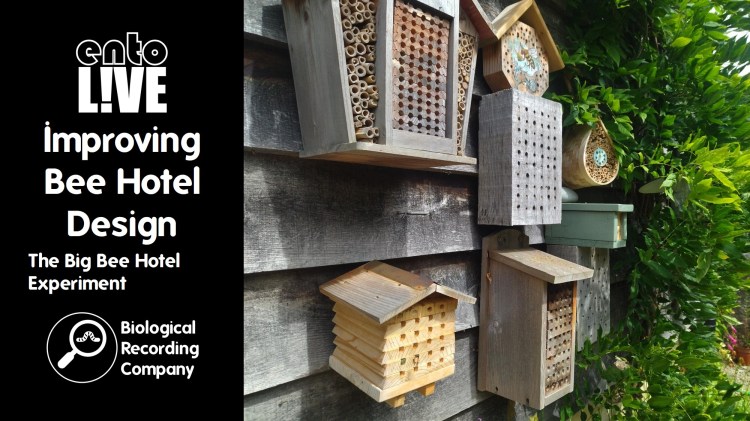
Putting up a bee hotel is a popular – and accessible – wildlife gardening activity, but typical designs are very focused on the needs of a small sub-set of solitary bees. Buzz Club projects are looking to expand the ecological value of the Hymenopteran hotel to provide support for a much wider range of insects. They also aim to identify and avoid possible pitfalls and problems when using these in real garden environments!
Dr Linda Birkin is a specialist in citizen science and urban entomology. She has a particular interest in ecological outreach and wildlife gardening.
Issy Sexton is a Research Assistant at the University of Sussex, specialising in pollinator-focused citizen science. She also has a background in community engagement and environmental policy.
Q&A Dr Linda Birkin and Isobel Sexton
If and how often should you clean a bee hotel? Linda: That is a great question and one that we’d really like to investigate through the Buzz Club. There is discourse around how regularly you should clean a bee hotel. In nature, cavity-nesting bees would be making use of transient nesting opportunities – such as plant stems or digging burrows. It’s unlikely that these specific nesting sites would be re-used the following year as they would no longer exist. Bee hotels are not transient in nature, meaning that they can be re-used. Cleaning is a hot topic because parasites and fungi become established in nests and re-use of nesting sites could benefit these parasite populations. We really do need data in order to give evidence-based advice, but it is likely that some form of cleaning is advisable for artificial bee nesting sites. Issy: This is a question that we are asking as part of ourBig Bee Hotel Experiment. We ask if and when the last time bee hotels were cleaned and the data that we are gathering should help us address this question in the future.
What natural features will bees nest in? Linda: Hollow plant stems, such as brambles and anything that has left a stem over winter which has become hollow.
What materials are suitable for bee hotels? Linda: Ideally you should avoid using glass or plastic for the tubes as these are not permeable and condensation can form, which enables fungi to grow within the bee hotel. Naturally materials are much better, but be aware of wood that has been treated with insecticides. We don’t know if these treatments have an impact on nesting bess. If you’re not sure, I’d advise leaving the wood that you plan on using in the garden for a year or so to give time for any residual chemicals to leach out.
What direction should the bee hotel face? Linda: Bees are insects and cold-blooded… meaning that they like sun. So the best direction for your bee hotel to face is south or southeast. The warmest wall that you have is ideal! It may also be worth angling the tubes up a little bit so that rain can’t flow down the tubes. I’m not aware of any research showing that bees have a preference, in fact I’ve seen them use vertical holes, but anything that can lead to water getting in to the bee hotel may enable fungus to grow. Issy: There are still lots of questions that we are not certain about and require more research. This is why we’re encouraging as many people as possible to take part in the Big Bee Hotel Experiment to help us address some of the questions.
What is the difference between a bee hive and bee hotel? Issy: A bee hive is used by honeybees, which are social bees that form a colony. Bee hotels are aimed more at solitary bees, which do not form colonies and create a nest for their own offspring only.
Do different species of bee use the same bee hotels? Linda: You will find different species of bee using the same bee hotel and they will co-exist quite happily. They don’t tend to use the same tubes as the occupant bee will try to bully the other bee out of using the same tube.
Do bees hibernate in the bee hotels? Linda: The adult bees that laid the eggs will not – they have a short lifespan and will be dead by the end of the season. The eggs will hatch and the larvae will eat the pollen before pupating and then waiting for spring. The males are laid at the front of the tube so they will emerge first.
entoLIVE webinars feature guest invertebrate researchers delving into their own invertebrate research. All events are free to attend and are suitable for adults of all abilities – a passion for invertebrates is all that’s required!
entoLIVE is delivered by the Biological Recording Company in partnership with the British Entomological & Natural History Society, Royal Entomological Society and Amateur Entomologists’ Society, with support from Buglife.
The entoLIVE programme is delivered by Biological Recording Company and receives sponsorship from the following organisations:
The education programme included 3 entoLEARN education webinars that are available to view below.
Introduction To Earthworms
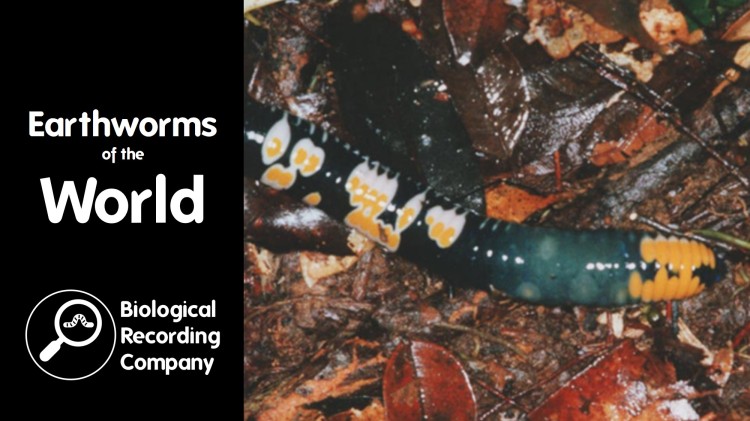
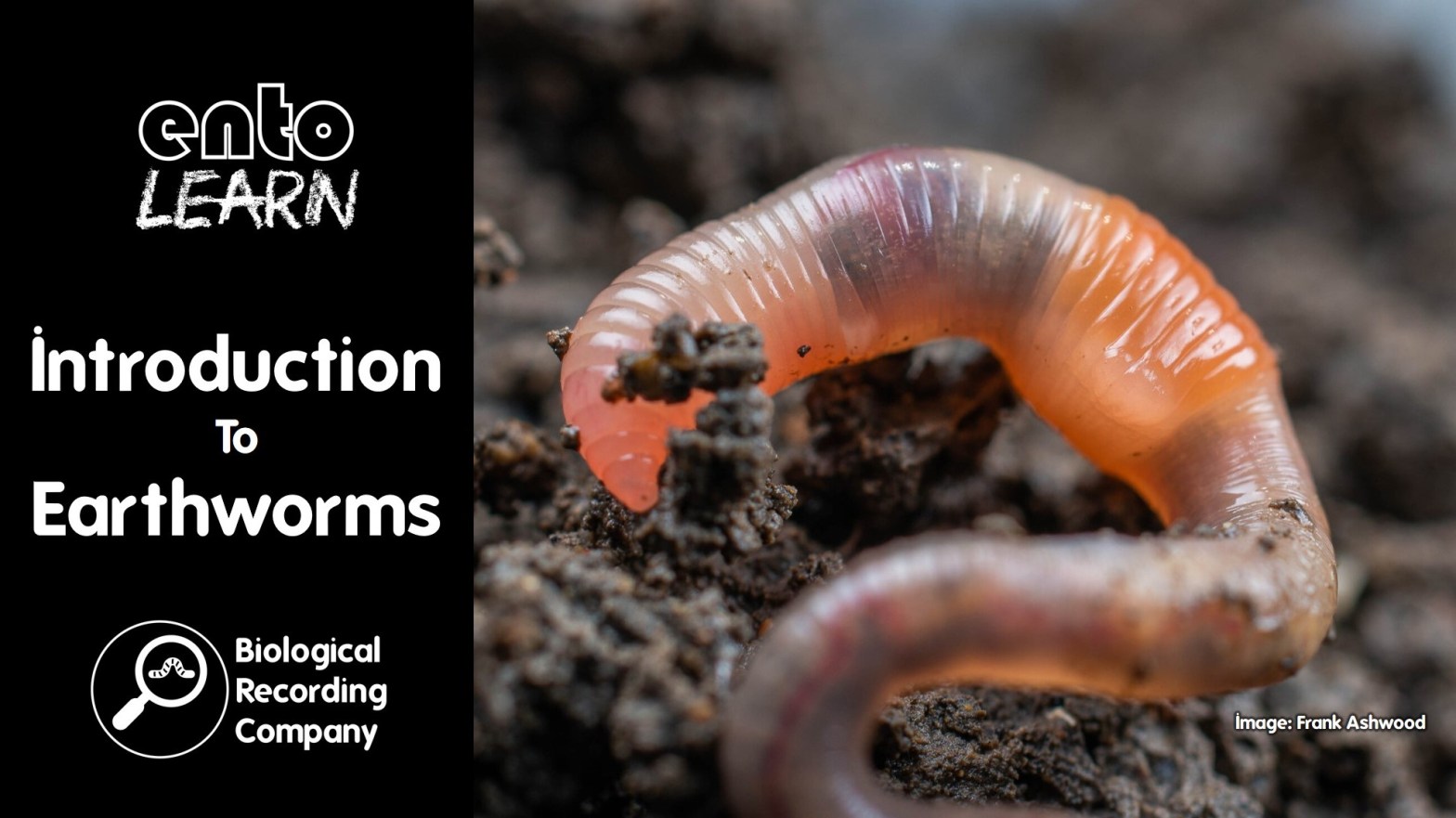
Known as the gardener’s best friend, it is widely recognised that earthworms are important creatures. However, few people realise that there are different kinds of earthworms doing different jobs, and the true level of their importance goes unrecognised. In the talk below talk, Keiron will take us on a journey into the weird yet wonderful world of worms. We’ll learn what makes an earthworm an earthworm and explore some of the fascinating aspects of their biology, ecology and behaviour, and discuss how not all earthworms are found below ground! We’ll look at some exotic earthworms from around the world and discover what the current status quo is with British earthworms.
Below you will find copies of the Annelid Taxonomy and Earthworm Ecosystem Services infographics used in the presentation and some useful links.
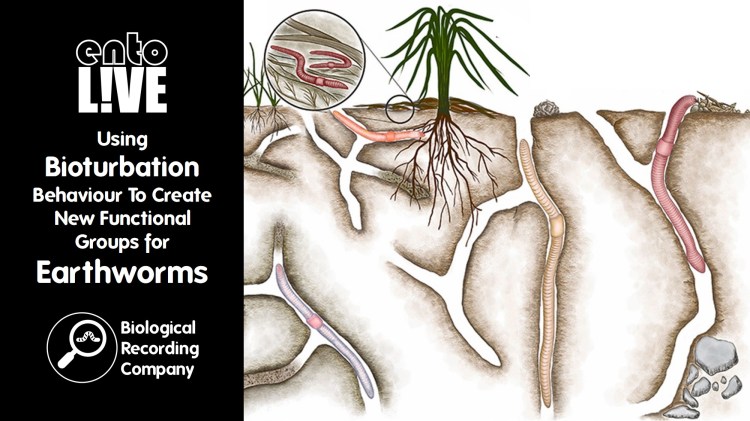
The productivity of agricultural systems is heavily reliant upon the condition of the soils below. Earthworms contribute to important soil processes and provide ecosystem services such as waste recycling, carbon and nutrient regulation, water flow regulation, soil aeration and soil structure maintenance. In the presentation below, Keiron introduces how different types of earthworms contribute to these agricultural benefits in different ways, what threats our earthworms face in agricultural landscapes and what farming practices might be better for supporting healthy earthworm populations.
Below you will find the Soil Formation& Soil Processes and Earthworms & a link to more events with the Tees-Swale Naturally Connect project.
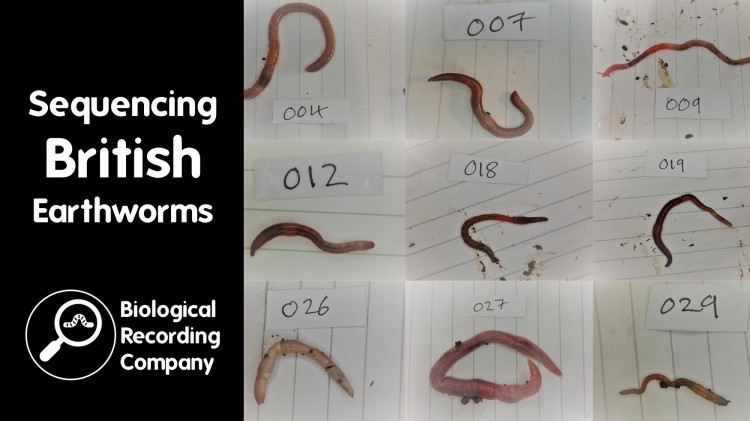
The UK and Ireland has 32-33 species of earthworms that can be found occurring in natural habitats that have been recorded to date. We are exploring all 32-33 species over the course of 3 webinars. Part 1 covered some of the most common species and is available to view for free below. Part 2 was delivered in September 2024 and Part 3 will cover the rare species and is due to take place on 13 January 2025 (you don’t need to have viewed either part 1 or 2 to enjoy and understand part 3).
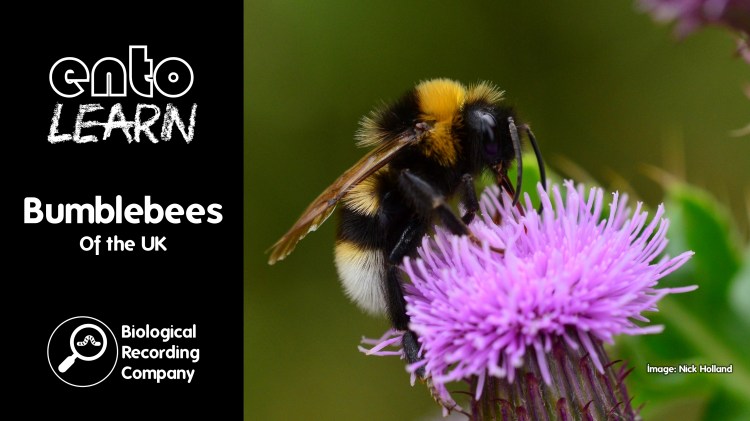
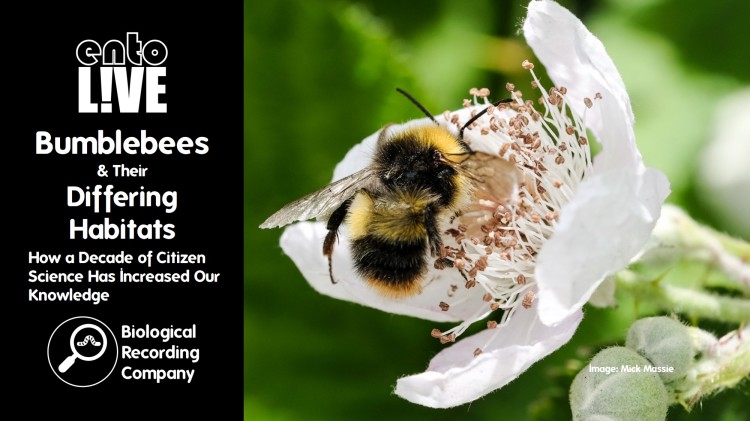
The Short-haired Bumblebee project was a 12-year-long landscape reintroduction and habitat restoration project in south Kent and south East Sussex. This talk will outline its aims, achievements (and what also didn’t go so well) and its legacy. This talk will also introduce a new project currently being delivered in east and southeast London called Buzzing in the East End (B.E.E).
Dr Nikki Gammans has worked for Bumblebee Conservation Trust since 2009, firstly as a project officer and more recently, as Conservation Project Manager for SE England. Prior to conservation work, she completed a PhD and Post Doc on ant behaviour and ecology.
Q&A Dr Nikki Gammans
Dr Nikki Gammans has worked for Bumblebee Conservation Trust since 2009, firstly as a project officer and more recently, as Conservation Project Manager for SE England. Prior to conservation work, she completed a PhD and Post Doc on ant behaviour and ecology.
If only the queens overwinter, how are the queens fertilised for next year’s brood? The queens mate before hibernation, so they are already fertilised before they overwinter.
Why are rare bees found in the East End Docklands? Brownfield sites are incredibly important for many of our rare species. Most of our rare species are now only found in coastal areas because of increasing urbanisation and fragmentation. The Thames Estuary has always been a hotspot for these species. On some of these brownfield sites, we’re seeing that the Brown-banded Carder Bee (Bombus humilis) and the Shrill Carder Bee (Bombus sylvarum), the UK’s rarest species, are actually doing quite well. These industrial brownfield sites often have a lot of scrubland and lots of “weed” species that are actually really good for these species. These areas are often referred to as wasteland, but they are far from that and with some small habitat improvement can be wonderful sites for our rare bees that support a sustainable life cycle.
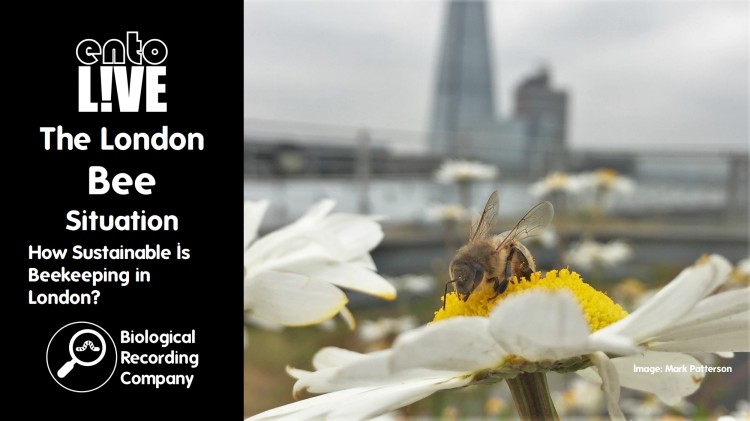
What is the relationship between honey bees and our rare bumblebees in London? The issue that we have in London is lots of people wanting to help bees and thinking that the solution is to keep honey bees. The Western Honey Bee (Apis mellifera) is a domesticated animal (i.e. livestock) and the number of bees correlates with the number of hives that are being kept. The issue in London is hive density. We currently don’t know as hive registration is not mandatory, so we recommend that beekeepers register their hives with their local beekeepers association so that we can monitor hive density. We want to avoid honey bees competing with our rare native bees for nectar and pollen resources in areas where the rare bees are hanging on. Check out Mark Patterson’s entoLIVE on The London Bee Situation for more info on this topic.
Are you aware of any successful bumblebee reintroductions from elsewhere in the world? We were actually the first in the world to attempt a bumblebee reintroduction and I’m not aware of any other reintroductions. Bumblebees have been introduced to countries where they are not native. For example, 4 species, including the Short-haired Bumblebee (Bombus subterraneus), were introduced to New Zealand for pollination services. Moving species around the world is very risky as you are not just moving the target species, you’re also moving their pathogens and parasites. The introduction of European bee species to North America has proved devastating for some of their species due to the pathogens that were also introduced.
Is there anything that you would do differently if you were given the chance? We believe that the time in quarantine may have been the issue, but we need to ensure the bees are quarantined to avoid importing pathogens and parasites. One way around this would be to construct quarantine greenhouses where the imported queens would be held and mated for the first year, with the offspring of these being the individuals that are actually released into the wild. This would be an incredibly expensive operation and there is still no guarantee that it would be successful. The most important thing is to ensure that we are conserving and improving habitats for bumblebees, and preventing any further species extinctions.
Will the spread of the Asian Hornet be an issue for our bumblebees going forward? The Asian Hornet (Vespa velutina) is a non-native species of wasp and a threat to insect species that it preys on. It is an aerial predator that is fairly opportunistic – feeding on whatever it can find. Bumblebees appear to be more savvy with them when compared to honey bees, as they will drop when they feel threatened. However, it does mean that yet another threat to our bees is being added into the mix, so it is important that sightings are reported. I think it is inevitable that they will colonise the UK as we’ve been notified of a colony here in Kent recently and they are well established across the channel on the continent.
What are the best species to plant within your garden to help our bumblebees? It’s important to remember that different bees have different needs, so understanding what rare bees may occur in your area is always useful. What we try to do at Bumblebee Conservation Trust is provide ‘monthly menus’ on the Bee The Change website and our Bee Kind garden assessment and recommendation tool. We’re still analysing the forage data that we gathered and it won’t be published for a little while yet. It’s also worth checking out the Plants For Pollinators entoLIVE webinar with Dr Abigail Lowe for more information about this.
entoLIVE webinars feature guest invertebrate researchers delving into their own invertebrate research. All events are free to attend and are suitable for adults of all abilities – a passion for invertebrates is all that’s required!
entoLIVE is delivered by the Biological Recording Company in partnership with the British Entomological & Natural History Society, Royal Entomological Society and Amateur Entomologists’ Society, with support from Buglife.
The entoLIVE programme is delivered by Biological Recording Company and receives sponsorship from the following organisations:
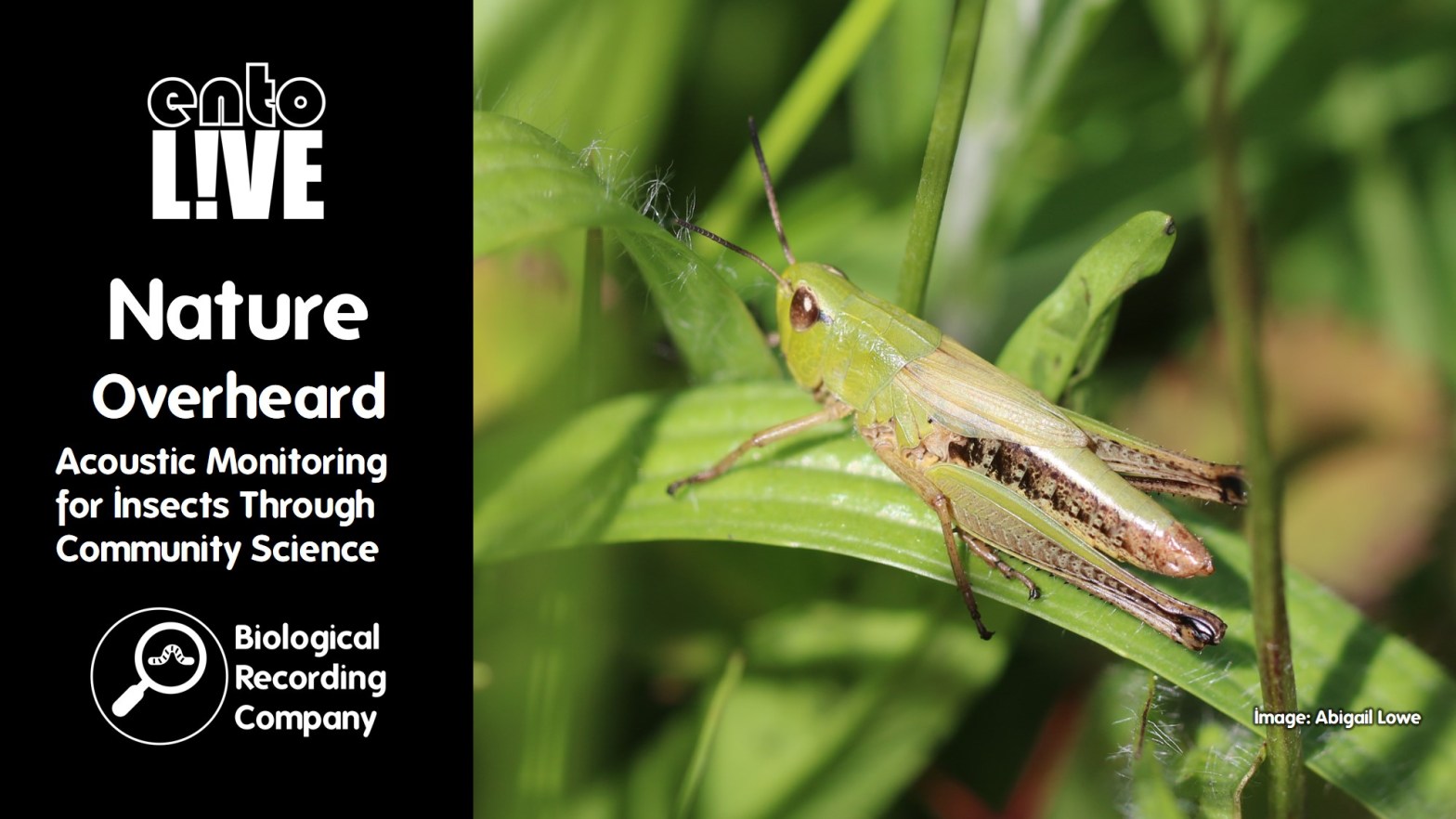
Nature Overheard is a national programme of community science activities run by the Natural History Museum which aims to investigate the impact of noise pollution on insects. This talk will outline how the project was developed through co-design, how participants have been getting involved over the first year of delivery in activities designed for different levels of engagement, and present initial results of the main survey.
Dr Abigail Lowe is a Community Science Officer at the Natural History Museum, where she leads the delivery of Nature Overheard. Her PhD research, undertaken at the National Botanic Garden of Wales and Bangor University used DNA metabarcoding to investigate pollinator foraging and led to a huge interest in biological recording and community science.
Q&A Dr Abigail Lowe
Does your project accept records at any taxonomic level? In the online data submission form there is currently only the ability to record to the groups that we are asking people to record to. I’m aware there will be cases where people can actually identify the species. I advise that participants add the species name in the photo filename. This can then be picked up by the project verifiers when they work through the submissions and the species information will be retained.
Do phone settings and the use of different devices impact the results? We ask participants to provide details of the make and model of the device that they have used within the data submission form. This enables us to take these differences into consideration during analysis. The more recordings that we get, the more we’ll be able to account for these differences.
Are you recording any areas that are not next to roads to establish baseline data for areas that are not impacted by noise pollution? To date, we have only asked for survey data from areas within 10 metres of a road. The level of traffic on these roads varies greatly by site, with some roads being much quieter than others. As with any citizen science project, we’ve had to figure out what we can include, and at the moment areas away from roads are outside the scope of the project.
Can noise exposure to insects during larval development have significant impacts on the organism? That’s a great question! The truth is that there is still so much that we don’t know and this probably falls within this category. Insects are extremely variable, so factors that impact a species during larval development can vary from one group to the next. This is something that probably needs further research.
Does noise pollution impact insects more or less than other groups (such as birds and mammals)? The amount of research that has been published on the subject of noise pollution and insects is relatively limited. This means that we’re probably not in a position to answer this question yet and it is important that we continue to build on the research through projects like Nature Overheard.
How can we help as individuals reduce noise pollution for insects and other wildlife? The biggest cause of noise pollution is traffic, so any actions that reduce the level of traffic on our roads are helpful. This could be using public transport for journeys, car sharing or cycling in situations where you would normally drive. I understand that driving is a necessity for many people’s personal and work lives, and public transport is variable in its coverage across the UK. I don’t think it is practical to expect everyone to give up their cars – but if we all make a small effort to reduce our traffic footprints we can reduce noise pollution (as well as carbon emissions).
entoLIVE webinars feature guest invertebrate researchers delving into their own invertebrate research. All events are free to attend and are suitable for adults of all abilities – a passion for invertebrates is all that’s required!
entoLIVE is delivered by the Biological Recording Company in partnership with the British Entomological & Natural History Society, Royal Entomological Society and Amateur Entomologists’ Society, with support from Buglife.
The entoLIVE programme is delivered by Biological Recording Company and receives sponsorship from the following organisations:
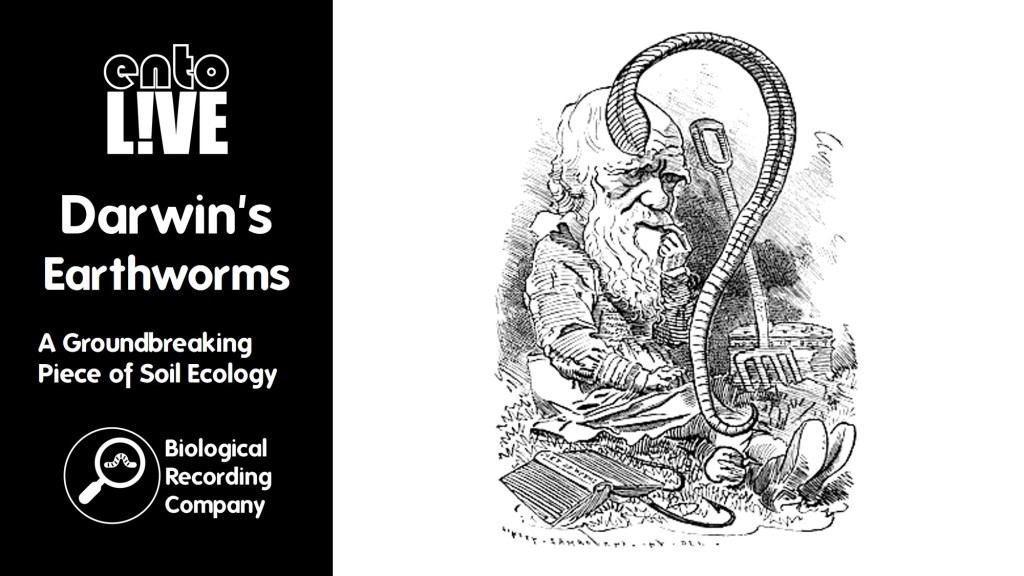
Charles Darwin might be best known for his work on evolution and his time on the Voyage of the Beagle, but he is also recognised as the father of earthworm science. After 44 years of studying earthworms, he published a best-selling book dedicated to the group, which is still one of the go-to resources for researchers today. Join us on Darwin Day to look back at the history of earthworm science and research and learn about some of the experiments Darwin did with earthworms.
Kerry Calloway is an earthworm recorder, course tutor and secretary for the Earthworm Society of Britain. She is very passionate about all aspects of natural history but particularly engaging people in the world of the humble but super important earthworm.
Q&A with Kerry Calloway
How do earthworms drag the leaves into their burrows? Earthworms use their mouth. The mouth is covered by a fleshy lobe known as the prostomium, which is used to grab the leaves and move backwards to pull the leaf into the earthworm burrow.
Did Darwin investigate when and how earthworms evolved? I’ve not seen any reference from Darwin regarding earthworm evolution. He doesn’t talk about this in his earthworm book and I don’t recall them being mentioned (at least in any significant way) in On the Origin of Species. We now know that earthworm-like organisms (belonging to the class Clitellata) were around as early as the Upper Ordovician Period (around 450 million years ago). The oldest known evidence of an annelid is from the early Cambrian period (around 514 million years ago) and was a polychaete worm called Dannychaeta tucolus. Earthworms don’t fossilise well so they are not recorded in fossil records as readily as animals with exoskeletons or bones, with most fossil evidence coming from fossilised burrows and casts.
Does Darwin discuss species diversity mush in his earthworm book? No, Darwin doesn’t discuss earthworm species diversity in any detail in On The Formation of Vegetable Mould Through the Actions of Worms. We know from Darwin’s other research that he was interested in species diversity, so I personally find this really surprising. I think there were around 13 described species of earthworm in Britain around that time and Darwin was certainly aware of this, but he didn’t seem to collect and identify any earthworm specimens. Since Darwin’s work, other researchers have been to Down House where he conducted many of his experiments, and they have since found that the dominant species appears to be Aporcetodea longa (a large deep-burrowing species that casts on the surface).
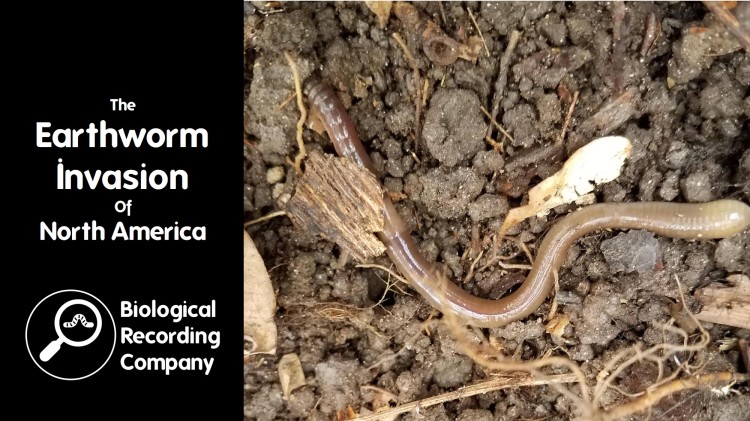
Is it true that earthworms are not native to the USA? Not exactly. There are earthworms native to North America and these are found across much of the USA. This includes species that have since been introduced here, such as Bimastos eiseni, Bimastos rubidus, and Sparganophilus tamesis. However, there are parts of the USA (such as the Great Lakes area) that have not been naturally colonised by earthworms since the last ice age. European and Asian earthworms have been introduced by humans to these areas and are now causing issues as they change the ecosystem from the ground up. You can learn more about this in The Earthworm Invasion of North America blog by Professor Katalin Szlávecz.
Do earthworms die during floods? Different species have different tolerances to flooding. Earthworms actually require moisture to be able to breathe through their skin so being in water is not a problem for earthworms – and many species are actually wet soil specialists. However, if the water becomes stagnant and deoxygenated then the earthworms can die through suffocation. Earthworm populations are generally robust due to the cocoon stage of the life cycle, as these can survive more extreme environmental conditions. Even if the adults and juveniles are killed off by unsuitable environmental conditions, the next generation will wait out the unsuitable environmental conditions in the cocoon stage.
What is the impact of non-native invasive flatworms on our earthworm populations? We have a number of non-native invasive flatworms in the UK, none of which were ever mentioned by Darwin and we have no evidence to suggest that they were around in his day. There has been research into the impact of the New Zealand Flatworm (Arthurdendyus triangulatus) and we know that this impacts the larger deep-burrowing species in particular. We know very little about the impact of the Australian Flatworm (Australoplana sanguinea), Obama Flatworm (Obama nungara) and other earthworm-eating non-native invasive flatworms. the Earthworm Society recommend that people record these flatworms when they see them by taking photos and submitting their records to iRecord so that we can build a picture about where they are and how they are spreading. Once a flatworm is established it is pretty much impossible to get rid of, but understanding how they spread may help us fend off future threats such as the New Guinea Flatworm (Platydemus manokwari), which is impacting earthworm populations on mainland Europe. Check out the Earthworm Society’s Flatworms page for more info.
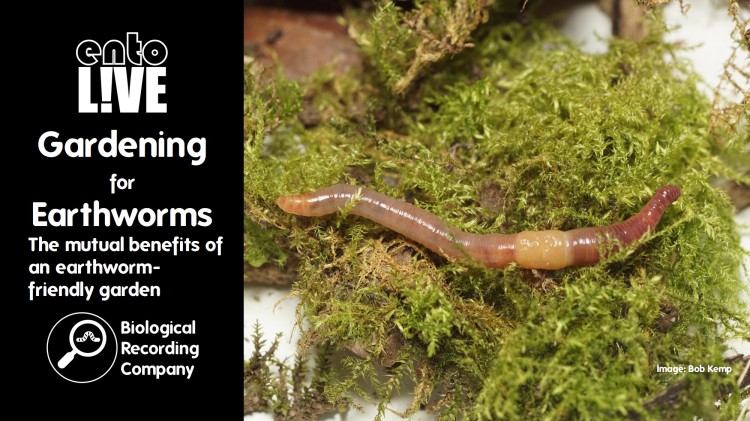
What one thing can people do to improve their garden for earthworms? There are lots of different species of earthworm and gardens are really good for housing a wide range of species. Having a range of habitats and places for earthworms to live will help support more diversity in your garden. Having a lawn is good for soil-dwelling earthworms and having leaf litter is great for surface-dwelling species. There are also specialists that you’ll find in compost or associated with deadwood, so introducing these microhabitats to your garden will provide what these species need. Earthworms love residing underneath things, so having plant pots provides this for them. It’s also important to ensure that you leave something for them to eat, such as leaving dead leaves for the deep-burrowing and surface-dwelling species. You can learn more about this in the Gardening For Earthworms: Mutual Benefits of Earthworm-friendly Gardening entoLIVE blog by Keiron.
entoLIVE webinars feature guest invertebrate researchers delving into their own invertebrate research. All events are free to attend and are suitable for adults of all abilities – a passion for invertebrates is all that’s required!
entoLIVE is delivered by the Biological Recording Company in partnership with the British Entomological & Natural History Society, Royal Entomological Society and Amateur Entomologists’ Society, with support from Buglife.
The entoLIVE programme is delivered by Biological Recording Company and receives sponsorship from the following organisations:
Local Nature Recovery Strategies (LNRS) are the government’s spatial strategies for nature. From late 2024 LNRSs must be in place across England. They must be evidenced-based, mapping the best locations to create, enhance and restore nature. LNRSs must identify and bring together a partnership group to align multiple nature-based projects and initiatives (the Nature Recovery Network). The collaborative approach will provide a means for consistent communication of local priorities, and efficient use of time and resources to ensure actions are completed.
Throughout 2020 and 2021 five LNRS pilots were run. The lessons learned have helped to shape the direction of LNRS design since then.
This blog offers an opportunity for all involved partners (Government, Landowners, businesses, local communities and conservation groups) to hear from experienced LNRS project leaders, as well as data providers, on their progress regarding spatial mapping. It features the following presentations (and associated links):
Cumbria Local Nature Recovery Strategy: Challenges and Opportunities with Megan Lindeman (Westmorland and Furness Council)
The London Local Nature Recovery Strategy: The Journey So Far with Francis Castro (Greater London Authority)
Supporting and Designing an LNRS using BiodiversityView with Chris Burnett (Map Impact)
Panel discussion facilitated by Dr Dan Carpenter (Digital Ecology)
Cumbria Local Nature Recovery Strategy: Challenges and Opportunities
Megan Lindeman (Westmorland and Furness Council)
Cumbria is one of five areas that were selected to pilot the development of a Local Nature Recovery Strategy (LNRS) in 2021. Megan will reflect on the lessons learnt from the pilot scheme and how Cumbria is building on the work that has already been done in the development of the current Cumbria LNRS. Cumbria is a large and ecologically diverse county; ranging from the highest peak in England to the coast, Cumbria’s habitats vary from montane to lowland wetland, coastal and estuarine to blanket bog, woodland to the productive grasslands of the Eden Valley. The presentation will discuss the challenges and opportunities posed by developing an LNRS across such a large, predominantly rural, and ecologically diverse county.
Megan Lindeman is the Technical Support Officer for the Cumbria LNRS and works for Westmorland and Furness Council which are the appointed Responsible Authority for Cumbria. She has over 10 years of experience working in ecological consultancy, specialising in the production and delivery of habitat management plans for a range of projects including renewables, infrastructure, housing, and conservation schemes. She specialises in project management and strategy development, with a particular specialism in upland habitat management and peatland restoration.
The London Local Nature Recovery Strategy: The Journey So Far
Francis Castro (Greater London Authority)
The LNRS for London is not about starting from scratch. It is about understanding the good work that is being carried out across London and empowering those (new and old) who want to continue this rich tradition of action for nature! With 33 local authorities (each a unitary council and a huge number of organisations and community groups passionate about the climate crisis facing us, This presentation will discuss what approach the GLA will take in making this process actually useful!
Francis Castro is an Ecologist and Local Authority Officer with over 18 years of experience. Key projects include successful application to the National Lottery Heritage Fund for the Restoration of Hainault Forest. He is a veteran of conservation and environmental regulation in London and now works as a Biodiversity specialist at the Greater London Authority, overseeing the production of the London LNRS.
Supporting and Designing an LNRS using BiodiversityView
Chris Burnett (Map Impact)
Map Impact has launched our England-wide BiodiversityView dataset that aligns with the Defra Biodiversity Metric Calculator. This presentation will talk about how the data is created, structured and delivered, and how it can support the objectives of a Local Nature Recovery Strategy by being an independent, objective, and large-scale tool that crosses boundaries, to aid in delivering the baseline strategies, and monitor their effectiveness over time.
Chris Burnett has more than twenty years of experience in the geospatial and Earth Observation sector, managing projects globally, and building products to support environmental applications.
What do you think is key to a successful Local Nature Recovery Strategy? Megan: The key thing is that it is used and delivered. For this to happen it needs to be realistic and people need to be engaged with it. Francis: Integration with existing systems and policies is vital. It can’t work as a stand-alone document. We will also need big money to make this work – it absolutely needs to be funded and we need to be unapologetic about stating this. Chris: From a data perspective, it is important that we have data that is repeatable and that can be used to measure success.
How do you work with neighbouring authorities? Megan: There is a wider northwest responsible authority group that meets and shares learning and progress. We also have informal catch-up calls with one another to keep up to date with each other’s progress. There are strategies underpinning our LNRS that cross boundaries and these should help us align with neighbouring LNRS areas. For example, the North Pennines National Landscape Recovery Plan will inform both the Cumbria and Northumberland LNRS. Francis: There is a real appetite for people to work together as we’re all working towards the same goal. We meet up with our neighbouring authorities and we also have a landscape that crosses borders, such as river catchments.
How do you ensure that people living within the area are able to input into the LNRS? Francis: There are 9 million people living in London so we need to be realistic about the scale at which we can engage people. Within London, each of the 33 unitary councils/London Boroughs will have their own process for engaging with residents. We will provide guidance and tools to help with that process but also feed into existing pan-London partnerships, that already work with communities, enabling us to engage at a really local level rather than asking broad questions to a cross-London audience. Megan: We have 3 people (2 FTE) in the core Responsible Authority LNRS team. As individuals, the number of people and organisations we can engage with is limited, but we can use representatives for existing networks and groups to reach a wider audience. It’s also important that we engage different stakeholders at the right time in the process, and we have an engagement plan to help us do this.
How reliable are the datasets behind habitat maps and how will we know how much things have changed over time? Chris: We use a combination of satellite datasets and well-maintained datasets (including the Priority Habitat layer from Natural England). As we work through the data, we do find anomalies and we fix these to reduce the impact of these (such as something that looks like a high distinctiveness habitat within an urban area). It is important that these datasets are ground-truthed where possible to check how reliable the satellite data is and to update the data regularly so that changes in condition are picked up.
What is the one thing that you hope will be achieved through the development of your LNRS? Megan: There is lots of really good work already going on in Cumbria. I would like to see the Cumbria LNRS provide a strategic overview and help to join up these actions to deliver maximum benefit. Francis: A community who are passionate and working together to protect nature and demanding the investment needed to deliver nature recovery on the ground. Chris: Ensuring that nature is preserved and around for all of us to enjoy regularly.
Questions About BiodiversityView
Are there any plans to expand Biodiversity View to include marine environments? Map Impact: BiodiversityView for marine environments is a future product development that we are considering (in particular to align with incoming marine legislation). We would welcome collaborative conversations with other organisations regarding development and implementation of an expanded product.
How are you dealing with the uncertainties in Living England? Map Impact: We are aware that there are uncertainties within the current Living England data and we have engaged with the Natural England team to provide feedback. Within Map Impact, we have performed a range of corrections and enhancements on the data, such as re-classification of wetland habitats in certain locations.
Is there an aim to increase resolution over time? Map Impact: We are exploring provision of a more granular resolution product within certain use cases (e.g. urban environments).
Will BiodiversityView be available for academic use? Map Impact: BiodiversityView is not yet available with a specific academic use license. We would encourage anyone who is interested in academic use to contact us at info@mapimpact.io, to discuss their requirements.
How can BiodiversityView improve on the NVC survey and condition assessment datasets for priority habitats that are already held for some regions? Map Impact: BiodiversityView provides a consistent approach to mapping habitats and condition across all of England (not just priority habitats). It can therefore complement data already available by providing a complete picture of the status of biodiversity.
Does BiodiversityView focus on tree cover and greenness when using satellite imagery to assess habitat condition? Map Impact: We are using a range of satellite indices to assess habitat condition, with greenness being one of the indicators considered. Alongside greenness we are considering factors such as soil moisture. A further explanation is provided in the Can Satellite Imagery Data Be Used For Biodiversity Net Gain? article.










 Biological Recording