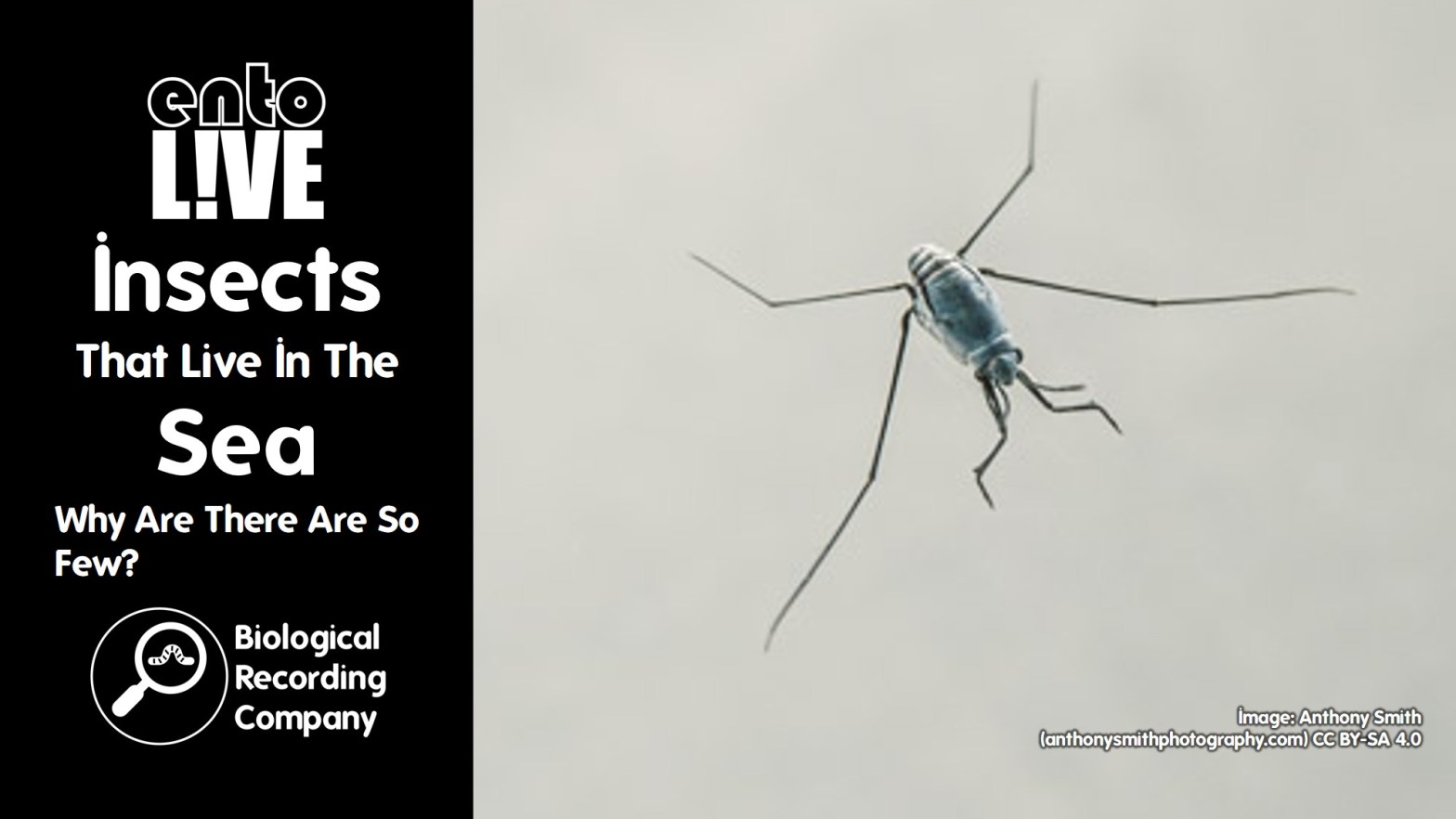
Insects are everywhere – but only on land and in freshwater. Around a million species of insect have been described, but less than 2000 live in close association with the sea, with only a handful of chironomid flies and hemipteran water skaters living fully marine lives. Even then, it can be argued that these fully ocean-going species live on top of the sea rather than in it. Why have insects been so unsuccessful at colonising the oceans? In this presentation, we will look at those few insects that have managed to make some sort of accommodation with the sea, and speculate on why they are so few of them.
Q&A with Prof Stuart Reynolds
Stuart Reynolds is an Emeritus Professor of Biology at the University of Bath, and is an Honorary Fellow and Past President of the Royal Entomological Society. He is interested in everything about insects, from ecology to immunology, and behaviour to genomes. But he is especially fascinated by the astonishing evolutionary success of insects in colonizing almost every terrestrial and freshwater habitat.
Is there a name for the semi-circle shaped tree diagram?
It’s a phylogenetic tree, specifically an arc-style or semi-circular phylogenetic tree. These diagrams visually represent the evolutionary history and relationships between different species, organisms, or genes from a common ancestor.
Are there any marine insects in land-locked seas, such as the Salton Sea in California?
There are a lot of insects that are adapted to very salty conditions like you find in the California Sierra lakes and the Dead Sea. They do well in these hypersaline conditions because there aren’t that many fish. There are, of course, inland seas that are not hypersaline, but I don’t know if there are marine insects there. People haven’t studied them yet.
How is climate change likely to affect marine insects?
Sea levels will go up with climate change, but those insects, like the Halobates spp, that live out at sea should be fine. They’ll just float. The ones that live on the shoreline, they’ll simply migrate up the shoreline. So, I don’t think I’d expect big changes.
Do you think that the crustacea and insects have a common ancestor in the sea or from land?
The macroevolutionists are pretty clear that insects and crustaceans are indeed very closely related. The ancestral hexapod is thought to have arisen from a rather obscure class of crustacea called the Remipedia. These are crustacea that live in caves with brackish water. It looks, from DNA evidence, as though all hexapods are derived from this obscure order. The Remipedia live in salty water so the question really is if the ancestor of all hexapods today migrated into fresh water and then to land, or whether the colonisation of land by insects took place directly from brackish and salty water with freshwater habitats being colonised secondarily from the land, or whether the ancestral hexapods first entered fresh water and only later crawled up onto the land.
Accompanying Antenna Article
Join the Royal Entomological Society to receive the quarterly Antenna magazine: https://www.royensoc.co.uk/membership-and-community/membership/
Literature References
- Gosse (1855) A Manual of Marine Zoology of the British Isles Part I, p 178, London, J. van Voorst: https://www.biodiversitylibrary.org/item/22491#page/7/mode/1up
- Plateau, F. (1890) Journal de l’Anatomie 26, 236–269: https://www.biodiversitylibrary.org/item/178223#page/246/mode/1up
- Cheng (1976) Marine Insects: https://escholarship.org/content/qt1pm1485b/qt1pm1485b.pdf
- Tihelka et al. (2021) The evolution of insect biodiversity: https://doi.org/10.1016/j.cub.2021.08.057
- Pak et al. (2022) The evolution of marine dwelling in Diptera: https://doi.org/10.1002/ece3.7935
- Tang et al. (2022) Maritime midge radiations in the Pacific Ocean (Diptera: Chironomidae): https://doi.org/10.1111/syen.12565
- Page et al. (2004) Phylogeny of “Philoceanus complex” seabird lice (Phthiraptera: Ischnocera) inferred from mitochondrial DNA sequences: https://doi.org/10.1016/S1055-7903(03)00227-6
- Leonardi et al. (2022) How Did Seal Lice Turn into the Only Truly Marine Insects?: https://doi.org/10.3390/insects13010046
- Edwards (1926) On Marine Chironomidae (Diptera); with Descriptions of a New Genus and four New Species from Samoa: https://zslpublications.onlinelibrary.wiley.com/doi/abs/10.1111/j.1469-7998.1926.tb07127.x
- Chang et al. (2021) Navigation in darkness: How the marine midge (Pontomyia oceana) locates hard substrates above the water level to lay eggs: https://doi.org/10.1371/journal.pone.0246060
- Templeton (1835) Description of a new hemipterous insect from the Atlantic Ocean (Halobates streatfieldiana): https://www.biodiversitylibrary.org/item/48195#page/252/mode/1up
- White (1883) Report on the pelagic Hemiptera procured during the Voyage of H.M.S. Challenger in the years 1873-1876. https://www.biodiversitylibrary.org/page/12810019#page/5/mode/1up
- Chang et al. (2024) Skimming the skaters: genome skimming improves phylogenetic resolution of Halobatinae (Hemiptera: Gerridae): https://doi.org/10.1093/isd/ixae015
- Mahadik et al. (2020) Superhydrophobicity and size reduction enabled Halobates (Insecta: Heteroptera, Gerridae) to colonize the open ocean: https://doi.org/10.1038/s41598-020-64563-7
Further Info
- WoRMS (World Register of Marine Species): https://www.marinespecies.org/
entoLIVE
entoLIVE webinars feature guest invertebrate researchers delving into their own invertebrate research. All events are free to attend and are suitable for adults of all abilities – a passion for invertebrates is all that’s required!
- Donate to entoLIVE: https://www.gofundme.com/f/entolive-2025
- Upcoming entoLIVE webinars: https://www.eventbrite.com/cc/entolive-webinars-74679
- entoLIVE blog: https://biologicalrecording.co.uk/category/entolive-blog/
- entoLIVE on YouTube: https://youtube.com/playlist?list=PLuEBNUcfMmE95Re19nMKQ3iX8ZFRFgUAg&feature=shared
entoLIVE is delivered by the Biological Recording Company in partnership with the British Entomological & Natural History Society, Royal Entomological Society and Amateur Entomologists’ Society, with support from Buglife.
The entoLIVE programme is delivered by Biological Recording Company and receives sponsorship from the following organisations:
- British Entomological & Natural History Society
- Royal Entomological Society
- Amateur Entomogists’ Society
Learn more about British wildlife
 Biological Recording
Thanks for the article. Indeed, the absence of insects in the seas raises interesting questions, especially since they are very successful on land and in freshwater. It seems the challenges of the marine environment are too great for them, which explains why their numbers there are so low compared to on land. An enjoyable article that opens up room for thought.
LikeLike