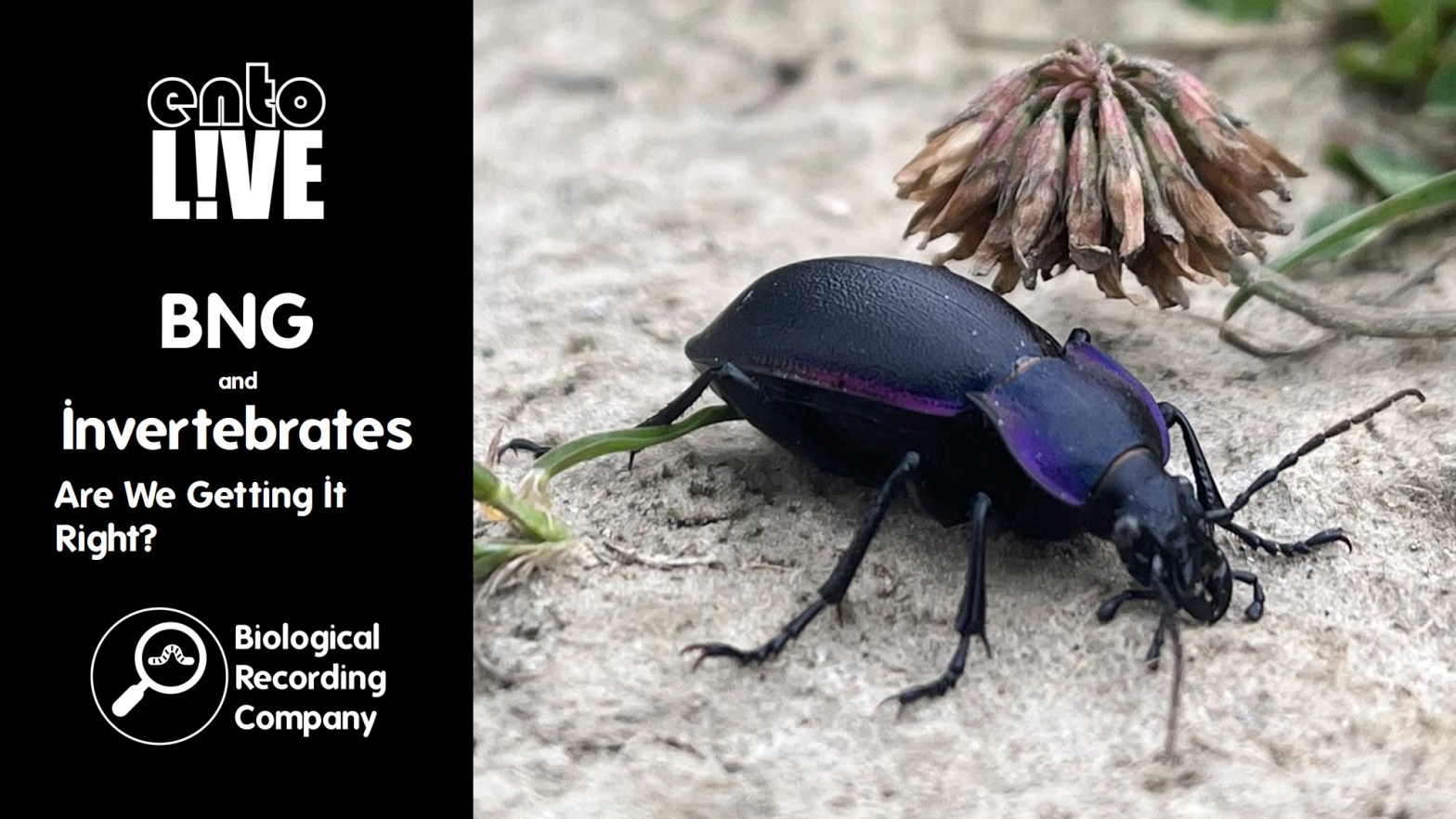
Biodiversity Net Gain (BNG) is an ambitious environmental policy which aims to reconcile the impacts of infrastructural development on nature and leave the environment in a measurably better state. In this presentation, Natalie will be discussing what BNG is, how it is measured, as well as her research into the possible ecological outcomes of BNG for invertebrates.
🎓 Check out BNG guidance, case studies and updates here: https://courses.biologicalrecording.co.uk/courses/biodiversity-net-gain
Q&A with Natalie Duffus
Natalie Duffus is a PhD student from the Department of Biology at the University of Oxford. Natalie’s research looks at the ecological outcomes from biodiversity offsetting policies, with a current focus on Biodiversity Net Gain in England. Her recent work has been exploring the possible outcomes of BNG in England for invertebrates.
Why is there a preference for on-site biodiversity gain over off-site? Might this lead to fragmentation of suitable habitat?
This preference emerges because BNG has multiple objectives; it is not purely designed to benefit biodiversity but also to provide and protect green space for the benefit of local communities. The latter goal is often best achieved through on-site biodiversity net gain. In practice the preference may indeed prove problematic, potentially leading to landscapes with highly fragmented pockets of suitable habitat. Off-site biodiversity net gain has the potential to solve this issue by focusing efforts at creating larger, continuous habitat areas. However, this approach then comes with the risk of separating these large habitat patches far from one another, impacting landscape connectivity. On-site vs off-site can be a controversial issue where each alternative has its advantages and disadvantages. The best solution for any one case depends on the context.
Is there a role for the Pantheon system in considering invertebrates in BNG?
Pantheon is a free tool for identifying important habitat features and resources for invertebrate assemblages. We need to remember that one of the key goals of BNG is ensuring simplicity of use for developers within the planning system. There is potential to incorporate Pantheon into BNG assessments if it can be done in a way that ensures simplicity is retained.
🎓 Book on our Understanding Invertebrate Assemblages course to learn how to use Pantheon effectively: https://www.eventbrite.co.uk/e/understanding-invertebrate-assemblages-tickets-1976437656234
Have the results of your work been shared with Natural England and Defra?
Yes, we have been in communication with Natural England and Defra throughout the project. Whilst it is sometimes challenging to reconcile differing objectives – for example the desire from governmental bodies to keep BNG simple versus the desire of ecologists to keep BNG grounded in ecology – open communication is the key to ensuring success. In the next few years, the performance of the BNG metric will be reviewed and communication around this will hopefully allow any needed adjustments to be made.
Do you think a connectivity metric should be factored back into the metric?
I do think it is important to consider connectivity and would support it being factored back in, though I recognise there are challenges. One example to perhaps draw inspiration from is the Local Nature Recovery Strategies that are integrating connectivity into their design. I would also stress the importance of assessing connectivity during baseline ecological surveys, which is a crucial but often forgotten step. Fortunately, there are a range of tools available for optimal conservation planning, and the exploration of these as a tool for BNG could be explored.
🎓 Local Nature Recovery Strategies: Updates and Strategies ecoTECH blog: https://biologicalrecording.co.uk/2024/02/08/local-nature-recovery-strategies/
Do you think that we need a register for on-site credits as well as off-site credits?
For off-site biodiversity credits there is indeed a publicly accessible online register which allows anyone to identify where habitat banks responsible for off-site BNG are located. Where publicly accessible, these can even be visited in person to see the biodiversity gain being carried out as promised. Such transparency holds people accountable. The proceedings associated with on-site biodiversity gains, in contrast, are buried deep in Local Planning Authority (LPA) portals. A system which holds developers to account their on-site BNG promises would be an important step of progress. A publicly-accessible register – akin to that used for off-site BNG – could work well.
Literature References
- Duffus et al. (2025) Leveraging Biodiversity Net Gain to address invertebrate declines in England: https://doi.org/10.1111/icad.12820
- Duffus et al. (2025) A globally influential area-condition metric is a poor proxy for invertebrate biodiversity: https://besjournals.onlinelibrary.wiley.com/doi/10.1111/1365-2664.70166
- Duffus et al (preprint 2025) Early outcomes of England’s new biodiversity offset market: https://www.biorxiv.org/content/10.1101/2025.06.22.660961v1
- Miles et al (preprint 2025) An influential biodiversity market may not direct investment towards habitats of national importance: https://ecoevorxiv.org/repository/view/8562/
- Rampling et al. (2023) Achieving biodiversity net gain by addressing governance gaps underpinning ecological compensation policies: https://conbio.onlinelibrary.wiley.com/doi/10.1111/cobi.14198
- Timberlake et al. (2019) Phenology of farmland floral resources reveals seasonal gaps in nectar availability for bumblebees: https://besjournals.onlinelibrary.wiley.com/doi/full/10.1111/1365-2664.13403
- Rampling et al (Pre-print 2023) Improving the ecological outcomes of compensatory conservation by addressing governance gaps: a case study of Biodiversity Net Gain in England: https://doi.org/10.31219/osf.io/avrhf
- Falk (2021) Comments on the Biodiversity Net Gain Metric 3.0: http://dx.doi.org/10.13140/RG.2.2.19630.28485
- Marshall et al. (2024) England’s statutory biodiversity metric enhances plant, but not bird nor butterfly, biodiversity: https://besjournals.onlinelibrary.wiley.com/doi/10.1111/1365-2664.14697
Further Info
- Learn about the latest BNG policy updates, case studies and research via the Biodiversity Net Gain Virtual Symposium content: https://courses.biologicalrecording.co.uk/courses/biodiversity-net-gain
- Biodiversity Net Gain: What Could BNG Mean For Pollinators? entoLIVE blog: https://biologicalrecording.co.uk/2024/10/28/bng-and-pollinators/
- Zero Hour article ‘Obstructionism? This is a plea for due process’: https://www.zerohour.uk/planningbillpause/
- The Guardian article ‘Planning bill ‘throws environmental protection to the wind’, say UK nature chiefs’: https://www.theguardian.com/environment/2025/apr/09/planning-bill-throws-environmental-protection-to-wind-uk-nature-chiefs
entoLIVE
entoLIVE webinars feature guest invertebrate researchers delving into their own invertebrate research. All events are free to attend and are suitable for adults of all abilities – a passion for invertebrates is all that’s required!
- Donate to entoLIVE: https://www.gofundme.com/f/entolive-2025
- Upcoming entoLIVE webinars: https://www.eventbrite.com/cc/entolive-webinars-74679
- entoLIVE blog: https://biologicalrecording.co.uk/category/entolive-blog/
- entoLIVE on YouTube: https://youtube.com/playlist?list=PLuEBNUcfMmE95Re19nMKQ3iX8ZFRFgUAg&feature=shared
entoLIVE is delivered by the Biological Recording Company in partnership with the British Entomological & Natural History Society, Royal Entomological Society and Amateur Entomologists’ Society, with support from Buglife.
The entoLIVE programme is delivered by Biological Recording Company and receives sponsorship from the following organisations:
- British Entomological & Natural History Society
- Royal Entomological Society
- Amateur Entomogists’ Society
Learn more about British wildlife

 Biological Recording
Thanks, Keiron Derek Brown, for the article. Considering habitat connectivity in BNG is essential for comprehensive and accurate ecological outcomes.
LikeLike