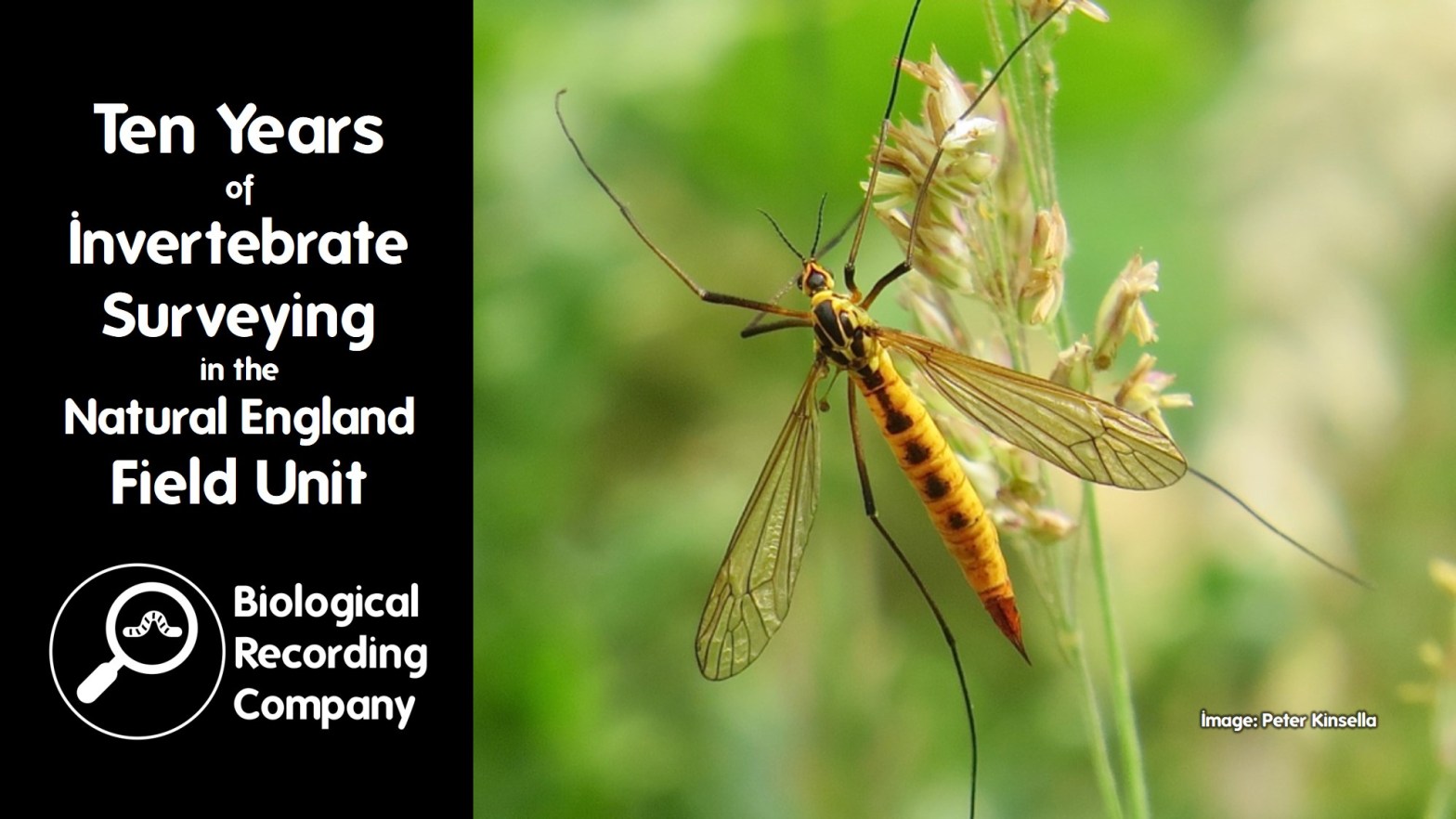
This second iteration of the Natural England Field Unit (NEFU) will celebrate its tenth year in 2024. NEFU currently has 5 entomologists working on condition assessments for the organisation, as well as contributing to a host of other entomological work, including DNA work, supporting PhDs, training and a range of other work. Pete will introduce a range of this work, showing the valuable entomological work NEFU does.
Pete Boardman FRES has worked in the Natural England Field Unit (NEFU) since 2016, having previously run a number of training projects at the Field Studies Council for a decade, and freelanced for thirteen as an entomologist. He was until recently national recorder of the Cranefly Recording Scheme, and has extensively taught various entomological subjects for Natural England, Universities, Wildlife Trusts, etc.
Q&A with Pete Boardman
- Do the SNCOs for Northern Ireland, Scotland and Wales also have equivalent field units?
I don’t believe there are equivalent field units in Northern Ireland or Scotland. They will have funding to contract out services where needed, rather than delivering surveying in-house. In Wales, they have a team of desk-based staff that undertake surveys from existing data and aerial maps. We’re very aware that we are lucky to have this team in-house as a country agency, and it is worth reiterating that the NEFU doesn’t undertake all of our invertebrate site surveys and we still need to contract out these services once we’ve reached our capacity. - Are there any freshwater specialists in the NEFU?
We don’t have anybody within the field unit but always try to campaign for people with freshwater expertise as there are potential jobs that we could do if we had somebody with these skills. Currently, the freshwater work that NE undertakes would be contracted out to freshwater ecologist contractors. - Are you using any technologies to speed up the identification?
Most of our methods involve traditional identification using a microscope, particularly due to the complexities of trying to identify small invertebrates in the field. The large point of what we do with the Natural History Museum is to increase the databases so that in the future we are able to get a species list from DNA analysis of the malaise trap catch. - Do you undertake any identification in the field?
We are limited as to what we can do in the field because most of what we are looking at needs observation under a microscope. However, where we can identify a specimen in the field we will try to do so and release it once it is identified. We usually have an idea of which high-fidelity species we are likely to find on site so we can be on the lookout for these to limit the number of specimens that we take of these. As an entomologist becomes more experienced, the chances of them collecting rare specimens becomes lower as they have a better idea of what they’re looking for. - Can you impose a site designation if the landowner opposes it?
Natural England does have the power to do this. It can get quite expensive as it needs to go through the courts and we’d need to engage with legal experts.
Further info and links
- Pantheon invertebrate assemblages tool: https://pantheon.brc.ac.uk/
- iRecord: https://irecord.org.uk/
- Instagram: https://www.instagram.com/nefieldunit/
- Twitter/X: https://x.com/i/flow/login?redirect_after_login=%2Fnefieldunit
- Stratiomys singularior: https://species.nbnatlas.org/species/NBNSYS0000007840
- W114: https://pantheon.brc.ac.uk/lexicon/stream-river-margin
- W126: https://pantheon.brc.ac.uk/lexicon/seepage
- Glanville fritillary: https://butterfly-conservation.org/butterflies/glanville-fritillary
More for environmental professionals

 Biological Recording
wow!! 1Assessing the Status of UK Earthworms
LikeLike