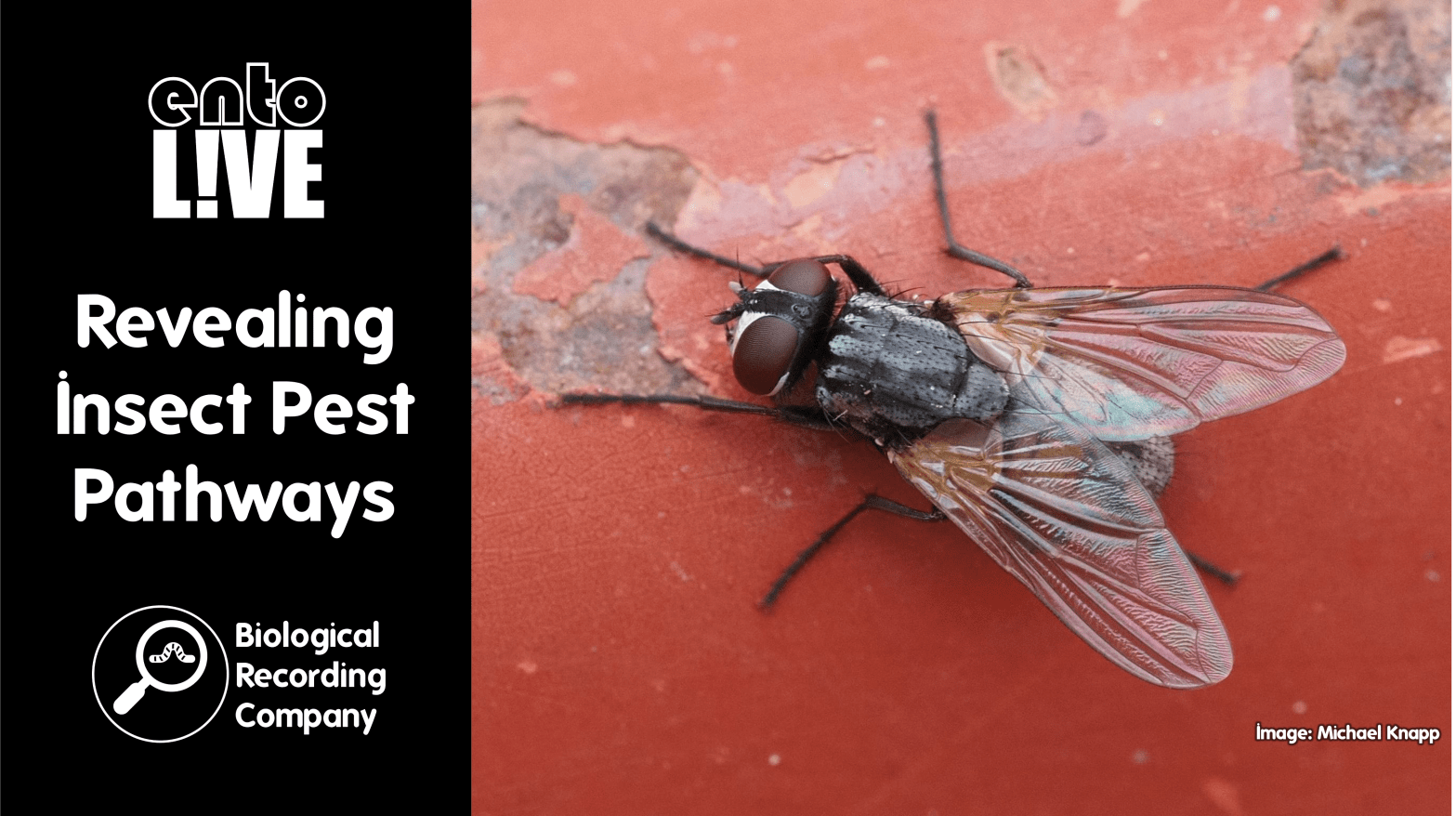
All plants and animals carry a natural chemical signature shaped by the environment in which they grow and feed. This signature comes from stable isotopes – naturally occurring forms of elements that differ slightly in mass but do not decay over time. The relative abundance of these isotopes varies predictably with factors such as climate, geography, and diet. Stable Isotope Ratio Analysis (SIRA) is a powerful analytical technique based on this principle. It measures these subtle differences in isotope ratios, allowing samples to be “fingerprinted” according to their origin. Over the past several decades, SIRA has been widely used to trace the production and movement of biological materials. This presentation introduces the principles behind stable isotopes and SIRA, and explores how the technique can be applied to identify insect pest pathways. Case studies include house flies and wood-boring beetles, such as the invasive Asian longhorn beetle and Ips typographus.
Q&A with Katharina Heinrich
Katharina Heinrich is an inorganic Chemist, working since 2002 across various food safety and authenticity programs at Fera (the Food and Environment Research Agency). Her specialty is stable isotope ratio mass spectrometry. Her current research uses this technique with a focus on the determination of geographical origin, especially the origin of nuisance or invasive insect pests.
1. How precisely can you pinpoint an insect’s geographical origin using Stable Isotope Ratio Analysis? Is it possible to identify a specific region within a country as the origin, for example?
It entirely depends on which stable isotopes you are using and which species you are studying. It also depends whether you are looking only for geographic markers or also diet aspects. If focused just on diet, you can differentiate easily if something is fed on a C3 or a C4 plant in a given location, for example. With geographic origin it’s a little more variable. To give a non entomology example, when analysing the origins of cattle within the UK, SIRA would certainly allow you to distinguish cows from the South of the country from those in the North. It might even allow you to identify cattle from particular distinct populations. Such high precision is possible because we have a large database of stable isotope ratios for cattle in the UK. In other situations, it’s usually less precise. Precision depends on the quality of the existing database of stable isotopes ratios for that species and region. We can only identify if a stable isotope ratio matches that from a certain geographical region if we have known stable isotope ratios from that region to compare against!
2. In the Ips typographus project, what do you suspect was the reason behind the observed intra-specific variation?
I think the reason that the Norwegian population was so distinct was likely due to the much colder climate there compared to the other more central European countries studied.
3. Can Stable Isotope Ratio Analysis be done on the droppings of mammals which eat invertebrates, e.g. bats?
It’s definitely possible, yes. Stable isotopes are carried through the diet of all animals and excreted as faeces. One can also perform dosing studies to see how well certain supplements can be absorbed by the body. In another non-insect based example we supported a project at the University of Newcastle to study the uptake of Vitamin A in infants.
4. Are there any other insect pests – either on the horizon or already here in the UK – which Stable Isotope Ratio Analysis would be particularly useful to study?
Yes, definitely. One we tried to work on recently was Emerald Ash Borer (Agrilus planipennis), a serious pest of ash trees (Fraxinus spp.). Unfortunately, that didn’t receive funding when we last applied to work on it, but there’s always a possibility it could get picked up again in the future. Colleagues elsewhere in FERA are also working on the Asian Hornet (Vespa velutina), applying genetic techniques to track geographical origins. It might be useful to combine the current genetic work with SIRA to complement their results at some point in the future.
Literature References
- Heinrich et al. (2011) ‘Determining the source of house flies (Musca domestica) using stable isotope analysis’: https://scijournals.onlinelibrary.wiley.com/doi/10.1002/ps.2215
- Heinrich and Collins (2016) ‘Determining the geographical origin of Asian longhorn beetle (Anoplophora glabripennis) specimens using stable isotope and trace element analyses’: https://scijournals.onlinelibrary.wiley.com/doi/abs/10.1002/ps.4408
- Heinrich (2023) ‘Forensic techniques used to differentiate origins of invasive beetles’: https://zenodo.org/records/7568807#.Y9E8kHbMLct
- Javal (2017) ‘Invasion du capricorne asiatique Anoplophora glabripennis: génétique, traits d’histoire de vie et écologie’: https://theses.univ-orleans.fr/public/2017ORLE2034_va.pdf
- Blake et al. (2024) ‘Recent outbreaks of the spruce bark beetle Ips typographus in the UK: Discovery, management, and implications’: https://www.sciencedirect.com/science/article/pii/S2666719324000165
Further Info
- fera: https://www.fera.co.uk/
- ‘International cooperation helps understand the threat from an invasive forest pest’ (Forestry Comission Blog): https://forestrycommission.blog.gov.uk/2024/07/25/international-cooperation-helps-understand-the-threat-from-an-invasive-forest-pest/
- ‘Drones join battle against eight-toothed beetle threatening forests’ (BBC News): https://www.bbc.co.uk/news/articles/clyr8yml9rro
entoLIVE
entoLIVE webinars feature guest invertebrate researchers delving into their own invertebrate research. All events are free to attend and are suitable for adults of all abilities – a passion for invertebrates is all that’s required!
- Donate to entoLIVE: https://www.gofundme.com/f/entolive-2025
- Upcoming entoLIVE webinars: https://www.eventbrite.com/cc/entolive-webinars-74679
- entoLIVE blog: https://biologicalrecording.co.uk/category/entolive-blog/
- entoLIVE on YouTube: https://youtube.com/playlist?list=PLuEBNUcfMmE95Re19nMKQ3iX8ZFRFgUAg&feature=shared
entoLIVE is delivered by the Biological Recording Company in partnership with the British Entomological & Natural History Society, Royal Entomological Society and Amateur Entomologists’ Society, with support from Buglife.
The entoLIVE programme is delivered by Biological Recording Company and receives sponsorship from the following organisations:
- British Entomological & Natural History Society
- Royal Entomological Society
- Amateur Entomogists’ Society
Learn more about British wildlife

 Biological Recording