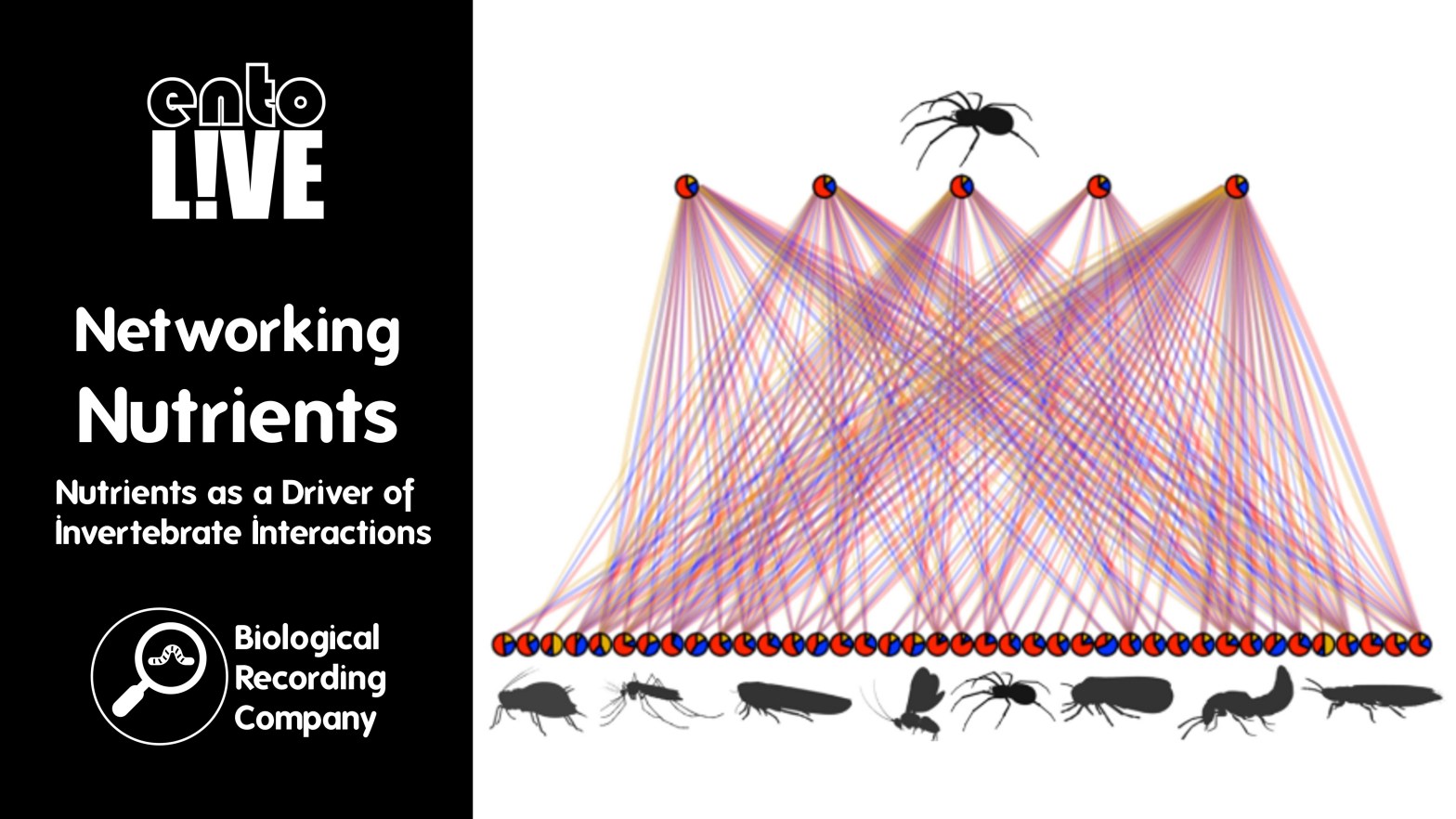
Nutrients are one of the most fundamental drivers of interactions between species. How nutrients drive foraging by invertebrates in nature has traditionally been difficult to study, but modern methods pave the way for an enhanced understanding of invertebrate nutritional dynamics. Jordan will describe how we can study the influence of nutrients on foraging, the structure of interactions across whole ecosystems and the implications for ecosystem services like biocontrol of crop pests.
Q&A with Jordan Cuff
Jordan Cuff is a research fellow based in Newcastle University and leads the Foraging Ecology Research Group. Jordan’s research uses molecular methods to study the interactions between invertebrates and the factors that drive and constrain those interactions.
Is there a relationship between habitat complexity at a small scale, like in gardens, and the complexity of networks?
Yes, absolutely. Generally speaking, habitat heterogeneity is key. So, it’s not just having loads of long grass or loads of short grass, but a mixture of habitat structures, with different habitat types and plant species. In other words, having lots of options for different invertebrates is key.
Do you think it is possible to extend these networks to look at soil nutrient availability and start to look at how soil invertebrates are interacting with above-ground networks?
There is a really interesting dynamic between above ground and below ground systems which is vital for ecosystem health. One of my PhD students, Will Dawson, is working on soil trophic networks, not necessarily looking at the nutrient content of the invertebrates, but looking at fertiliser inputs and how that’s likely to influence the structure of those networks. We’re hoping to find some interesting results on this in the next couple of years.
What are the broader implications of this research? What do you see this research being used for?
My main interest is the fundamental science of knowing what drives invertebrate foraging, behaviour and ecology, and understanding how these systems work. Applying our understanding of these systems to agriculture and wider ecosystem services might be beneficial for people, though, by helping us to understand and manage these services and benefits. Also, understanding how our ecosystems are structured by and depend on nutrients is key to conservation, particularly now with the increasing pressures on our insect populations and subsequent biodiversity loss.
Literature References
- Michalko et al. (2019) Global patterns in the biocontrol efficacy of spiders: A meta-analysis: https://doi.org/10.1111/geb.12927
- Symondson et al. (2002) Can Generalist Predators be Effective Biocontrol Agents?: https://doi.org/10.1146/annurev.ento.47.091201.145240
- Mayntz et al. (2005) Nutrient-Specific Foraging in Invertebrate Predators: https://doi.org/10.1126/science.1105493
- Cuff et al. (2022) Density-independent prey choice, taxonomy, life history, and web characteristics determine the diet and biocontrol potential of spiders (Linyphiidae and Lycosidae) in cereal crops: https://doi.org/10.1002/edn3.272
- Cuff et al. (2024) Sources of prey availability data alter interpretation of outputs from prey choice null networks: https://doi.org/10.1111/een.13315
- Cuff et al. (2021) MEDI: Macronutrient Extraction and Determination from invertebrates, a rapid, cheap and streamlined protocol: https://doi.org/10.1111/2041-210X.13551
- Cuff et al. (2025) Prey nutrient content is associated with the trophic interactions of spiders and their prey selection under field conditions: https://doi.org/10.1111/oik.10712
- Cuff et al. (2024) Networking nutrients: How nutrition determines the structure of ecological networks: https://doi.org/10.1111/1365-2656.14124
- South et al. (2025) Aquatic biological invasions exacerbate nutritional and health inequities: https://doi.org/10.1016/j.tree.2025.06.007
- Timberlake et al. (2022) A network approach for managing ecosystem services and improving food and nutrition security on smallholder farms: https://besjournals.onlinelibrary.wiley.com/doi/pdf/10.1002/pan3.10295
- Senior et al. (2016) Social Network Analysis and Nutritional Behavior: An Integrated Modeling Approach: https://www.frontiersin.org/journals/psychology/articles/10.3389/fpsyg.2016.00018/full
Further Info
- Foraging Ecology Research Group: https://foragingecology.com/
- Agricultural and Forest Entomology journal: https://resjournals.onlinelibrary.wiley.com/journal/14619563
entoLIVE
entoLIVE webinars feature guest invertebrate researchers delving into their own invertebrate research. All events are free to attend and are suitable for adults of all abilities – a passion for invertebrates is all that’s required!
- Donate to entoLIVE: https://www.gofundme.com/f/entolive-2025
- Upcoming entoLIVE webinars: https://www.eventbrite.com/cc/entolive-webinars-74679
- entoLIVE blog: https://biologicalrecording.co.uk/category/entolive-blog/
- entoLIVE on YouTube: https://youtube.com/playlist?list=PLuEBNUcfMmE95Re19nMKQ3iX8ZFRFgUAg&feature=shared
entoLIVE is delivered by the Biological Recording Company in partnership with the British Entomological & Natural History Society, Royal Entomological Society and Amateur Entomologists’ Society, with support from Buglife, Field Studies Council and National Biodiversity Network Trust.
The entoLIVE programme is delivered by Biological Recording Company and receives sponsorship from the following organisations:
- British Entomological & Natural History Society
- Royal Entomological Society
- Amateur Entomogists’ Society
Learn more about British wildlife
 Biological Recording