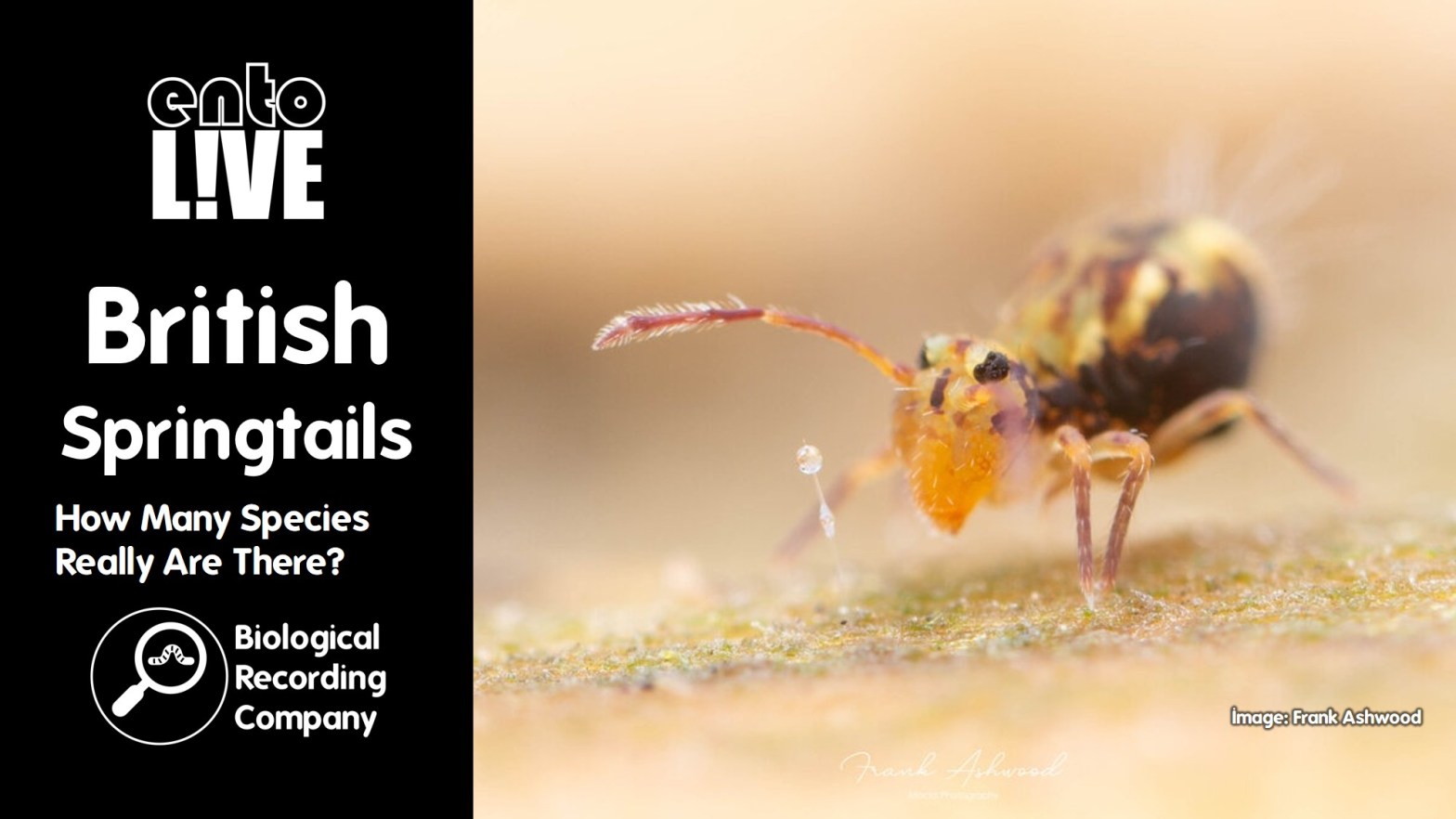
Springtails – small invertebrates closely related to insects – are everywhere: in the soil, up trees, in rockpools, and even being blown around thousands of feet up in the air. They can reach densities of thousands per cubic metre of substrate, yet we know disproportionately little about them. We have a poor grasp on even the most basic level of information: which, and how many, species we have in the UK. James will put forward the case that we may be underestimating the diversity of springtails we have in the UK, and explain how we can resolve this using various sources of data, from citizen science to whole genome sequences. He will also delve into how getting a firm grasp of springtail diversity, as well as understanding how this diversity has come to be, has implications for evolutionary biology, ecology, invasion biology, and conservation.
Q&A with James McCulloch
James McCulloch is the National Recorder for springtails (Collembola), and a PhD student in the evolutionary genomics of springtails at the Wellcome Sanger Institute and the University of Cambridge.
What do you see as the main barriers in terms of recruiting people into recording springtails?
I think that the FSC springtail AIDGAP key published in 2007 was really useful for people with microscopes to identify springtails. However, beginners who purchase this key as a starting point to identify springtails could find it quite difficult because a lot of their features do rely on microscopy. But a lot of springtails can be identified from record photos. Creating a resource that is focused more on identification through photos as opposed to microscopy would be a good way to encourage new recorders.
What is the practical impact of these cryptic species on springtail recording?
When we realised how much cryptic diversity there might be in springtails, we wondered how we were going to keep track of them. A lot of people don’t have access to genetic sequencing facilities, and it could make getting into springtail recording very difficult or off-putting for new people. I think that it is still useful to record springtails that are different morphologically as morphospecies. That way we can still get a lot of data while acknowledging that they may not be species in the strict genetic sense; these data will still be useful given that cryptic species are likely to be similar ecologically.
Do you need fresh specimens for genome sequencing?
Ideally the specimens should be alive until they go into the lab. They are then flash frozen at -70 degrees. This prevents the DNA from breaking down into smaller chunks and we can get longer reads that are much easier to piece together into a genome. Short-read genome sequences can be used for population genomic analysis, which can tell us about population movements and gene flow, for example, and these can be assembled from dead specimens stored in high concentration ethanol for a short time. These are most useful when there is already a high-quality long-read reference genome for that species or a closely-related species, though the pace of methodological advancements will make it easier to assemble good reference genomes from dead specimens in the near future.
Has there been any progress in using eDNA in the study of springtails?
I am not aware of any eDNA work on springtails specifically. Since springtails occur at such high densities in soil, it isn’t totally unreasonable to consider studying them from an eDNA perspective. However, we don’t have a comprehensive DNA database for springtails yet so we wouldn’t be able to confidently identify a lot of the genetic sequences that we would see in the eDNA samples.
Literature References
- McCullock (2025) Entomobrya petri sp. nov.: A new species of springtail found in the British Isles: https://doi.org/10.25674/476
- Hutchinson and McCulloch (2024) Fasciosminthurus quinquefasciatus (Symphypleona: Bourletiellidae), New to Britain: https://www.researchgate.net/publication/379733637_Fasciosminthurus_quinquefasciatus_Symphypleona_Bourletiellidae_New_to_Britain
- Du et al. (2024) Revisiting the four Hexapoda classes: Protura as the sister group to all other hexapods: https://www.pnas.org/doi/10.1073/pnas.2408775121
- Chen et al. (2019) Structure and functions of the ventral tube of the clover springtail Sminthurus viridis (Collembola: Sminthuridae): https://www.researchgate.net/publication/330711582_Structure_and_functions_of_the_ventral_tube_of_the_clover_springtail_Sminthurus_viridis_Collembola_Sminthuridae
- Yu et al. (2014) Whole-genome-based phylogenetic analyses provide new insights into the evolution of springtails (Hexapoda: Collembola): https://www.sciencedirect.com/science/article/abs/pii/S1055790324001611
- Whalley and Jarzembowski (1981) A new assessment of Rhyniella, the earliest known insect, from the Devonian of Rhynie, Scotland: https://www.nature.com/articles/291317a0
- Potapov et al. (2023) Globally invariant metabolism but density-diversity mismatch in springtails: https://www.nature.com/articles/s41467-023-36216-6
- Hensel et al. (2013) Tunable nano-replication to explore the omniphobic characteristics of springtail skin: https://www.researchgate.net/publication/245540698_Tunable_nano-replication_to_explore_the_omniphobic_characteristics_of_springtail_skin
- Lukić et al. (2018) Setting a morphological framework for the genus Verhoeffiella (Collembola, Entomobryidae) for describing new troglomorphic species from the Dinaric karst (Western Balkans): https://www.researchgate.net/publication/328285277_Setting_a_morphological_framework_for_the_genus_Verhoeffiella_Collembola_Entomobryidae_for_describing_new_troglomorphic_species_from_the_Dinaric_karst_Western_Balkans
- Lukić et al. (2019) Distribution pattern and radiation of the European subterranean genus Verhoeffiella (Collembola, Entomobryidae): https://onlinelibrary.wiley.com/doi/abs/10.1111/zsc.12392
- Dukes et al. (2022) Specific and intraspecific diversity of Symphypleona and Neelipleona (Hexapoda: Collembola) in southern High Appalachia (USA): https://www.researchgate.net/publication/364257425_Specific_and_Intraspecific_Diversity_of_Symphypleona_and_Neelipleona_Hexapoda_Collembola_in_Southern_High_Appalachia_USA
- Zhang et al. (2025) Diversification of alpine soil animals corroborates uplifts and environmental changes of Qinghai-Tibetan Plateau and Himalayas: Insights from molecular phylogeny and cryptic diversity of the Isotoma quadridentata Complex (Collembola: Isotomidae): https://onlinelibrary.wiley.com/doi/10.1111/zsc.70004?af=R
- Martin et al. (2019) Recombination rate variation shapes barriers to introgression across butterfly genomes: https://journals.plos.org/plosbiology/article?id=10.1371/journal.pbio.2006288
- Chernova et al. (2009) Ecological significance of parthenogenesis in Collembola: https://link.springer.com/article/10.1134/S0013873810010033
- Riparbelli et al. (2006): Centrosome inheritance in the parthenogenetic egg of the collembolan Folsomia candida: https://pubmed.ncbi.nlm.nih.gov/16906420/
- Hart et al. (2025) Genomic divergence across the tree of life: https://www.pnas.org/doi/10.1073/pnas.2319389122
Further Info
- Checklist of the Collembola of the world: https://www.collembola.org/
- A Key to the Collembola (Springtails) of Britain and Ireland: https://www.field-studies-council.org/shop/publications/springtails-aidgap/)
- AJC Springtails: https://collembolla.blogspot.com/
- Ed Phillips’ springtail photographs: www.edphillipswildlife.com/collembola-springtails
- Frank Ashwood Springtail photographs: https://www.frankashwood.com/macrophotography/collembola
entoLIVE
entoLIVE webinars feature guest invertebrate researchers delving into their own invertebrate research. All events are free to attend and are suitable for adults of all abilities – a passion for invertebrates is all that’s required!
- Donate to entoLIVE: https://www.gofundme.com/f/entolive-2025
- Upcoming entoLIVE webinars: https://www.eventbrite.com/cc/entolive-webinars-74679
- entoLIVE blog: https://biologicalrecording.co.uk/category/entolive-blog/
- entoLIVE on YouTube: https://youtube.com/playlist?list=PLuEBNUcfMmE95Re19nMKQ3iX8ZFRFgUAg&feature=shared
entoLIVE is delivered by the Biological Recording Company in partnership with the British Entomological & Natural History Society, Royal Entomological Society and Amateur Entomologists’ Society, with support from Buglife, Field Studies Council and National Biodiversity Network Trust.
The entoLIVE programme is delivered by Biological Recording Company and receives sponsorship from the following organisations:
- British Entomological & Natural History Society
- Royal Entomological Society
- Amateur Entomogists’ Society
Learn more about British wildlife

 Biological Recording
One thought on “British Springtails: How Many Species Really Are There?”