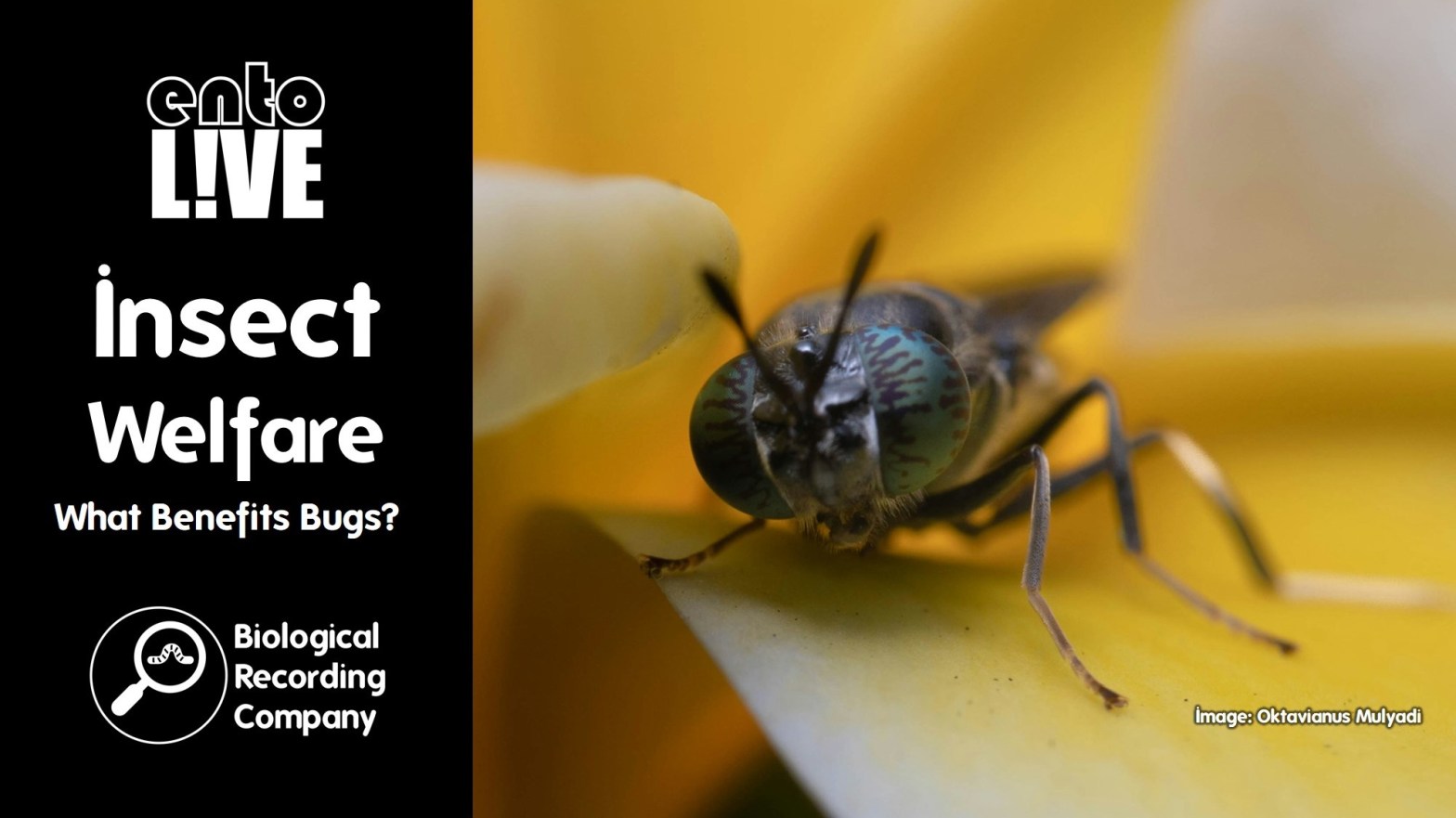
Recent progress in the research on insect sentience and pain suggests that some insects at some life stages may be sentient. But if insects are sentient, what should we do to protect and promote their welfare in the contexts where we use or manage them? The concept of individual welfare will be introduced and applied to consider strategies for improving the lives of insects.
Q&A with Dr Meghan Barrett
Dr Meghan Barrett is an Assistant Professor of Biology at Indiana University Indianapolis and Director of the Insect Welfare Research Society. Her research focuses on insect neuroscience, physiology, and welfare, particularly in the farmed context.
Does the Insect Welfare Research Society work on other groups of invertebrates besides insects, like crustaceans, molluscs etc?
We call ourselves the Insect Welfare Research Society because we are hoping to shed light on this specific, long-neglected group. But, really, our values are that we are the understudied invertebrate research society, it just isn’t as cool a name. So, for example, we do have decapod crustacean guidelines that were produced by our researchers, and we are happy to consider other invertebrates as well if there’s a researcher community to support. We have student and small meeting support grants that can go to any invertebrate group.
Has any research been done on the effects of deep freezing as a humane euthanasia strategy for insects?
Very little research has been done to demonstrate whether freezing can be considered a humane euthanasia strategy for insects. But it’s a great question because a lot of people do want to know what we recommend. There are some recommendations in the 2024 guidelines that we are refining specifically on this point for the 2026 guidelines as we try to stay on top of the best available evidence. At least some insects have unique, cold-evoked nocifensive responses that suggests cold may be, minimally, stressful for the animal to experience prior to unconsciousness (e.g., chill coma). Thus, especially for larger-bodied species or those with cold adaptations (like bumblebees, shivering) where the amount of time it will take for insects to become unconscious will be lengthened, cold euthanasia is not currently recommended.
Additionally, BIAZA (British and Irish Association for Zoos and Aquaria) have a terrestrial invertebrate group composed of insect specialists and veterinarians that’s actually looked at this issue. They also don’t recommend freezing insects as a humane method of euthanasia (Pellet et al. 2013). However, they say if you need to do it, then first put them into a fridge for four hours to let them acclimate to the cool temperature and then put them into the coldest available freezer immediately after that.
What about the use of ethanol?
Direct to ethanol killing would definitely not be recommended as it clearly results in distress. You will likely have seen the animals struggling in the tubes if they haven’t been frozen first. That’s an indication that the suffocation happening to the animal may be stress-inducing. Typically, this method would need to be justified (e.g., ethanol was the only way to preserve the specimen in a manner required for research purposes) if it were to be used instead of a more humane method. If direct-to-ethanol killing is necessary for a scientific aim, we recommend anesthetizing the animals first. If possible, employing a method of euthanasia prior to immersion in ethanol (e.g., crushing of the head capsule to destroy the brain) is preferred, where this does not stand in the way of a justified scientific objective.
Literature References
- Makarova et al. (2020) ‘Small brains for big science’: https://www.sciencedirect.com/science/article/pii/S0959438821001021
- Barrett and Fischer (in press) ‘preprint – The Era Beyond Eisemann et al. (1984): Insect pain in the 21st century’: https://osf.io/preprints/osf/ng7pu_v1
- Li et al. (2020) ‘The connectome of the adult Drosophila mushroom body provides insights into function’: https://elifesciences.org/articles/62576
- Birch et al (2021) ‘Review of the evidence of sentience in cephalopod molluscs and decapod crustaceans’: https://www.lse.ac.uk/News/News-Assets/PDFs/2021/Sentience-in-Cephalopod-Molluscs-and-Decapod-Crustaceans-Final-Report-November-2021.pdf
- Fischer et al. (2025) ‘Defending and refining the Birch et al. (2021) precautionary framework for animal sentience’: https://www.cambridge.org/core/journals/animal-welfare/article/defending-and-refining-the-birch-et-al-2021-precautionary-framework-for-animal-sentience/F60CF6102B4D2B9A5A5218ED42AEDCC6
- Gibbons et al. (2022) ‘Can insects feel pain? A review of the neural and behavioural evidence’: https://chittkalab.sbcs.qmul.ac.uk/2022/Gibbons%20et%20al%202022%20Advances%20Insect%20Physiol.pdf
- Zipple et al. (2024) ‘Animal emotions and consciousness: A preliminary assessment of researchers’ perceptions and biases and prospects for future progress’: https://pmc.ncbi.nlm.nih.gov/articles/PMC11558068/
- Barrett et al. (2024) ‘Entomologists’ knowledge of, and attitudes towards, insect welfare in research and education’: https://resjournals.onlinelibrary.wiley.com/doi/full/10.1111/een.13415
- Mellor et al. (2020) ‘The 2020 Five Domains Model: Including Human–Animal Interactions in Assessments of Animal Welfare’: https://pmc.ncbi.nlm.nih.gov/articles/PMC7602120/#sec3-animals-10-01870
- Lalander et al. (2025) ‘Working out the bugs: navigating challenges and unlocking opportunities in the insect industry’: https://brill.com/view/journals/jiff/aop/article-10.1163-23524588-20250001/article-10.1163-23524588-20250001.xml
- Shah (2024) ‘Insect farming: Investment trends and projected production capacity’: https://rethinkpriorities.org/research-area/investments-into-insect-farming/
- McKay and Shah (2025) ‘Forecasting Farmed Animal Numbers in 2033’: https://rethinkpriorities.org/research-area/forecasting-farmed-animal-numbers-in-2033/
- Dortsman et al. (2017) ‘Insect farming: investment trends and projected production capacity’: https://www.semanticscholar.org/paper/Black-soldier-fly-biowaste-processing%3A-a-guide-Dortmans-Diener/4982a69fd8dafeafab9564ca1c9c9cce65d6ab0c#citing-papers
- Shepperd et al. (2002) ‘Rearing methods for the black soldier fly (Diptera: Stratiomyidae)’: https://pubmed.ncbi.nlm.nih.gov/12144307/
- Barrett et al. (2025 preprint) ‘Dietary preferences and impacts of feeding on behavior, longevity, and reproduction in adult black soldier flies (Diptera: Stratiomyidae; Hermetia illucens)’: https://osf.io/p74xq_v1
- Perl et al. (2024 preprint) ‘Identifying trends in reporting on the ethical treatment of insects in research’: https://osf.io/preprints/osf/hs4gr
Further Info
- Insect Welfare Research Society Research Guidelines: https://www.insectwelfare.com/research-guidelines
- Invertebrate Sentience: Do Invertebrate Experiences Deserve Respect & Welfare Protection? entoLIVE: https://biologicalrecording.co.uk/2023/07/17/invertebrate-sentience/
- 80,000 hours Podcast #198 ‘Meghan Barrett on challenging our assumptions about insects’: https://80000hours.org/podcast/episodes/meghan-barrett-insect-pain-consciousness-sentience/
- The Cambridge Declaration on Consciousness (2012): https://fcmconference.org/img/CambridgeDeclarationOnConsciousness.pdf
- The New York Declaration on Animal Consciousness (2024): https://sites.google.com/nyu.edu/nydeclaration/declaration
- Royal Entomological Society Statement on the Ethical Treatment of Insects: https://www.royensoc.co.uk/news/res-statement-on-the-ethical-treatment-of-insects/#:~:text=Where%20insects%20are%20ethically%20killed%20for%20research%2C%20researchers%20should%20consider,their%20studies%20and%20research%20objectives.
- BENHS Code of Conduct for Collecting Insects and Other Invertebrates: https://www.benhs.org.uk/resources/collecting/
entoLIVE
entoLIVE webinars feature guest invertebrate researchers delving into their own invertebrate research. All events are free to attend and are suitable for adults of all abilities – a passion for invertebrates is all that’s required!
- Donate to entoLIVE: https://www.gofundme.com/f/entolive-2025
- Upcoming entoLIVE webinars: https://www.eventbrite.com/cc/entolive-webinars-74679
- entoLIVE blog: https://biologicalrecording.co.uk/category/entolive-blog/
- entoLIVE on YouTube: https://youtube.com/playlist?list=PLuEBNUcfMmE95Re19nMKQ3iX8ZFRFgUAg&feature=shared
entoLIVE is delivered by the Biological Recording Company in partnership with the British Entomological & Natural History Society, Royal Entomological Society and Amateur Entomologists’ Society, with support from Buglife, Field Studies Council and National Biodiversity Network Trust.
The entoLIVE programme is delivered by Biological Recording Company and receives sponsorship from the following organisations:
- British Entomological & Natural History Society
- Royal Entomological Society
- Amateur Entomogists’ Society
Learn more about British wildlife
 Biological Recording