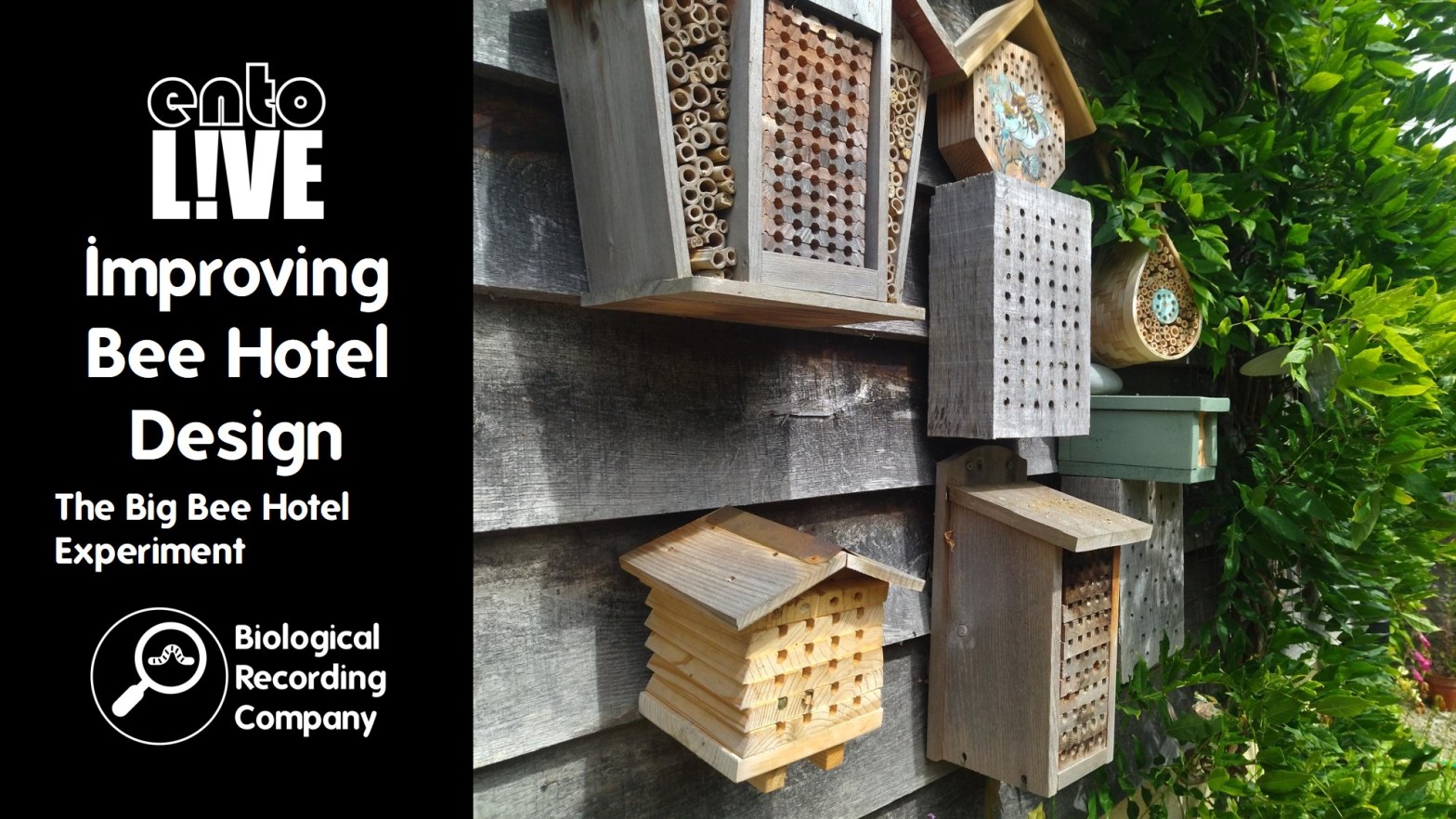
Bee hotels have become very popular, but some designs are likely to be better than others. Dave will introduce the concept of bee hotels, then present results from the Buzz Club’s Big Bee Hotel Experiment, in which the public gathered data on the success of 576 bee hotels of varying design. We’ll also explore what has been learned about the optimal design and positioning of bee hotels.
Q&A with Prof Dave Goulson
Dave Goulson is a Professor of Biology at the University of Sussex, specializing in bee ecology. He has published more than 300 scientific articles on the ecology and conservation of bumblebees and other insects, and founded the Bumblebee Conservation Trust in 2006, a charity which has grown to 12,000 members and more than 50 staff.
What is The Big Bee Hotel Experiment?
This experiment asks members of the public to try out a bee hotel in their garden and take a photograph every month of the face of the hotel for us. From these photos we can determine what species of bees are occupying your hotels. The Buzz Club also asks for information about your bee hotel e.g. what it is made out of, where you have positioned the hotel? Etc. This enables us to find out what design of bee hotel is most effective.
From this experiment, we can investigate:
- The pattern of occupancy and how it changes over time
- The relative abundance of different species
- How is the above affected by hotel design and location… and more!
We have a year’s worth of data so far. The Big Bee Hotel Experiment is open for 2025! Sign up here: https://www.thebuzzclub.uk/thebigbeehotelexperiment
What are bee hotels and are they needed?
Bee hotels are intended to provide homes for cavity-nesting bees. These are solitary bees, who would normally nest in hollow stems or beetle holes in deadwood.
Because of the way we garden and keep greenspaces, these natural habitats tend to be in short supply, meaning providing artificial holes in the form of bee hotels may be a good way to help these bees. Many insect houses that are commercially sold, anecdotally, don’t reliably work. However, we can confirm that from the TBBHE 2024 data, bee hotels do work and provide an effective alternative habitat for cavity-nesting bees.
What were the outcomes of the 2024 project?
In the pilot year of this study, we had 594 hotels registered, and 487 of those produced useable data. Throughout the year, 7293 bee hotel holes were occupied: 83% of those were mud-capped, 7% leaf, and 9% leaf mastic. On average, a hotel had 27% of holes occupied!
It is important to get your bee hotels out in Spring as the peak nesting season was shown to be between March and May, with rates then declining until the bee hotels began to empty due to predation and other factors in September.
An overall summary of the key points are below:
- Cardboard, wood or bamboo are good to make your hotel from – avoid plastic!
- Put your hotel on a sunny wall or fence, facing East or South, with a range of hole sizes (4-10mm in diameter).
What direction should your bee hotels be facing?
A common question asked when hanging a bee hotel is just this: what direction should my bee hotel be facing? From our data it is clear that hotels facing North, North-West and West performed pretty poorly. South and East performed well, perhaps the bees enjoy the early morning sun to get them ready for the day!
Should you clean out your bee hotel?
Bee hotels are often home to different bee parasites and pests, such as pollen mites and Houdini flies. It is often suggested that you should clean out your hotel between years to help prevent the occurrence of such creatures. However, does cleaning out your hotel in between seasons increase the proportion of bee occupancy in a bee hotel?
From our data, it shows that the answer to this is no! The hotels that weren’t cleaned out had more occupied holes on average than those which were cleaned. Our data also show that new hotels had fewer occupied holes, suggesting that maybe it takes a year or two for the bee population to build up in a new hotel. We want to continue to test this out in 2025 and beyond!
Do you investigate other kinds of bug hotels?
The Buzz Club runs many projects testing out the effectiveness of different bug hotels.
- Air Bee ‘N’ Bee: This was our original bee hotel and you can catch up with the Refurbishing bee hotels entoLIVE with Dr Linda Birkin here.
- Hoverfly Lagoons: Hoverfly Lagoons, designed by Dr Ellen Rotheray, are effective habitats to add to your garden. They are proven to be used as artificial breeding sites for hoverflies that have an aquatic life stage. They are easy, cheap and fun to make – a great one to survey with kids as well! Check out the Hoverfly Lagoons entoLIVE with Ellen.
- Bug Bunkers: Bug Bunkers is a new bug hotel experiment, which has proven to be very successful so far in housing different invertebrates over winter. Find out more here!
Literature References
- Hallman et al (2017) More than 75% decline in flying insect biomass: https://journals.plos.org/plosone/article?id=10.1371/journal.pone.0185809
- Christman (2021) Effect of height and colour of Bee bricks: https://repository.falmouth.ac.uk/4388/
- Beyer et al (2023) The contrasting response of cavity-nesting bees, wasps and their natural enemies to biodiversity conservation measures:https://resjournals.onlinelibrary.wiley.com/doi/10.1111/icad.12638
Further Info
- The Big Bee Hotel Experiment: https://www.thebuzzclub.uk/thebigbeehotelexperiment
- Refurbishing the Bee Hotel: Different Bees, Different Needs entoLIVE article: https://biologicalrecording.co.uk/2024/04/11/refurbishing-the-bee-hotel/
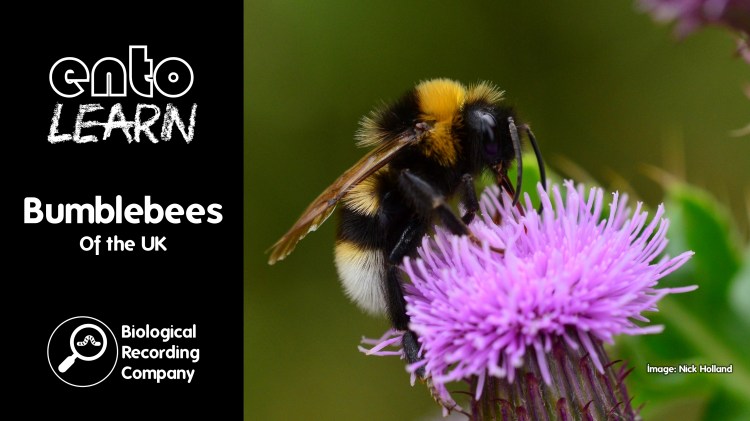
- Bumblebees of the UK online course: https://courses.biologicalrecording.co.uk/courses/bumblebees
- Bees and Beyond: Ecosystem Services at a Garden Scale entoLIVE article: https://biologicalrecording.co.uk/2024/09/05/bees-and-beyond/
- Bees and Heatwaves entoLIVE article: https://biologicalrecording.co.uk/2024/06/05/bees-and-heatwaves/
entoLIVE
entoLIVE webinars feature guest invertebrate researchers delving into their own invertebrate research. All events are free to attend and are suitable for adults of all abilities – a passion for invertebrates is all that’s required!
- Donate to entoLIVE: https://www.gofundme.com/f/entolive-2025
- Upcoming entoLIVE webinars: https://www.eventbrite.com/cc/entolive-webinars-74679
- entoLIVE blog: https://biologicalrecording.co.uk/category/entolive-blog/
- entoLIVE on YouTube: https://youtube.com/playlist?list=PLuEBNUcfMmE95Re19nMKQ3iX8ZFRFgUAg&feature=shared
entoLIVE is delivered by the Biological Recording Company in partnership with the British Entomological & Natural History Society, Royal Entomological Society and Amateur Entomologists’ Society, with support from Buglife, Field Studies Council and National Biodiversity Network Trust.
The entoLIVE programme is delivered by Biological Recording Company and receives sponsorship from the following organisations:
- British Entomological & Natural History Society
- Royal Entomological Society
- Amateur Entomogists’ Society
Learn more about British wildlife
 Biological Recording
One thought on “Improving Bee Hotel Design: The Big Bee Hotel Experiment”