
Keiron Brown, Naturalist at the Biological Recording Company
I’ve been delivering natural history training courses for over 10 years, starting with earthworm ID and surveying, before branching out into earthworm ecology, terrestrial invertebrates, butterflies, moths, iRecord and biological recording.
For 5 years, I commissioned other invertebrate specialists for the FSC BioLinks project, and I’m once again commissioning those species group specialists for biological recording events through the Biological Recording Company.
Starting my own company has been a learning curve in so many ways, especially when it comes to setting fair rates for the incredible natural history tutors I work with. I’m deeply committed to running an ethical business that not only delivers high-quality training but also ensures that the tutors who make it all happen are paid fairly for their expertise and passion.
This feels more important than ever, given the rising cost of living in the UK. It’s clear to me that the fees we offer our natural history tutors need to keep pace with inflation and the increasing demands placed on workers. From my own experience, I’ve noticed how much tutor rates can vary between organisation – even for delivering the same course. This inconsistency led me to ask an important question: What are our natural history tutors truly worth?

Natural History Tutor Survey
To answer this question, I wanted to find out from natural history tutors themselves, so I launched a short survey aimed at those currently teaching natural history subjects to adults and shared it via my professional networks. The survey asked a series of questions about the type of courses tutors teach, the subjects they cover and the audiences their courses are aimed at so that I can categorise responses. To standardise the results, respondents were asked to respond with a daily rate rather than a ‘per course’ rate, i.e. a 3-day course would be counted as 3 one-day courses, and the fee received should be divided by 3.
The survey also asked what the minimum and maximum fees were that tutors had received for delivering a day of training, as well as what they believed should be the daily rate for course delivery.
Survey Data
The survey was completely anonymous and did not collect any personal information such as name, email, address or phone number. Due to the sensitive nature of the data regarding contractor payments, individual responses and the raw survey data will not be made publicly available.
54 natural history tutors responded to the survey between June and October 2023. The responses to each of the questions have been summarised and are outlined below.

About The Training That Tutors Deliver
What broad categories of courses do you teach?
Respondents covered a diverse range of broad categories within the natural history sector, with all of the provided categories selected by at least 7% of participants:
- Biology and ecology
- Surveying and monitoring
- Species identification
- Conservation and habitat management
- Biodiversity policy and legislation
- Use of digital resources
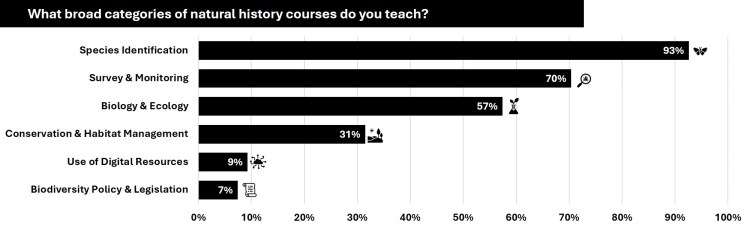
The majority of respondents (93%) teach species identification, with surveying & monitoring the second most taught category (70%). Biology & ecology (57%) and conservation management (31%) were also well represented. Biodiversity policy & legislation (7%) and use of digital resources (9%) were less represented, so any follow-up survey should endeavour to target tutors teaching subjects in these areas.
22% of respondents also reported that they taught courses aimed at amateur naturalists and/or biodiversity professionals that did not fall within the provided categories.
Which species groups do you specialise in?
Respondents were asked to select which species groups they specialised in. Invertebrate tutors were the individuals most represented in this survey (61% for terrestrial invertebrates and 20% for freshwater invertebrates), likely due to the fact that my professional network is biased towards invertebrate specialists. Botany was also well represented, with 35% of respondents reporting that they teach botanical subjects. Any future follow-up survey should endeavour to target species group specialists for groups that were under-represented, such as fungi (6%), fish (2%), marine invertebrates (2%), marine mammals (2%) and lichens (0%).

Which audiences do you generally deliver training for?
Respondents were asked to select which adult audiences they had delivered training to from a list of 9 adult audience categories. They were advised to only select categories where the training that they had delivered was designed for that audience and asked to refrain from selecting all boxes for general interest courses (e.g. not to select ‘Researchers’ because some PhD students had attended courses that were designed primarily for biological recorders and amateur naturalists).
- General Public Adults (i.e. those not previously engaged in natural history)
- University Students (i.e. training specifically targeted at university students)
- Researchers (i.e. training specifically for researchers or research teams)
- Amateur Naturalists (e.g. wildlife gardeners, photographers, conservationists)
- Biological Recorders (i.e. training specifically designed to encourage recording)
- Environmental Educators (e.g. outdoor educators, teachers or Forest School practitioners)
- Professional Ecologists (e.g. local government, NGO or consultant ecologists)
- Other Biodiversity Professionals (e.g. conservationists, policy makers etc.)
- Professionals from other sectors
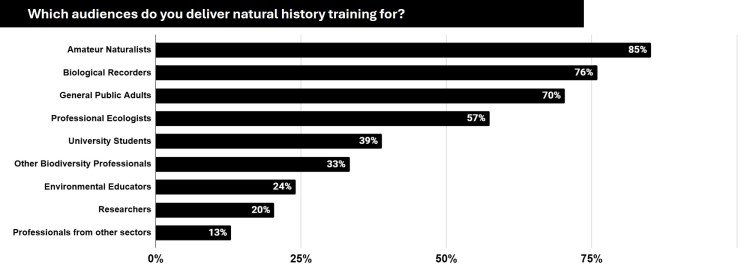
Non-professional audiences were the most common audience types, with 70% or more of all respondents reporting that they taught amateur naturalists, biological recorders and the general public. Of the professional audiences, professional ecologists was the most common audience type (57%). 39% of the respondents reported delivering training aimed at a university student audience (with most of these responses thought to be referring to teaching courses for the MSc Biological Recording & Monitoring delivered by Harper Adamas University in partnership with the Field Studies Council). These results do not highlight any obvious biases in the survey data, as these proportions appear to mirror sector provision.
How many days of natural history training do you deliver within courses each year?
Reponses varied from 0 days (indicating delivery of training less frequently than annually) through to 100 days (indicating that natural history training delivery accounts for a substantial component of the the respondents’ profession). Overall, the mean number of days was 18 days and the median was 6 days.

How often do you deliver training courses for no fee?
Respondents were asked to indicate how frequently they provided training as volunteers (i.e. without charging a fee for their services) by selecting one of the following options:
- Very regularly (10 or more times per year)
- Regularly (5 to 9 times per year)
- Occasionally (2 to 4 times per year)
- Hardly ever (about once per year or less)
- Never

A fifth (20%) of respondents deliver natural history training courses as volunteers (i.e. without charging a fee for their time) at least 5 or more times per year. Over two-fifths (41%) deliver training occasionally (2 to 4 times per year) for free. Only 17% of natural history tutors who responded to this survey never provide their training services for free.
Natural History Tutor Fees
Respondents were asked to provide their answers to the nearest pound for the following questions. They were also asked not to include the free courses that they deliver in the minimum and maximum fee estimates unless they have never been paid tutoring fees.
What is the minimum rate that you charge for a 1 day of training?
Responses ranged from as low as £50 per day day to £450 per day. The most common response was £150 (8 responses). The mean daily fee was £185 and the median fee was £175.
What is the maximum rate that you charge for 1 day of training?
Responses for this question were extremely varied, with the lowest response at just £100 per day and the highest at £2,500 per day. The most common response was £350 (10 responses), with both £250 and £300 also receiving 7 responses each. The mean daily fee was £388 and the median fee was £300.
What do you believe should be the standard daily rate?
Respondents were advised that “we understand that daily rates may vary by experience level, product, subject and target audience so please provide a rate that you think recognises your expertise and skills”. They were also reminded that minimum wage for those aged 23 and over was £83.36 for the average (8-hour) working day so they could not enter a figure lower than £84.
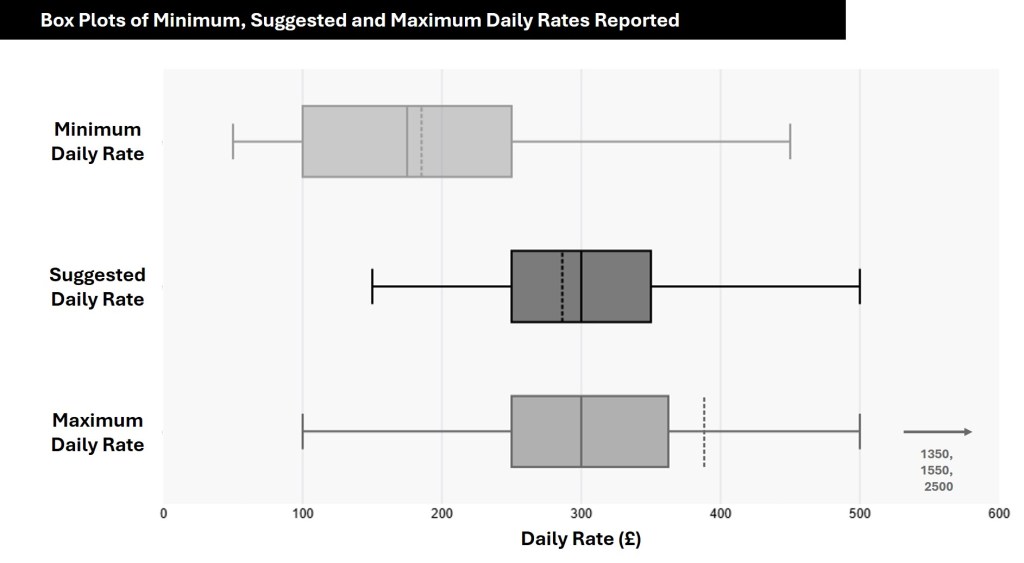
The lowest suggested amount for a standard daily fee was £150 (suggested by 4 respondents) and the highest was £500 (suggested by a single respondent). The most popular response was £300 (suggested by 15 respondents). Taking into account all responses, the mean amount was £286 and the median was £300.
Discussion
Based on the responses of the natural history tutors that participated in this survey, natural history tutors are on average contracted for between £185 – £388 per day of training delivery. Respondents suggested that a minimum standard daily rate for natural history training courses should be around £300.
This figure should be treated very much as a minimum, as additional factors such as tutor experience, professional memberships, travel time or admin related to scheduling in a course may also be relevant when calculating an appropriate natural history tutor fee.
The preparation of course materials and training course planning (which can include pre-course site visits or specimen collection) can also add a significant amount of work to the delivery of natural history training courses. Therefore, where this is not renumerated for within natural history tutor contracts it should be taken into consideration when calculating a contractor’s daily rate.
It is also clear from this survey that the natural history training sector is heavily dependent on volunteer natural history tutors to deliver training, with over 60% of respondents (this author included) delivering free training courses multiple times every year. This indicates that those involved in teaching natural history are passionate about their subjects, and this is something to be celebrated. However, it also raises potential issues for those looking to establish a career as a natural history tutor if they are expected to deliver their services for free or find that those teaching as a hobby are happy to accept lower rates of pay and unintentionally undermine the ‘going rate’ for a natural history tutor.
This survey is not comprehensive and there are biases within the data. The survey was never intended to provide a definitive answer to the question “What are our natural history tutors worth?”, but to encourage discussion around the subject and to get those commissioning tutors (including the Biological Recording Company) to review their natural history tutor rates. At the very least, it has enabled me to establish a minimum daily rate of £300 plus expenses for Specialist Naturalists that deliver training courses and Field Recorder Days on behalf of the Biological Recording Company as contractors.
More for environmental professionals





 Biological Recording