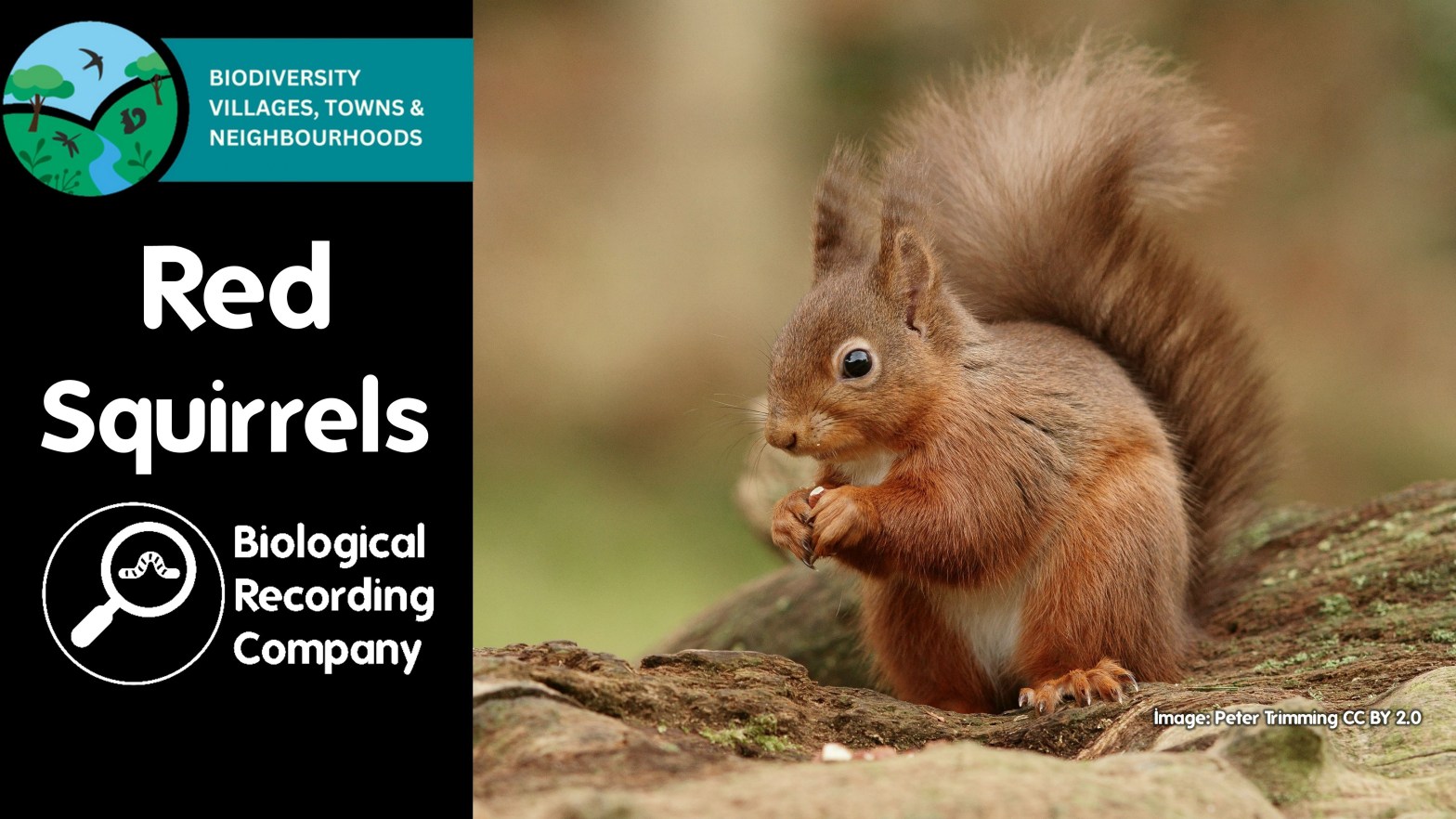
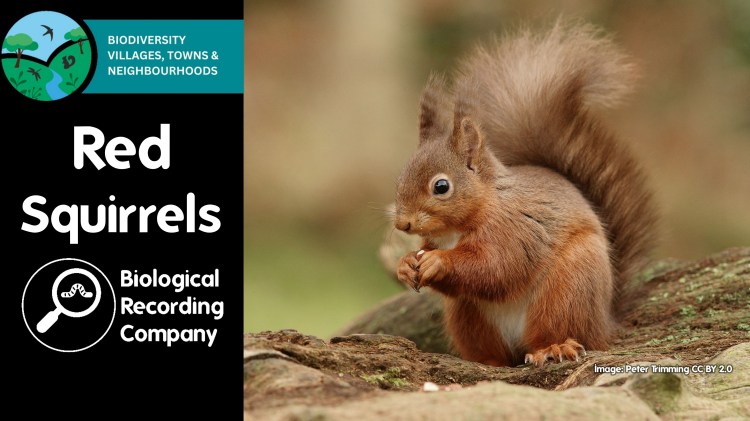
The Red Squirrel (Sciurus vulgaris) is the UK’s only native squirrel. This once widespread mammal is now limited to Scotland and a few other populations, facing challenges from the invasive Grey Squirrel (Sciurus carolinensis).
This blog features presentations from two Red Squirrel specialists from Saving Scotland’s Red Squirrels, that will explore the biology and ecology of these fascinating animals, before highlighting the threats that our Red Squirrels face and what we can do to help them.
Red Squirrels and their Ecology
David Morton (Saving Scotland’s Red Squirrels)
Easily recognisable by its reddish-brown fur, tufted ears and bushy tail, the Red Squirrel (Sciurus vulgaris) is a small, arboreal rodent native to Europe and parts of northern Asia that was once common across the British Isles. Red Squirrels primarily inhabit coniferous and mixed woodlands, where they rely on a diet of seeds, nuts, berries, fungi, and occasionally bird eggs. They are solitary and territorial, using tree cavities or dreys (nests made of twigs and leaves) for shelter. Unlike some rodent species, red squirrels do not hibernate but instead store food for the winter. They play a crucial ecological role as seed dispersers, particularly for tree species like Scots pine. Learn more about these fascinating small mammals in this presentation.
Red Squirrel Threats and Conservation
Susie McNaughton (Saving Scotland’s Red Squirrels)
Red Squirrels (Sciurus vulgaris) face several significant threats, which have led to their decline in many parts of their range. The main threat in the UK is the introduction of the invasive Grey Squirrel (Sciurus carolinensis) from North America. Grey squirrels are more adaptable, enabling them to outcompete Red Squirrels for food and habitat. They also carry the squirrelpox virus, which is harmless to them but fatal to Red Squirrels. Saving Scotland’s Red Squirrels will discuss the status of our Red Squirrel populations and how various conservation methods are being undertaken to turn the tide for the declining population, including how simply submitting your squirrel sightings can help conserve these amazing animals.
Q&A with David Morton & Susie McNaughton
David Morton is the Monitoring & Control Officer and has been with the Saving Scotland’s Red Squirrels project since 2023. He studied Zoology and Environmental Studies at university and has a lifelong interest in wildlife and Conservation.
Susie McNaughton is the Highland Line Conservation Lead at Saving Scotland’s Red Squirrels, where she works hand-in-hand with a dedicated team, landowners and volunteers to support Red Squirrel populations in Tayside, Angus & the Mearns and Argyll, Trossachs & Stirling.
Do Red Squirrels prefer coniferous or broadleaf forests where Grey Squirrels are not present?
David: A mixed woodland is best for Red Squirrels as it provides diverse food sources. Red Squirrels can survive at low densities in single species coniferous woodland where grey squirrels cannot.
Why are you not controlling Grey Squirrels in Edinburgh and other cities?
Susie: Our work is focused in priority target areas where populations of red squirrels are under threat from greys. These target areas are designated by the Scottish Squirrel Group’s 2015-2025 Scottish Strategy for Red Squirrel Conservation, convened by the government’s nature agency, NatureScot. Thus, our decisions about where we control grey squirrels is based on the proximately of greys and reds – and the specific dance between them – rather than targeting the grey species across the board. Our resources are limited so we need to ensure that they are targeted where they can make a difference to red conservation. The only Scottish city that makes the cut for grey control at present is Aberdeen, where SSRS has worked for over ten years to control the grey island population in the area with much success. You can hear more about this in the accompanying presentation, including our hope to confirm the eradication of grey squirrels in Aberdeen city in the very near future.
Do Red Squirrels behave differently in areas where they come into contact with Grey Squirrels?
David: Red Squirrels will move away where Grey Squirrel density is high. When only occasional contact is made, both species avoid close interaction.
What are the natural predators of Red Squirrels?
David: In the UK the main native predators are the Pine Marten, Goshawk and Buzzard.
Are there any successful reintroductions of Red Squirrels?
Susie: In Scotland, the organisation Trees for Life have been reintroducing red squirrels to selected suitable habitats in the North-west Highlands since 2016. So far 200 squirrels have been translocated to create 12 new communities. It’s great to see the squirrel sightings map now including reports of reds from north-west Scotland.
Are there any emerging technologies that could help save Red Squirrels from extinction in the UK?
Susie: There are two areas where new innovations are being tested, and may become practically viable in the next few years.
- Firstly, the development of a contraceptive to reduce grey squirrel numbers. The present challenge is to devise an effective delivery mechanism for the contraceptive vaccine to reach the ‘target’ squirrels, and thus test its efficacy in preventing breeding.
- Secondly, Project Red Haven is a collaborative research project designed to develop and train an AI assistant for squirrel identification. The AI technology is being developed by a company called Genysis Engine, based in Northern Ireland, and is being tested with a number of UK partners. When the AI detects specified factors (e.g. red or grey squirrel), it can trigger a pre-determined response such as providing food, closing the door to a trap, or delivering medicine. SSRS is not presently involved, but we’re very interested in the results and potentially being involved in the future.
What is the one thing that you’d recommend people can do to help Red Squirrels?
David: Without the presence of non native Grey Squirrels it is abundantly clear that Red Squirrels would thrive across the UK. Consequently the most important thing people can do is report sightings of squirrels to their local squirrel group and, in particular, Grey Squirrels close to known Red Squirrel locations.
Susie: Spread the word about their story in Britain. In my experience, when people hear about the threat to red squirrels at a species level in the UK, they are keen to support action to address the further expansion of greys. This may not be immediately relevant on the ground in, say, Birmingham, but unless we act now and keep acting in strategic areas nationwide, it will be too late.
Useful links
Scotland
- Tayside Red Squirrel Projects: https://www.taysidebiodiversity.co.uk/get-involved/projects/projects-red-squirrels/
- Report a Squirrel Sighting (Scotland): https://scottishsquirrels.org.uk/squirrel-sightings/?ssrs_sighting_add=1#BreadcrumbsAtTop
- Saving Scotland’s Red Squirrels website: https://scottishsquirrels.org.uk/
- Information about Scotland’s Red Squirrels: https://scottishsquirrels.org.uk/scotlands-red-squirrels/
- Scottish Red Squirrel news: https://scottishsquirrels.org.uk/news/
- Sightings map for Red Squirrels in Scotland: https://scottishsquirrels.org.uk/squirrel-sightings/
- Report injured/dead Red Squirrels in Scotland to the SPCA: https://www.scottishspca.org/
England & Wales
- Red Squirrel Survival Trust: https://www.rsst.org.uk/
- Brownsea Island Red Squirrels: https://www.nationaltrust.org.uk/visit/dorset/brownsea-island/the-rare-red-squirrel-on-brownsea-island
- Isle of Wight Red Squirrels: https://www.wightsquirrels.co.uk/
- Anglesey Red Squirrels: https://www.nationaltrust.org.uk/visit/wales/plas-newydd-house-and-garden/red-squirrels-at-plas-newydd
- Mid Wales Red Squirrel Project: https://www.welshwildlife.org/red-squirrel-project
- Isles of Scilly Red Squirrels: https://www.ios-wildlifetrust.org.uk/wildlife-explorer/mammals/red-squirrel
- Report injured/dead Red Squirrels in England to the RSPCA: https://www.rspca.org.uk/reportaconcern
Event Partners
This blog was produced by the by the Biological Recording Company as part of the Tayside Biodiversity Partnership Biodiversity Towns, Villages and Neighbourhoods project.

Learn more about British wildlife

 Biological Recording