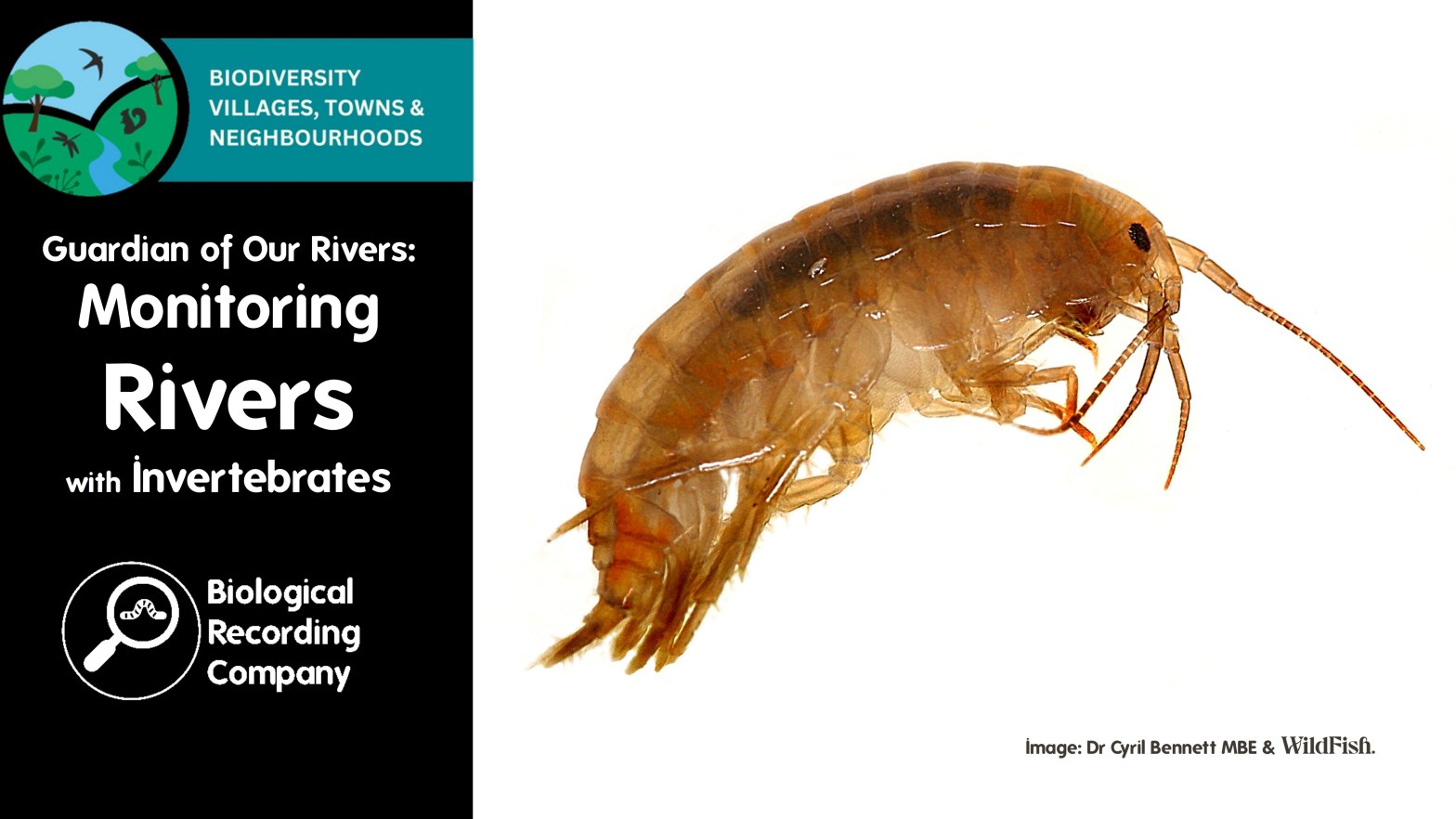
Freshwater invertebrates are powerful indicators of river health. Their presence, diversity, and sensitivity to pollution provide valuable insights into water quality and ecosystem stability. This talk will delve into the world of caddisflies, mayflies, stoneflies and freshwater shrimp – introducing these groups of invertebrate that inhabit our rivers and how they can be used to assess environmental changes, detect pollution, and guide river restoration efforts. We’ll then hear about how the Guardians of Rivers project is connecting communities with their rivers in Scotland.
Q&A with Kerry Dodd
Kerry Dodd is a Conservation Officer with Buglife Scotland and has been working on freshwater invertebrates for over 15 years. She works on the Guardian of Our Rivers project, where she enjoys surveying our rivers for invertebrates and inspiring communities to get involved in monitoring river health.
How long do the cased caddisfly larvae stay in their cases?
It depends on the family. Some make a new case at each instar (life stage), so that’s 5 cases. Some make their case larger as they grow. Glossomatidae sometimes leave their case if in still water and Microcaddis (Hydroptilidae) are caseless for the first four instars.
Do you do any chemical testing of rivers through Guardians of our Rivers?
Guardians of our Rivers monitors the health of rivers by surveying freshwater invertebrates. The freshwater invertebrates included in the survey are sensitive to water quality, stay in one place and most are found throughout the year. If there is dramatic decline in abundance across the groups, it suggests there is a problem with the water quality. It is unlikely to be due to seasonal variation or migration.
Chemical testing alone, may not pick up past pollution incidents as it gives a snapshot of the water quality at that moment. A decline in the abundance of invertebrates takes time to recover after the pollution has been washed downstream. Invertebrate surveys can pick detect past pollution incidents. However, chemical testing goes hand in hand with Guardians of our Rivers. We have groups that do the FreshWater Watch water testing (Nitrates, Phosphates and turbidity) each time they survey.
Do riverflies have any benefits to rivers aside from being prey items for other animals?
As well as being at the bottom of a complex a food chain, freshwater invertebrates help clean the watercourse. They feed by either breaking down organic matter such as plant material, detritus and algae or by filtering particles out of the water.
How can people get involved in riverfly monitoring across Great Britain?
If you are in Scotland, please email me at Kerry.dodd@buglife.org.uk to find your nearest Guardians of our Rivers group and upcoming training opportunities. In the rest of the UK, please contact The Riverfly Partnership at info@riverflies.org to find your nearest group and training opportunities.
Useful links
- Guardians of our Rivers project: https://www.buglife.org.uk/projects/guardians-of-our-rivers/
- Riverfly Partnership website: https://www.riverflies.org/
- Buglife Freshwater Hub: https://www.buglife.org.uk/resources/habitat-hub/freshwater-hub/
- The Hunt for the Northern February Red: https://www.buglife.org.uk/get-involved/surveys/the-hunt-for-the-northern-february-red/
- Guardians of our Rivers: Next Steps: https://www.buglife.org.uk/projects/guardians-of-our-rivers-next-steps/
- Riverflies: The Canary of Our Rivers entoLIVE blog: https://biologicalrecording.co.uk/2023/09/18/riverflies/
Event Partners
This blog was produced by the by the Biological Recording Company as part of the Tayside Biodiversity Partnership Biodiversity Towns, Villages and Neighbourhoods project.

Learn more about British wildlife

 Biological Recording