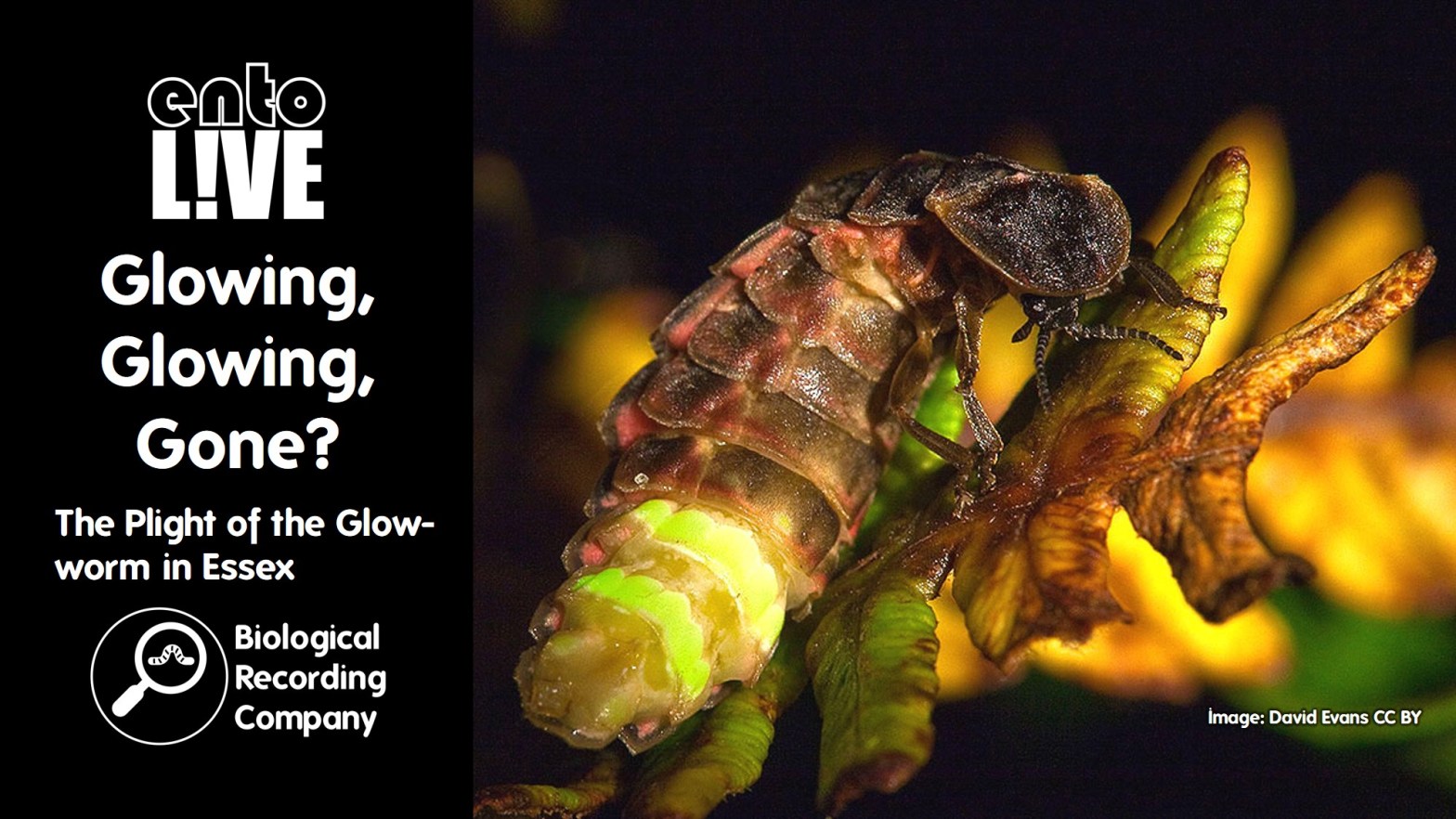
The glow-worm Lampyris noctiluca (Coleoptera: Lampyridae) is thought to be declining in the United Kingdom. Yet, much of the evidence for this is anecdotal, with a shortage of standardised long-term data to investigate temporal changes in abundance. A long-term transect study from Essex has produced statistical evidence of a decline (75%) in glow-worm abundance since 2001. There is a clear signal of climate warming and drying effects on glow-worm numbers and of local site changes due to a lack of active scrub management. Conservation strategies that mitigate local population losses could be an essential buffer against climate-driven declines in south-east England.
Q&A with Dr Tim Gardiner
Dr Tim Gardiner is a children’s author, ecologist, editor, essayist, poet, songwriter and storyteller. His scientific papers, poetry and prose have been published all over the world.
How widespread are glow worms in the UK?
They’ve been recorded in many places in the UK. As you go further north, populations become more isolated (possibly due to climate). However, there are old records from the Isle of Skye where people were seeing thousands. It’s on the west coast, so a bit milder there. You can check the distribution records on the Glow-worm (Lampyris noctiluca) NBN Atlas page. You can submit your records through the Glow-worm iRecord form. The thing with distribution maps is that they only show where the recorders are and an absence of records doesn’t necessarily mean that the species isn’t there. This is where people can make a real difference – we need more people looking in the places where there are gaps, seeing if they are there and submitting records.
What kinds of numbers would indicate a healthy and sustainable glow worm population?
If you’ve seen about 40, that’s a good population, but even 20 to 30 is a decent number. Whether that’s a viable population is another question. How big does a population need to be to be completely viable in the long term? It’s definitely double figures with at regular counts of numbers in the 30s and 40s. Counts in the 100s appear to be a thing of the past. Ideally, the individuals should also be spread out rather than concentrated in a small area, to reduce the risk of someone mowing the whole lot, unintentionally destroying the population. This is where corridor habitats are important.
How successful is Glow-worm translocation?
It really is too early to tell. I’m not aware of any post-release data, and there certainly hasn’t been enough time elapsed to get any long-term data. There was a site, in south Essex, where they were moving reptiles and they discovered larvae at the same time so they also moved the Glow-worm population. In this instance, the larvae were translocated because otherwise they too would have been doomed – it wasn’t planned and it was not part of scheme to seed an area with Glow-worms. This was at least successful for a few years and there are still some glow worms in that area, but we need the accurate scientific monitoring of these translocations to be certain they work and they don’t jeopardise the population you take insects from. The people doing the translocations need to not only monitor but also to publish their results. And we need to talk about failure as much as success.
Is it known how far males will fly?
They don’t seem to fly that far; they stay quite local. One idea is that male and female larvae aggregate in certain areas and then the males and females are all there together. It makes mating a bit easier. Again, more research is needed.
Literature References
- Gardiner & Didham (2020) Glowing, glowing, gone? Monitoring long-term trends in glow-worm numbers in south-east England: https://doi.org/10.1111/icad.12407
- Gardiner (2022) There Is a Light That Never Goes Out! Reversing the Glow-Worm’s Decline: https://doi.org/10.1016/B978-0-12-821139-7.00021-0
Further Info
- The UK Glow-worm Survey: https://www.glowworms.org.uk/
- Submit your records through the Glow-worm iRecord form: https://irecord.org.uk/enter-glow-worm-record
- Explore Glow-worm records on the NBN Atlas: https://species.nbnatlas.org/species/NBNSYS0000010994
- Reversing the Glow-Worm’s Decline article: https://www.notechmagazine.com/2021/04/reversing-the-glow-worms-decline.html
entoLIVE
entoLIVE webinars feature guest invertebrate researchers delving into their own invertebrate research. All events are free to attend and are suitable for adults of all abilities – a passion for invertebrates is all that’s required!
- Donate to entoLIVE: https://www.gofundme.com/f/entolive-2025
- Upcoming entoLIVE webinars: https://www.eventbrite.com/cc/entolive-webinars-74679
- entoLIVE blog: https://biologicalrecording.co.uk/category/entolive-blog/
- entoLIVE on YouTube: https://youtube.com/playlist?list=PLuEBNUcfMmE95Re19nMKQ3iX8ZFRFgUAg&feature=shared
entoLIVE is delivered by the Biological Recording Company in partnership with the British Entomological & Natural History Society, Royal Entomological Society and Amateur Entomologists’ Society, with support from Buglife.
The entoLIVE programme is delivered by Biological Recording Company and receives sponsorship from the following organisations:
- British Entomological & Natural History Society
- Royal Entomological Society
- Amateur Entomogists’ Society
Learn more about British wildlife

 Biological Recording