
Most of us are aware of the hive mind—the power of bees as an amazing collective. But do we know how uniquely intelligent bees are as individuals? Lars Chittka draws from decades of research, including his own pioneering work, to argue that bees have remarkable cognitive abilities. He shows that they are profoundly smart, have distinct personalities, can recognize flowers and human faces, exhibit basic emotions, count, use simple tools, solve problems, and learn by observing others. They may even possess consciousness. Chittka illustrates how bee brains are unparalleled in the animal kingdom in terms of how much sophisticated material is packed into their tiny nervous systems. He looks at their innate behaviours and the ways their evolution as foragers may have contributed to their keen spatial memory. Chittka also examines the psychological differences between bees and the ethical dilemmas that arise in conservation and laboratory settings because bees might feel and think.
Q&A with Prof Lars Chittka
Lars Chittka is the author of the book The Mind of a Bee and Professor of Sensory and Behavioural Ecology at Queen Mary College of the University of London. He is also the founder of the Research Centre for Psychology at Queen Mary. He is known for his work on the evolution of sensory systems and cognition using insect-flower interactions as a model system. Chittka has made fundamental contributions to our understanding of animal cognition and its impact on evolutionary fitness by studying bumblebees and honeybees.
Do solitary bees show the same navigational ability and memory as the eusocial bees?
The challenges of spatial navigation for both solitary bees and social bees are similar. They both have to navigate often long distances away from the nest and reliably return to the nest. However, with a honeybee in a colony of 60,000 individuals, if it gets lost, it will die but the colony can compensate for that because there are lots of other workers that can take over. With solitary bees, if they don’t find their back to their nest, their offspring is likely going to perish as well. So there’s additional pressure. Also, solitary bee nests are often more hidden than social bee nests so that increases the challenge. But we don’t know much about solitary bees. There is a world of unknown biology that we should explore more.
Is there any difference in the learning between queens, workers and drones?
Male bees are famously lazy. They do not contribute to any work in the colony so people are often quite ready to dismiss them. But their learning is actually not that bad, especially in bumblebees. Males do their own flower foraging and so they also remember flower colours. They are, in fact, no worse than workers in associating colours with rewards and we can also teach them to pull strings just like we can with the workers. Bumblebee queens are basically ‘janes of all trades’. They have to visit flowers, build nests, defend the brood, warm the brood, forage etc. Their brains are very large and they are also very smart learners.
Honeybees are a little different. Honeybee drones can’t feed themselves; they rely on the workers to get fed. So, they don’t have to learn about the flowers. But if they fail to find a queen to mate with, they need to return to the colony, so they need spatial learning. Their brains are actually quite large, in part because their visual systems are huge – they have very large eyes that facilitate the detection of queens. Honeybee queens, who also don’t have to visit flowers, have relatively smaller brains compared to workers in proportion to their body sizes.
How long does it take to train the bees in the experiments?
Some tasks are very simple, like getting them to associate an attractive scent or a colour with a reward. Often two or three trials are enough for the bees to remember them for hours or even, sometimes, for days. Tasks like string pulling can take hours or days to train them. Interestingly, often with these types of tasks, the fastest way for them to learn is to observe skilled conspecifics. In this case, they sometimes get it right after just a single observation (although in many cases it takes a few more). It also depends quite strongly on the individual. So, for any task were testing, we’re finding that there are quite pronounced variations between individuals.
Is there any evidence that the nectar robbing behaviour by bumblebees involves social learning?
Long spurred flowers typically require long probosces for bees to get to the nectar. But some of the shorter-tongued bumblebees will actually find a shortcut by biting a hole into the spur and extracting the nectar without pollinating the flowers. Darwin thought that this bee behaviour spread via social learning. The first person who investigated this experimentally was my former PhD student, Elli Leadbeater who found that by default, most bees will visit the flowers in the regular way, but once a single individual figures out how to nectar rob, this technique spreads quite quickly through the colony via social learning.
Are bees able to pass on negative information to the rest of the colony?
In bumblebees, we don’t know. In honeybees, the answer is yes. There are specific signals that tell the colony what kind of danger to look out for. There are also so-called ‘stop signals’ that have been investigated by James Nieh and colleagues, Bees have this famous dance language where they can advertise the coordinates, precise distances and direction of a food source to a colony. But if there is a predator present there, another bee will headbutt the dancing bees and give brief vibration pulses that function as a stop signal to interrupt the dancers’ communication to alert them to the predation threat.
Literature References
- Chittka (2023) The Mind of a Bee: https://press.princeton.edu/books/paperback/9780691253893/the-mind-of-a-bee
- Gallo and Chittka (2018) Cognitive Aspects of Comb-Building in the Honeybee?: https://www.frontiersin.org/journals/psychology/articles/10.3389/fpsyg.2018.00900/full
- Woodgate et al (2017) Continuous Radar Tracking Illustrates the Development of Multi-destination Routes of Bumblebees: https://www.nature.com/articles/s41598-017-17553-1
- Woodgate et al (2016) Life-Long Radar Tracking of Bumblebees: https://journals.plos.org/plosone/article?id=10.1371/journal.pone.0160333
- Alem et al (2016) Associative Mechanisms Allow for Social Learning and Cultural transmission of String Pulling in an Insect: https://journals.plos.org/plosbiology/article?id=10.1371/journal.pbio.1002564
- Loukola et al (2017) Bumblebees show cognitive flexibility by improving on an observed complex behavior: https://www.science.org/doi/full/10.1126/science.aag2360?casa_token=F9goXuRm8iQAAAAA%3AA3V4MFgAIeaJOsMqiVpxLvykIBuEgH5cN2Hc5hAaZTDxcqeOGFmsrCJrcN2AraE4pVdcyZ_rY3spHA
- Solvi et al (2020) Bumblebees display cross-model object recognition between visual and tactile senses: https://www.science.org/doi/full/10.1126/science.aay8064
- Dona et al (2022) Do bumblebees play?: https://www.sciencedirect.com/science/article/pii/S0003347222002366
- Ings & Chittka (2008) Speed-Accuracy Tradeoffs and False Alarms in Bee Responses to Cryptic Predators: https://www.cell.com/AJHG/fulltext/S0960-9822(08)01019-1
- Perry et al (2017) Studying emotion in invertebrates: what has been done, what can be measured and what they can provide): https://journals.biologists.com/jeb/article/220/21/3856/33729/Studying-emotion-in-invertebrates-what-has-been
- Maboudi et al (2017) Olfactory learning without the mushroom bodies: Spiking neural network models of the honeybee lateral antennal lobe tract reveal its capacities in odour memory tasks of varied complexities : https://journals.plos.org/ploscompbiol/article?id=10.1371/journal.pcbi.1005551
Further info
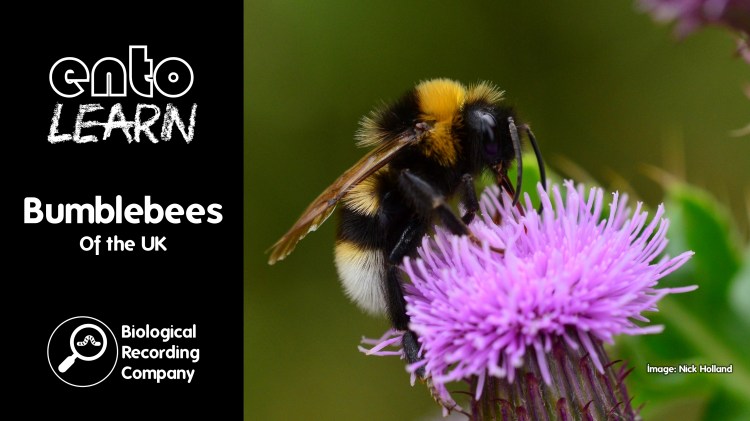
- Bumblebees of the UK online course: https://courses.biologicalrecording.co.uk/courses/bumblebees
entoLIVE
entoLIVE webinars feature guest invertebrate researchers delving into their own invertebrate research. All events are free to attend and are suitable for adults of all abilities – a passion for invertebrates is all that’s required!
- Donate to entoLIVE: https://www.gofundme.com/f/entolive-2025
- Upcoming entoLIVE webinars: https://www.eventbrite.com/cc/entolive-webinars-74679
- entoLIVE blog: https://biologicalrecording.co.uk/category/entolive-blog/
- entoLIVE on YouTube: https://youtube.com/playlist?list=PLuEBNUcfMmE95Re19nMKQ3iX8ZFRFgUAg&feature=shared
entoLIVE is delivered by the Biological Recording Company in partnership with the British Entomological & Natural History Society, Royal Entomological Society and Amateur Entomologists’ Society, with support from Buglife, Field Studies Council and National Biodiversity Network Trust.
The entoLIVE programme is delivered by Biological Recording Company and receives sponsorship from the following organisations:
- British Entomological & Natural History Society
- Royal Entomological Society
- Amateur Entomogists’ Society
More on bees
 Biological Recording