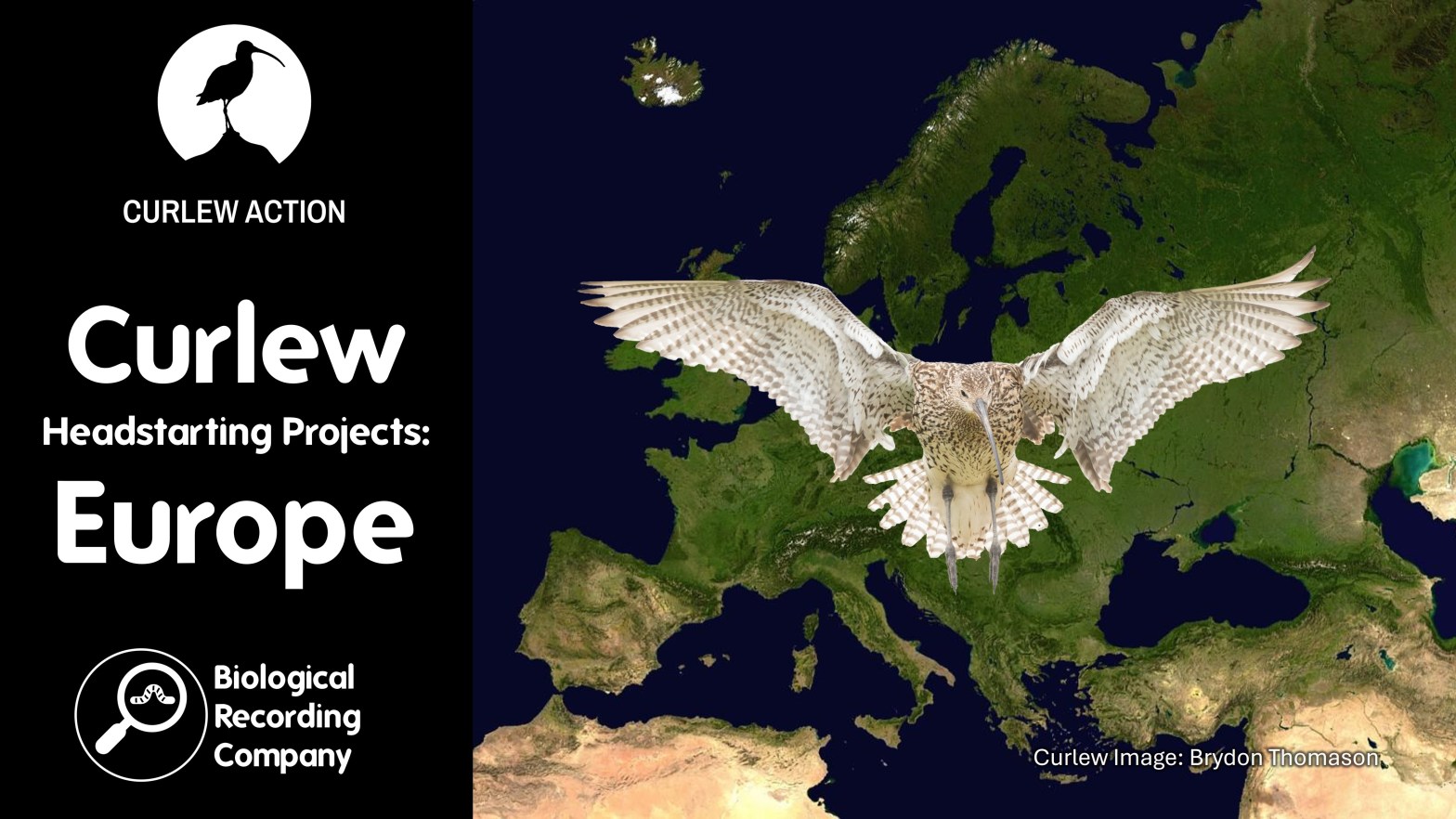
In this blog, conservationists will share their experiences and insights from headstarting projects across Europe. Presentations will cover local and national population trends, the motivations behind their initiatives, and the duration of these projects. Presentations will also showcase examples of indoor and outdoor facilities, address veterinary considerations, and provide updates on post-release monitoring and survival rates.
A Review of Curlew Headstarting Projects in Europe
Dr Sam Franks (British Trust for Ornithology)
Headstarting is now a commonly used tool in wader conservation, and over the last five years has become increasingly popular in efforts to conserve the Eurasian curlew, a wader species that has declined by 30-49% over the last 35 years in Europe. Here, Sam uses questionnaire and data request responses to review the reasons for, the methods used, and outcomes of eleven curlew headstarting projects from five European countries. Sam aims to provide an overview of current understanding and identify knowledge gaps to inform future headstarting projects.
Dr Samantha Franks’ interests focus on exploring how our changing environment is impacting threatened bird populations. She oversees BTO’s breeding wader research, with a particular focus on Curlew and working in partnership to develop evidence-based conservation management strategies for waders.
Further Info
Headstarting Curlews in Ireland
Donal Beagan (Breeding Waders EIP)
The Curlew Conservation Programme undertook a small scale pilot headstarting operation in a pre-planned and strategic manner back in 2022, in form of two pilot projects in counties Kerry and Monaghan. This presentation brings us up to speed with where headstarting is at in Ireland.
Donal Beagan is the Nest Protection and Headstarting Manager for Breeding Waders EIP, working on headstarting Curlew since 2022.
Further Info
- Curlew Conservation Programme
- Irish Curlew blog
- Breeding Waders EIP website
- Breeding Waders EIP Facebook (@Breeding-Waders-EIP-Project)
- Breeding Waders EIP Twitter (@BreedingWaders)
Headstarting Curlews in Flanders (Belgium)
Griet Nijs (Natuurpunt)
Curlew populations in Flanders are under great pressure. Only an estimated 170-230 bp currently remain and productivity is too low to sustain the local population. Since 2020, headstarting has been used to save nests that would otherwise be lost due to agricultural work, predation or weather conditions. This allowed a total of 20 young curlews to be released.
Griet Nijs works as an behavioural biologist for the nature conservation organisation Natuurpunt in Belgium where she studies the habitat requirements and breeding succes of the curlew in Flanders since 2020.
Further Info
- Curlew Conservation in Belgium: A Diary blog
- Reflections on Belgium Curlews blog
- Eurasian curlews (Numenius arquata, Scolopacidae) breeding in Flanders (Belgium) dataset
The Curlew Headstarting Programme of Tierpark Nordhorn (Germany)
Dr Heike Weber (Tierpark Nordhorn)
Tierpark Nordhorn zoo in Germany have a Curlew Headstarting Programme and this presentation will cover what they do, how their programme works, the problems they have experienced and the results to date.
Dr Heike Weber has been a zoo veterinarian and curator for more than 20 years in a small zoo in North West Germany, next to the border of the Netherlands, called Tierpark Nordhorn. The zoo hosts also a small rescue center for injured wildlife species as well as confiscated or located protected exotic species. One of the zoos conservation programs is the headstarting program of curlews for which they are also responsible.
Further Info
Headstarting Curlews in Poland
Przemysław Obłoza (Polish Society for the Protection of Birds)
The headstarting of the Eurasian Curlew started in Poland in 2014 as a response to the rapid decline in population. he program is carried out by cooperating non-governmental and governmental organizations. Over ten years, several hundred birds have been released. The effects of the program are becoming increasingly visible.
Przemek Obłoza is an employee of the Polish Society for the Protection of Birds and research coordinator in the Life project “Curlew in danger – protection of the Eurasian curlew Numenius arquata in Poland”. They are also a doctoral student at the University of Siedlce.
Further Info
- Curlew Conservation Plan
- Curlew In Danger project
- Reflections on Polish Curlews blog
- Curlew Conservation in Poland blog
- Polish Curlews with “UK wintering visa” blog
- Project LIFE Facebook
- Project LIFE X (formerly Twitter)
- Project LIFE Instagram
European Curlew Headstarting Online Workshop
This blog was produced as an output of the European Curlew Headstarting Online Workshop, a virtual event delivered by Curlew Action and the Biological Recording Company. Check out the other presentations and outputs in the other blogs resulting from this event.
- An Overview of Headstarting Curlews
- Curlew Headstarting Projects: Europe
- Curlew Headstarting Projects: England
- Curlew Headstarting: Eggs, Incubation and Hatching
- Curlew Headstarting: Rearing Chicks
- Curlew Headstarting: Health & Disease
- Curlew Headstarting: Releasing Birds
- Curlew Headstarting: Post-release Monitoring
For more information about this event, the speakers and the presentations see the event delegate pack below.
 Biological Recording