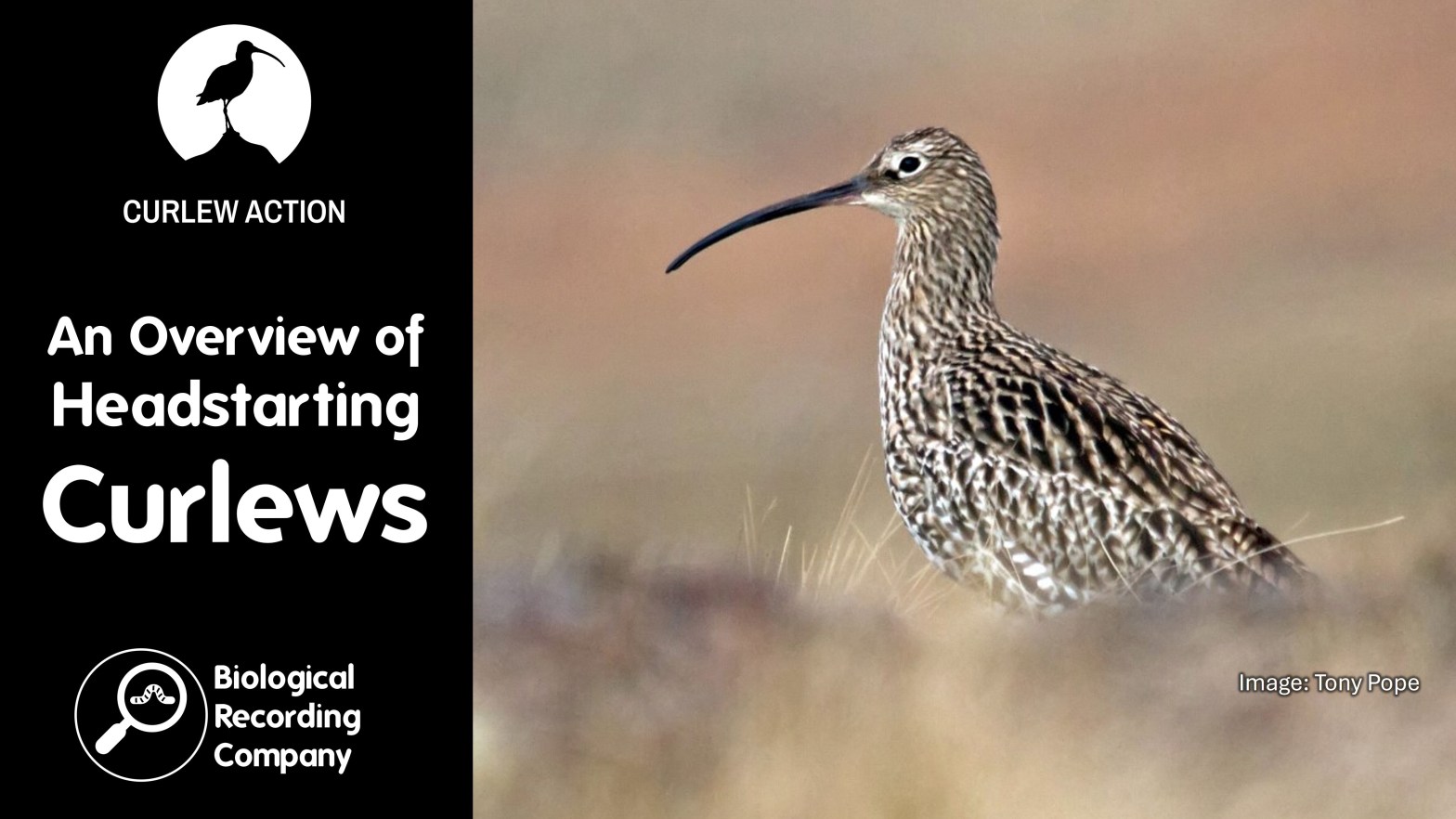
Headstarting is a crisis conservation technique for endangered species in which eggs are removed from areas in which they are unlikely to survive, reared in captivity and the young birds fledged back to the wild.
In February 2025, Curlew Action brought together conservationists and organisations from across Europe who are involved in headstarting the European Curlew to share knowledge and discuss the feasibility and best practices of curlew headstarting projects. This blog is the first of 8 that will disseminate the presentations and outputs from this 2-day virtual event.
Headstarting: The Big Picture
Dr Geoff Hilton (Wildfowl & Wetlands Trust)
Geoff puts curlew headstarting into context as a conservation intervention. What is the problem we are trying to solve with headstarting? Why is it a promising technique and what are its limits and constraints? What does all this tell us about when and where headstarting might be a sensible option for curlew conservation?
Dr Geoff Hilton is the Head of Conservation Evidence at WWT, the charity for wetlands. He has worked for 25 years on the science of threatened species recovery, and for the last six years has been involved in work to understand and Eurasian curlew declines and devise solutions.
Further Info
- Cook et al (2021) Temperature and density influence survival in a rapidly declining migratory shorebird
- Project Godwit
- Donaldson et al (2024) Headstarting boosts population of a threatened wader, the black-tailed godwit
- Donaldson, L. Nicol-Harper, A., Lee, R., Jarrett, N. & Hilton, G.M. (in review). When and why to give shorebirds a headstart. Conservation Biology. In review
- Curlew Recovery Partnership England
Headstarting as a Conservation Measure: Opportunity or Aberration?
Dr Helmut Kruckenberg (Institute for Wetlands and Waterbird Research, Germany)
Headstarting is a relatively new method used in species conservation. It is successfully used in reptiles and amphibia, but is this also useable for birds? This talk presents more questions than answers but gives an overview of the problems, as well as pros and cons.
Dr Helmut Kruckenberg is a biologist and Head of Institute for Wetlands and Waterbird Research.
Further Info
- Institute for Wetlands and Waterbird Research
- Institute for Wetlands and Waterbird Research Facebook
- Tracking Germany’s curlews
Headstarting in the UK: Licensing and Restrictions
Richard Saunders and Graham Irving (Natural England)
All wild birds, their eggs and nests are protected in the UK. Therefore, all headstarting projects require a licence. This presentation shows how licence applications for headstarting projects are assessed and describes the different types of headstarting project. It then focusses on one bird licensing issue – air safety. A change in approach has been used to the Curlew’s advantage. Through headstarting and translocation, hundreds of Curlew eggs and chicks have been rescued from sites where the birds were at risk. Is this situation unique to England, or might such opportunities exist elsewhere in Europe?
Richard Saunders is a Senior Ornithologist at Natural England, leading on Curlew and Avian Reintroductions for Natural England’s Birds Team.
Graham Irving is a Senior Advisor in the licensing team within Natural England. He liaises with the airbases and collects the curlew eggs in a portable incubator and delivers them to Pensthorpe.
Further Info
- Reintroductions and conservation translocations in England: code, guidance and forms
- Natural England announces new project to protect curlew eggs
Headstarting: WWT Perspective, Feasibility and Justification
Nigel Jarrett (Wildfowl & Wetlands Trust)
Nigel Jarrett will explain why he thinks headstarting is a justifiable and feasible conservation intervention that could help halt/reverse the decline of Curlew in southern England if the causes underlying the species’ declines are absent or controlled. He will touch on the costs of headstarting – it’s an expensive undertaking, as are many species conservation interventions.
Nigel Jarrett is WWT’s Conservation Breeding Manager. He has been involved in Curlew headstarting projects on Dartmoor and in the Severn and Avon Vales, as wel as headstarting projects for the Black-tailed Godwit and Spoon-billed Sandpiper. He has also worked on the reintroduction of the Madagascar Pochard. Eurasian Cranes translocations of the Layan Teal from Laysan Island to Midway Atoll in the Pacific Ocean and McQueen’s bustard in the UAE.
Further Info
- Wildfowl and Wetlands Trust
- Best Practice Guidelines for Conservation Translocations in Scotland
- AEWA Conservation Guidelines No. 13: Guidelines for the Translocation of Waterbirds for Conservation Purposes: Complementing the IUCN Guidelines
- Reintroductions and other conservation translocations: code and guidance for England
- IUCN Guidelines for Reintroductions and Other Conservation Translocations
- Curlew LIFE: Saving the call of the Curlew (December 2024)
- The Curlew Forum: Saving England’s lowland Eurasian Curlews (British Birds 2020 Vol.113: Pages 279–292)
- The Great Crane Project, (Damon Bridge, RSPB)
- Reintroducing common cranes (WWT)
- Donaldson et al (2024) Headstarting boosts population of a threatened wader, the black-tailed godwit
- WWT Eurasian Curlew Recovery
European Curlew Headstarting Online Workshop
This blog was produced as an output of the European Curlew Headstarting Online Workshop, a virtual event delivered by Curlew Action and the Biological Recording Company. Check out the other presentations and outputs in the other blogs resulting from this event.
- An Overview of Headstarting Curlews
- Curlew Headstarting Projects: Europe
- Curlew Headstarting Projects: England
- Curlew Headstarting: Eggs, Incubation and Hatching
- Curlew Headstarting: Rearing Chicks
- Curlew Headstarting: Health & Disease
- Curlew Headstarting: Releasing Birds
- Curlew Headstarting: Post-release Monitoring
For more information about this event, the speakers and the presentations see the event delegate pack below.
 Biological Recording