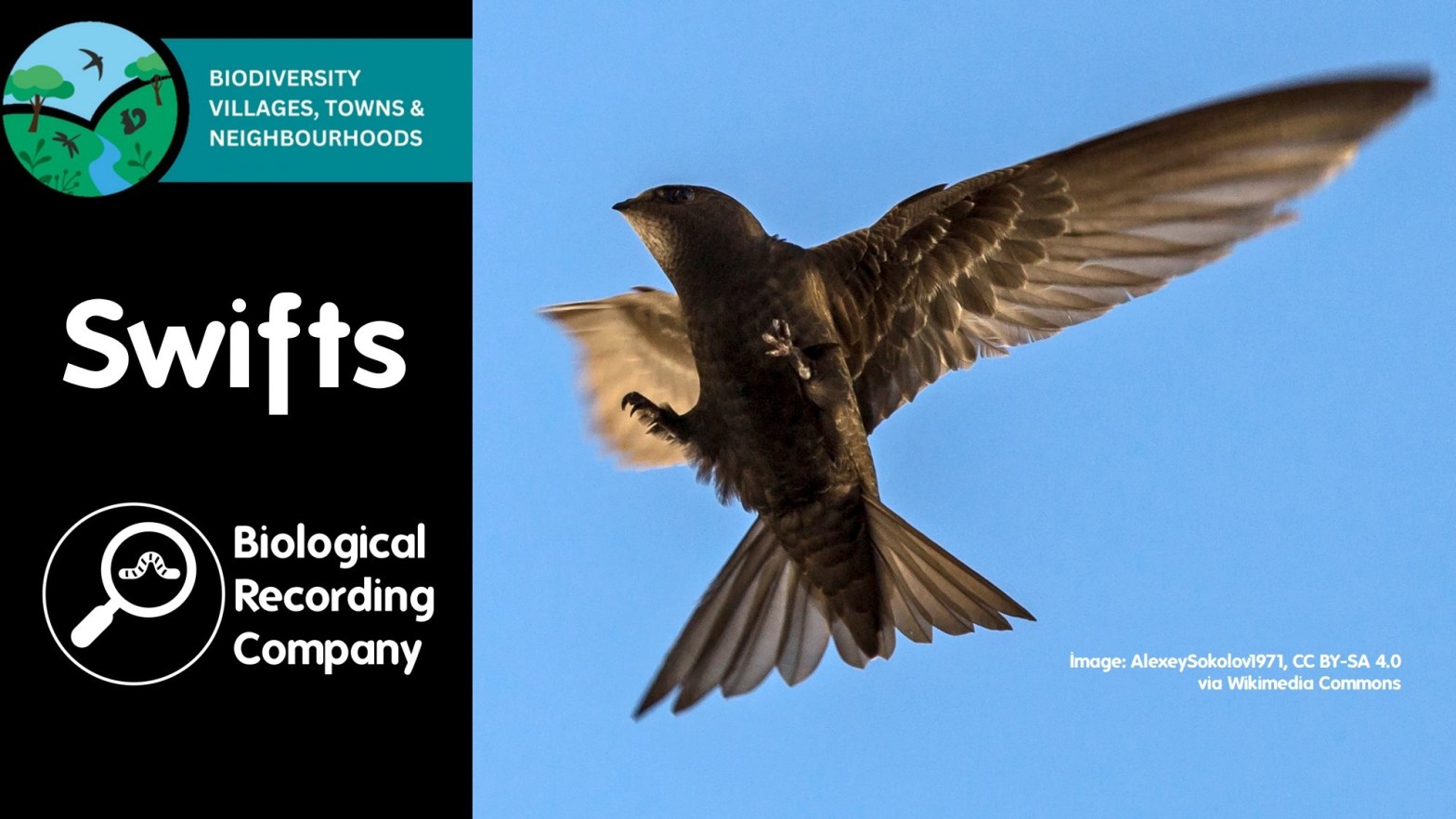
Though Swifts only spend 3 or 4 months each Summer with us, while they are here they bring spectacular aerial action and excitement to our urban lives! Swifts rely on buildings for nesting sites, but post-1945 buildings are often unsuitable because the techniques and materials used in modern buildings (and refurbished buildings) deny Swifts access to breed. Add in the fact that insects are declining, and our Swifts are faced with threats to both their food source and nesting sites.
This blog features presentations from two Swift specialists, that will explore the biology and ecology of these fascinating birds, before highlighting the threats that our Swifts face and what we can do to help them.
Swifts and their Ecology
Edward Mayer (Swift Conservation)
The Common Swift (Apus apus) is an impressive bird that migrates to and from Africa each year, can fly up to 69 miles per hour and does almost everything while flying – sleep, eat, bathe and mate. This presentation explores their biology, ecological role and behaviour. We’ll also delve into their spectacular migratory journey across vast distances and discuss their seasonal strategies, including migration and breeding, providing insight into how these unique birds interact with the temperate and tropical environments and contribute to the UK’s biodiverse ecosystem.
Swift Threats and Conservation
Cally Smith (Huntly Swift Group – NES Swifts)
Between 1995 and 2016 we lost over half of all the Swifts breeding in the United Kingdom. Our swifts are under threat from both declining insect populations (aka Swift food) and a loss of nesting sites due to changes in how we seal up buildings during construction and refurbishment. Cally will take us through the threats that our Swifts face and what we can all do to provide nesting opportunities in our homes, community buildings and workplaces.
Q&A with Edward Mayer and Cally Smith
Edward Mayer first became fascinated by Swifts at the age of six when he saw these amazing birds flying above his home in Southampton. He has been in love with them ever since. In 2003 he pioneered an approach to preserving the future of the Common Swift through advice, talks and the encouragement of widespread volunteer action. He studied the efforts of Swift experts in Germany and began his work by creating “London’s Swifts” an internet-based advice service focusing on how to preserve existing nest sites and create new provisions. It was such a success that the Royal Society for the Protection of Birds asked him to make it a national service and “Swift Conservation” was born. It soon started to receive appeals for help from enthusiasts in Europe, so Edward widened its scope to cover Europe too.
Cally Smith set up the Huntly Swift Group – NES Swifts in 2017 to address the decline in Common Swift numbers. The group’s activities include engaging local communities, school visits, conducting Swift surveys and advising both local authorities and local builders.
What do Swifts do at night?
Edward: They fly at night, we still do not know if they sleep like we do, go into a sort of automatic-pilot guided trance, or stay partly or mostly awake. So far it has been impossible to put an ecephalograph onto a Swift’s head to record its electrical brain activity, but we expect to be able to do something like that quite soon. Studies with radar have shown that Swifts ascend at dusk and descend again at dawn, and spend much of the night in flocks high in the sky. Studies in Holland have shown that they can descend at night to feed on swarms of insects over freshwater bodies illuminated by moonlight. But that is pretty much all we know so far.
What insects do Swifts eat?
Edward: Briefly, anything without a sting that they can get into their beak. Typical prey items include aphids, gnats, mosquitos, small beetles, hoverflies, flies, flying ants, and mayflies. They are opportunistic feeders and go for everything flying that is available, wherever it is accessible above ground level, even up to several thousand feet up.
What can we do to help Swifts apart from installing swift boxes?
Cally: There are a number of things that we can all do:
- Survey your own patch in June and July, August and find active swift nest sites. These are precious colonies (however small) which must be protected.
- Lodge your findings (check and record where YOUR local planning authority accesses environmental records so they flag up in local planning applications) Note of explanation, if i may: Sadly, not all building repairs will go through the planning process, they may be private upgrades (a man and a ladder), in which case you have a very difficult time of preventing losses once the homeowner has paid for and erected scaffolding and you realise there is a problem unless it is in the breeding season in which case you contact the WCO losing on the popularity stakes but maybe saving a colony!!!! Otherwise, your Planners should be an important ally, so RECORD.
- Keep a vigilant watch for threats to known colonies.
Do droppings cause an issue where Swift boxes are installed?
Cally: Not if used only by swifts as they consume their own droppings inside the nesting site and they don’t sit at the nest entrance and poop! IF the box/brick is used by other species there may be some dropping (publish that if you want to!) It is relatively easy to follow guidelines for siting boxes and still avoid directly over walkways etc if it’s a concern. Personally, unless I am reinstating an active nest site like for like I would nearly always install nest boxes on the side or rear of a building for aesthetic reasons (following guidelines of course for exposure).
Are there any specific Swift bricks that you recommend?
Edward: The Action for Swifts and Ibstock Swift bricks, both designed by Swift experts, both made here in the UK, and both with good records of success.
Cally: OMG too tricky!! One size does NOT fit all. Action for Swifts S Brick – great for brick/stone builds and retrofits. The Vivara Pro/ Schwegler (and similar) is good for block-built new builds or rendered situations. Action for Swifts’ half brick entrance piece is great for bespoke situations.
What is the one recommendation that you’d make to anyone who wants to help Swifts?
Cally: Survey and record Swifts in order to protect long-standing colonies! It’s important that sitings of Swifts are fed into the system so check with your local swift group or Local Environmental Record Centre to find out the best way to record Swifts locally so that records will be considered within the planning process.
Edward: Learn all you can about them and talk about them and the wild world in general to your friends, neighbours and colleagues. The great problem with wildlife conservation is people’s ignorance. Apart from enthusiasts, people seem to see wildlife as an optional extra, nice but not essential, fun to watch on TV but otherwise not so important, just a bit sad to see it all dying out, and they think that “nature” is something that can be stuck on a “reserve” and left to get on with it, job done, rather than the essential ingredient for our continued existence here on this planet. Yes, in theory, one could live in a sterile pod on Mars and eat synthetic food for the rest of one’s days, but one would soon go stark-staring mad and probably have to be drugged up to the eyeballs to keep one from suicide. And it’s the wild world that effectively produces the air and water and conditions for growing the food that we need to live. No wildlife = realistically, no humanity.
Useful links
- Swift Conservation: https://www.swift-conservation.org/
- Swift leaflets: https://www.swift-conservation.org/OurLeaflets.htm
- Local Swift Groups: https://www.swift-conservation.org/Local_Swift_Groups.htm
- Tayside Swift projects: https://www.taysidebiodiversity.co.uk/get-involved/projects/projects-swifts/
- Huntly Swift Group – NES Swifts: https://www.facebook.com/savetheaviators/
Recording Swifts
- Swift Mapper: https://www.swiftmapper.org.uk/
- BirdTrack: www.bto.org/birdtrack
- Find your Local Environmental Record Centre: https://www.alerc.org.uk/lerc-finder.html
Swift Nest Boxes
- Swift Conservation: https://www.swift-conservation.org/Shopping!.htm
- Action For Swifts: https://www.actionforswifts.com/
- Impeckable Nest Boxes: https://www.impeckable.co.uk/index.php/shop-online
- Peak Boxes https://www.peakboxes.co.uk/
- Jacobi Jayne: www.jacobijayne.com
- CJ Wildlife: https://www.birdfood.co.uk/nest-boxes/nest-boxes-for-house-martins-swifts-and-swallows
- NHBS: https://www.nhbs.com/4/swift
Event Partners
This blog was produced by the by the Biological Recording Company as part of the Tayside Biodiversity Partnership Biodiversity Towns, Villages and Neighbourhoods project.

Learn more about British wildlife
 Biological Recording
Edward Mayer gace an excellent presentation and isn an inspirational speaker
LikeLike