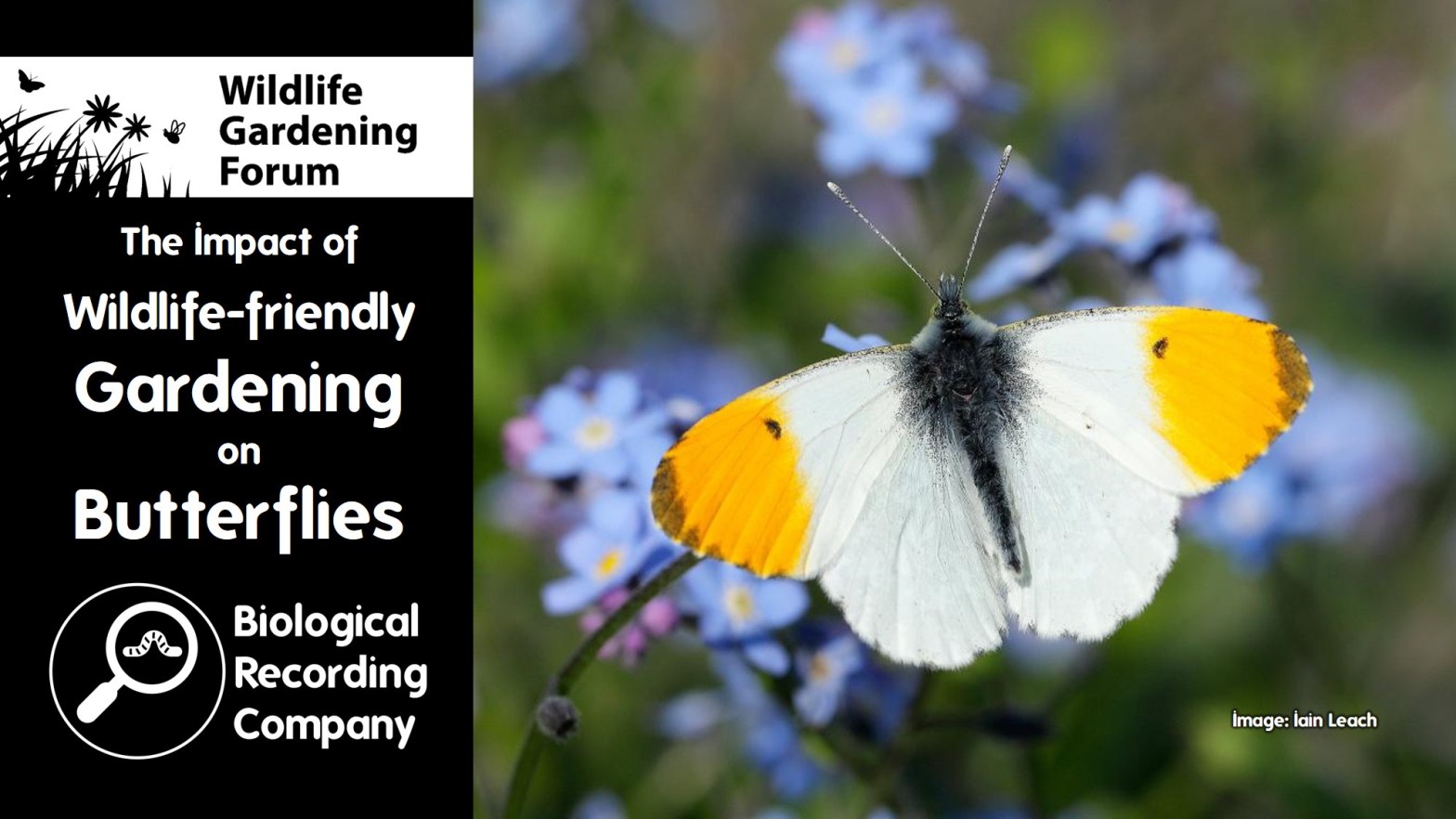
Much advice and information is available on gardening for butterflies yet very little of it is evidence-based. This talk will present recent research by Butterfly Conservation showing the impacts on butterfly abundance and species richness of two commonly recommended wildlife-gardening practices: leaving the grass to grow long and having flowering ivy.
Q&A with Dr Richard Fox
Dr Richard Fox has led Butterfly Conservation’s work on recording changes to the UK’s butterfly and moth populations for over 25 years. Having published 80 scientific papers and contributed to many television and radio programmes, Richard has in-depth knowledge coupled with a passion for communicating his fascination for these iconic insects.
Did you use data from other sources in your research?
This piece of research was only based on species sightings from Butterfly Conservation’s Garden Butterfly Survey. Butterfly Conservation, of course, runs many other schemes which provide vital data to support conservation work and ecological research. We’ve previously shown scientifically that the data from our Big Butterfly Count (aimed at anyone and everyone) shows very similar trends to the UK Butterfly Monitoring Scheme (undertaken by more experienced butterfly recorders). Butterfly sightings are also gathered by other organisations and scheme and we try to make sure that these data are all linked up. BTO, for example, gather butterfly data as part of Garden Birdwatch and have used these data to carry out research on how butterflies are faring in gardens.
What can we do to encourage more butterflies and other pollinators into our gardens?
There’s lot of advice out there for encouraging more butterflies and moths into your garden but for both groups, the important thing is to make sure you are creating breeding habitat by providing food for caterpillars. The decline of butterflies and moths in the UK is driven by the loss of breeding habitat so anything you can do to get moths and butterflies breeding in your garden is beneficial. The simplest things to do are not to be too tidy in your garden – neatness is the enemy of nature. As highlighted in my talk, letting some grass grow long and allowing ivy to flower are both proven to benefit butterflies. Planting native shrubs will provide homes for many moths, such as micro-moths whose caterpillars mine the leaves of Hawthorn, Hazel, willows and Field Maple, and Brimstone butterflies will lay their eggs on buckthorns. Not using pesticides is another obvious step that will help garden wildlife from butterflies to hedgehogs.
Is a more diverse selection of plants better than having a lot of one type of plant?
Many butterfly and moth species are very particular at the caterpillar stage. So while the adult insects will drink nectar from lots of different flowers, their caterpillars will only feed on specific parts of specific plants. So, diversity is going to be the best thing, especially with native plants. This means encouraging herbaceous plants by letting “weeds” grow in your long grass and planting native shrubs and trees, which you can always keep relatively small by pruning, if you are short of space.
What is the ideal mowing regime for a wildlife-friendly garden lawn?
We don’t have any scientific data on this from our study, but in order to create suitable breeding habitat for butterflies, moths and other wildlife by letting the grass grow long then at least some long grass should be present throughout the year. This is because many insects will still be present and some still active during the winter among the long grass. Indeed, some common butterfly caterpillars, such as Meadow Brown, will continue to feed on long grass through the winter. So, cutting all of the long grass in your garden at once is likely to be harmful for wildlife whatever time of year you do it. On the other hand, of course, long grass does need to be cut from time to time, otherwise it will transition into scrub (e.g. brambles) and ultimately woodland. I’d recommend cutting half of your long grass each autumn and leaving the other half, so that each part gets cut once every two years. You may need to tweak this depending on your local conditions, but always make sure there is some long grass left as a refuge at all times. Also, always remove the cuttings (to reduce soil fertility) although, if possible, leave them for a day or two so that any seeds can fall and any invertebrates can escape.
Literature References
- Hordley and Fox (2024) Wildlife-friendly garden practices increase butterfly abundance and species richness in urban and arable landscapes: https://doi.org/10.1016/j.scitotenv.2024.171503
- Gaston et al (2005) Urban domestic gardens (II): experimental tests of methods for increasing biodiversity: https://link.springer.com/article/10.1007/s10531-004-6066-x
Further info and links
- UK Butterfly Indicator: https://www.gov.uk/government/statistics/butterflies-in-the-wider-countryside-uk/butterflies-in-the-united-kingdom-habitat-specialists-and-species-of-the-wider-countryside-1976-to-2021
- State of the UK’s Butterflies entoLIVE blog: https://biologicalrecording.co.uk/2023/11/27/state-uk-butterflies/
- Garden Butterfly Survey: https://gardenbutterflysurvey.org/
- Garden Butterfly Survey results: https://butterfly-conservation.org/news-and-blog/boost-garden-butterfly-numbers-by-up-to-93-with-one-simple-step-new-study-reveals
- Wild Spaces https://wild-spaces.co.uk/
Learn more about British wildlife

 Biological Recording
One thought on “The Impact of Wildlife-friendly Gardening on Butterflies”