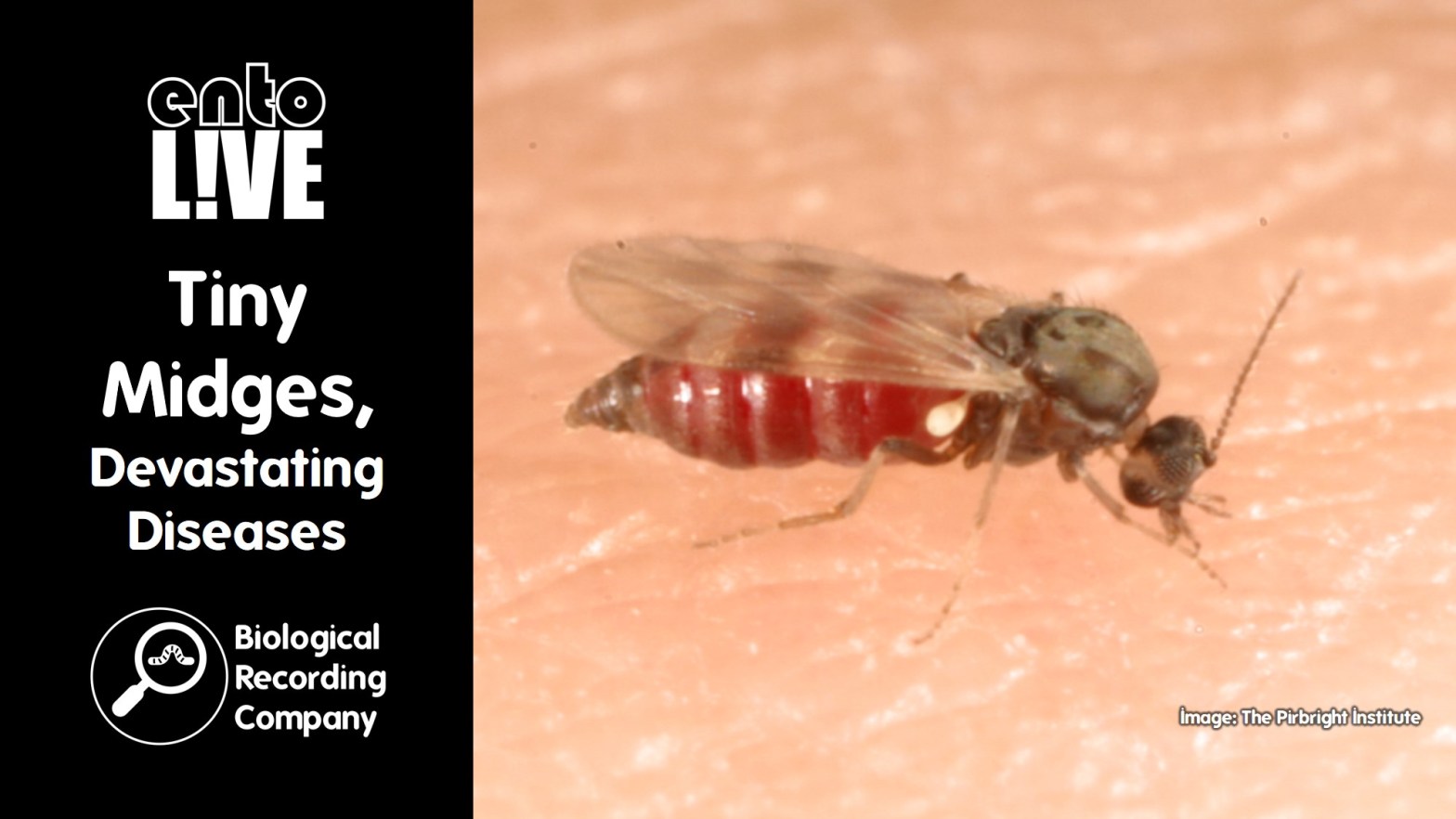
Some biting midges are able to transmit viruses that cause diseases in animals, particularly livestock. This talk will describe the ecology of these midges and how we can identify them. We will focus on the UK and northern Europe and explain how these areas are affected by the diseases carried by biting midges, and how these threats have increased in the last couple of decades.
Q&A with Dr Marion England
Dr Marion England is research fellow in Vector Ecology at The Pirbright Institute. Her research focuses on understanding the ecology of disease vectors, particularly biting midges, and how global change will impact arboviral threats. She leads the UK Culicoides Reference Laboratory which conducts surveillance of midges across the UK.
Does BTV infect any wild mammals found in the UK??
We assume deer in the UK are susceptible. We assume that they will become infected with BTV but we are not sure if they will be clinically affected. It may be that they will be totally fine and get over the virus in a short space of time, and we won’t see any disease. I’m more worried about epizootic haemorrhagic disease virus (EHDV) and what that could do to our deer. Potentially, however, our deer may be part of the BTV transmission cycle in the UK, so when deer populations are moving between farmed areas and woodlands, they could be helping to transmit the virus. The virus only affects ruminants so it’s very unlikely anything else would be affected.
What is the approximate cost of vaccine per animal?
In terms of the costs, it’s a few pounds per shot. It is a cost that farmers may struggle to meet depending on their herd/flock size.
The double doses are administered about four weeks apart. The vaccines are approved for use under emergency licence. The vaccines have not been in use for long enough to see how long immunity lasts, whether it’s six months, a year or longer. Its likely an annual booster will be required but we don’t have that information yet.
Do the midges have any predators?
These are native midges and birds and bats do eat them. However, they don’t make any real impact on midge populations because they are so numerous. In terms of biological controls, hitting them at the larval stage within the soil might be more effective. I am starting to look at the soil community that the midge larvae live in. They spend 90% of their life in the soil. Its understanding what other soil invertebrates might be predating them I think would be really interesting.
How many reproduction cycles does a female go through?
Probably two or three. The first time she takes a blood meal, she can acquire the virus and then lays an egg batch. As far as we know, the virus doesn’t transmit to the eggs/larvae. If females only went through this cycle once, we wouldn’t get any disease transmission. Based on this, we think two or three egg cycles but some will not survive that long.
Can transport of midges on aeroplanes explain outbreaks in new areas that can’t be explained by wind translocation?
BTV has popped up in the Netherlands twice in an area very close to Schiphol Airport, a massive international hub. The Netherlands is also a massive international shipping hub. A lot of products come into the Netherlands from across the world and then get dispatched across Europe. So midges can be on aeroplanes, however, there are questions around the cut-flower industry. Cut flowers are grown in places like Kenya, where BTV is endemic. If midges are resting in those cut flowers or on soils in pot plants, they could be transported to Europe in a chilled humid environment. In these cooler environments, their development slows down – they may go into a sort of stasis. When they arrive at their destination, if conditions are suitable they may survive and disperse.
Literature References
- Nelson et al (2022) A Qualitative Risk Assessment for Bluetongue Disease and African Horse Sickness: The Risk of Entry and Exposure at a UK Zoo: https://www.mdpi.com/1999-4915/14/3/502
- Holwerda et al (2024) Emergence of Bluetongue Virus Serotype 3, the Netherlands, September 2023: https://pmc.ncbi.nlm.nih.gov/articles/PMC11286052/
- Boender et al (2024) Spatial Transmission Characteristics of the Bluetongue Virus Serotype 3 Epidemic in The Netherlands, 2023: https://www.mdpi.com/1999-4915/16/4/625
Further Info
- The Pirbright Institute: https://www.pirbright.ac.uk/
- Bluetongue: news, information and guidance for livestock keepers: https://www.gov.uk/government/collections/bluetongue-information-and-guidance-for-livestock-keepers
- Vector Ecology Research Group https://www.pirbright.ac.uk/our-science/research-groups/vector-ecology
entoLIVE
entoLIVE webinars feature guest invertebrate researchers delving into their own invertebrate research. All events are free to attend and are suitable for adults of all abilities – a passion for invertebrates is all that’s required!
- Donate to entoLIVE: https://www.gofundme.com/f/entolive-2025
- Upcoming entoLIVE webinars: https://www.eventbrite.com/cc/entolive-webinars-74679
- entoLIVE blog: https://biologicalrecording.co.uk/category/entolive-blog/
- entoLIVE on YouTube: https://youtube.com/playlist?list=PLuEBNUcfMmE95Re19nMKQ3iX8ZFRFgUAg&feature=shared
entoLIVE is delivered by the Biological Recording Company in partnership with the British Entomological & Natural History Society, Royal Entomological Society and Amateur Entomologists’ Society, with support from Buglife, Field Studies Council and National Biodiversity Network Trust.
The entoLIVE programme is delivered by Biological Recording Company and receives sponsorship from the following organisations:
- British Entomological & Natural History Society
- Royal Entomological Society
- Amateur Entomogists’ Society
More on invertebrates
 Biological Recording