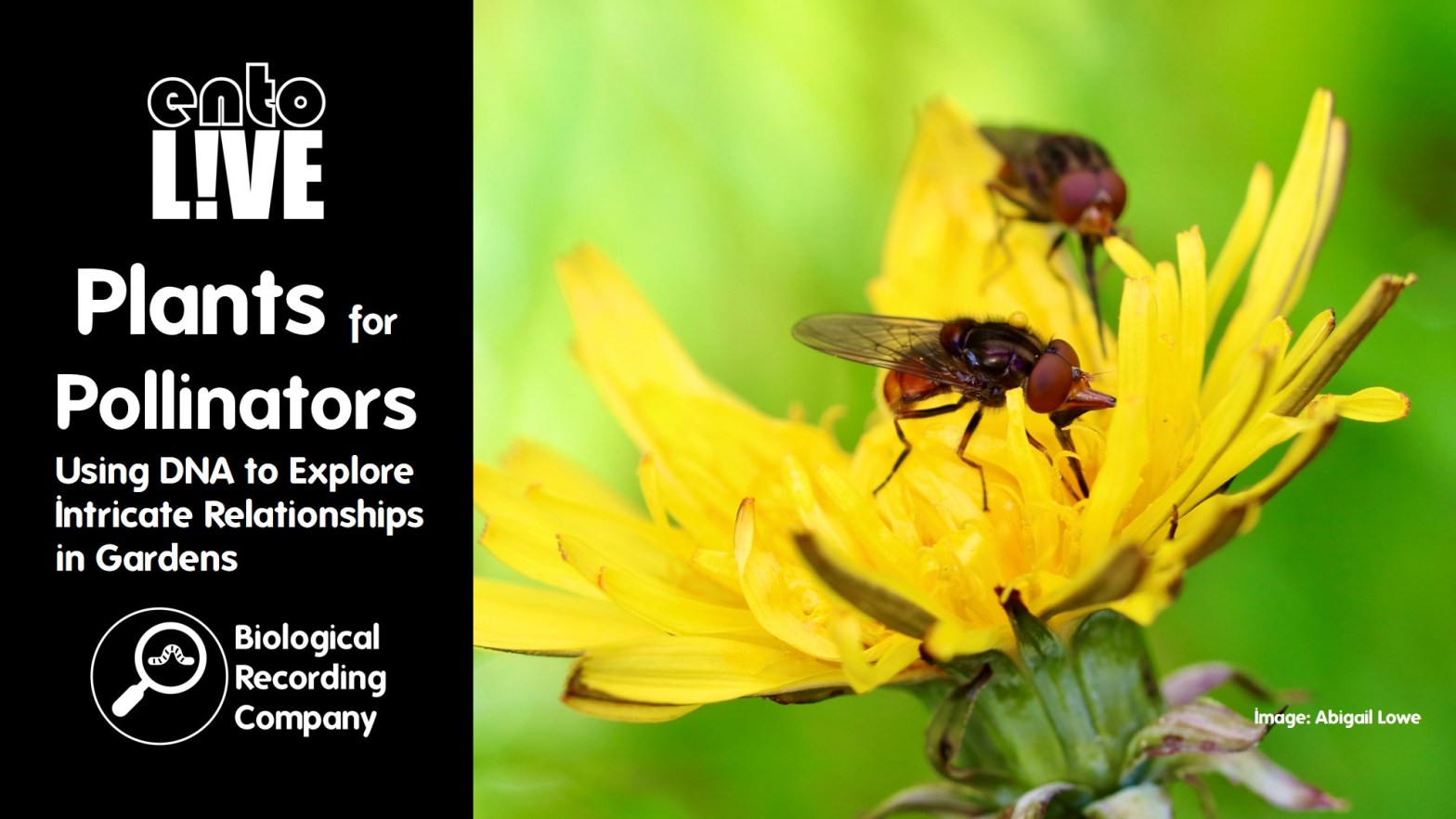
Many “plants for pollinators” recommendation lists exist; however they often rely on anecdotal evidence, show inconsistencies between lists, and cater to a limited range of pollinators. To effectively support pollinators in gardens throughout the year, a deeper understanding of foraging behaviour is crucial. In this talk, Dr Abigail Lowe takes us through her PhD research, which used DNA techniques to identify pollen collected by hoverflies, bumblebees, honeybees and solitary bees. Explore the similarities and differences in foraging behaviour within each group, and observe whether these patterns changed over two years. Discover whether native or non-native plants were preferred, and gain insights into how we can improve our gardens to provide support for these important insects.
Q&A with Dr Abigail Lowe
Dr Abigail Lowe is an Interdisciplinary Ecologist within the Biological Records Centre at the UK Centre for Ecology and Hydrology. Her research uses citizen science to understand the interaction of people, nature, and environmental data.
Is there one plant that you would recommend planting for pollinators?
I really don’t think there is one plant! However, one plant that gardeners don’t want to hear about and IS really important is bramble. Bramble often comes up in research as being great for pollinators, but obviously not a lot of people want their gardens to be full of bramble. The most important thing is making sure that you have plants in your garden from the beginning of the season right to the end. If you live in a warmer area, such as southern England, you want to make sure there is something in your garden in winter like Mahonia for bumblebees that are active through winter. Generally, make sure there’s a diversity of plants in your garden with different shapes and colours.
What percentage or proportion of pollinators are actually bees compared to all the other pollinators?
There are about 280 species of bees in the UK and 6,000 species of pollinating insects, so the proportion of pollinators that are bees is not as large as many people would imagine based on how pollinators and bees are often synonymous in the media. However, not all pollinating insects are equal in terms of their ability to pollinate. How effective a pollinator is will depend on lots of factors, and will vary depending on the plant species being pollinated.
What is a near native plant?
With DNA, we can’t always get to species, so if we have a genus that appears in the DNA results that includes native and horticultural species, we classify it as near native – for example Quercus (oak) species can be native or non-native. Horticultural plants are genera or species that are very obviously introduced.
How do you know that your research is detecting species diversity rather than pollen abundance levels?
That’s a really good point and the technique is not perfect and has biological limitations. You’re right in that a pollinator could visit a plant and be completely covered in the one particular pollen. It is something that we acknowledge might be the case but we hope that by sampling lots of individuals throughout the year and at different times of the day, it does reduce that impact a little bit. The research shows that the same plants come up time and time again, no matter the method used, plus the meta barcoding approach that we used is found to be semi-quantitative, so we assume that the abundance of pollen in the DNA is related to the actual abundance on the bodies of insects.
We do acknowledge that we don’t know how long the pollen has been on the insect’s body. We don’t know what sort of record that is – is it from the last hour, is it for a few hours? Bees will take their pollen back to feed their young and hoverflies will routinely clean themselves, so that’s another question really. The ultimate answer to any of these questions is that the more that you research, there are more questions to be asked.
What is the big research question that you think has come out in the work that you’ve done?
This might be a cop out answer, but the contribution to knowledge on individual specialisation. Not a lot of people are looking at individual specialisation and this research has bigger impacts. For instance, if insects are specialised, they are more likely to be vulnerable to environmental change, so there are big network theory questions around that. When we use observational methods to look at which plants are being used by pollinators, it’s actually quite hard to track an individual bumblebee around the landscape, whereas DNA meta barcoding can get you that broader spatial and temporal resolution which is what enabled the individual specialisation research.
Literature References
- Lowe et al (2022): Using DNA Metabarcoding to Identify Floral Visitation by Pollinators: https://www.mdpi.com/1424-2818/14/4/236
- Lowe et al (2022) Seasonal progression and differences in major floral resource use by bees and hoverflies in a diverse horticultural and agricultural landscape revealed by DNA metabarcoding: https://besjournals.onlinelibrary.wiley.com/doi/full/10.1111/1365-2664.14144
- Lowe et al (2022) Temporal change in floral availability leads to periods of resource limitation and affects diet specificity in a generalist pollinator: https://onlinelibrary.wiley.com/doi/full/10.1111/mec.16719
- Powney et al (2019) Widespread losses of pollinating insects in Britain: https://www.nature.com/articles/s41467-019-08974-9
Further Info
- Seasonal progression and differences in major floral resource use by bees and hoverflies in a diverse horticultural and agricultural landscape revealed by DNA metabarcoding paper summary: https://appliedecologistsblog.com/2022/04/28/seasonal-progression-and-differences-in-major-floral-resource-use-by-bees-and-hoverflies-in-a-diverse-horticultural-and-agricultural-landscape-revealed-by-dna-metabarcoding/
- Saving Pollinators Assurance Scheme https://botanicgarden.wales/our-work/research/saving-pollinators/saving-pollinators-assurance-scheme/
- Global honey bee data: http://www.fao.org/faostat/en/
entoLIVE
entoLIVE webinars feature guest invertebrate researchers delving into their own invertebrate research. All events are free to attend and are suitable for adults of all abilities – a passion for invertebrates is all that’s required!
- Donate to entoLIVE: https://www.gofundme.com/f/entolive-2025
- Upcoming entoLIVE webinars: https://www.eventbrite.com/cc/entolive-webinars-74679
- entoLIVE blog: https://biologicalrecording.co.uk/category/entolive-blog/
- entoLIVE on YouTube: https://youtube.com/playlist?list=PLuEBNUcfMmE95Re19nMKQ3iX8ZFRFgUAg&feature=shared
entoLIVE is delivered by the Biological Recording Company in partnership with the British Entomological & Natural History Society, Royal Entomological Society and Amateur Entomologists’ Society, with support from Buglife, Field Studies Council and National Biodiversity Network Trust.
The entoLIVE programme is delivered by Biological Recording Company and receives sponsorship from the following organisations:
- British Entomological & Natural History Society
- Royal Entomological Society
- Amateur Entomogists’ Society
More on citizen science

 Biological Recording
4 thoughts on “Plants for Pollinators: Using DNA to Explore Relationships in Gardens”