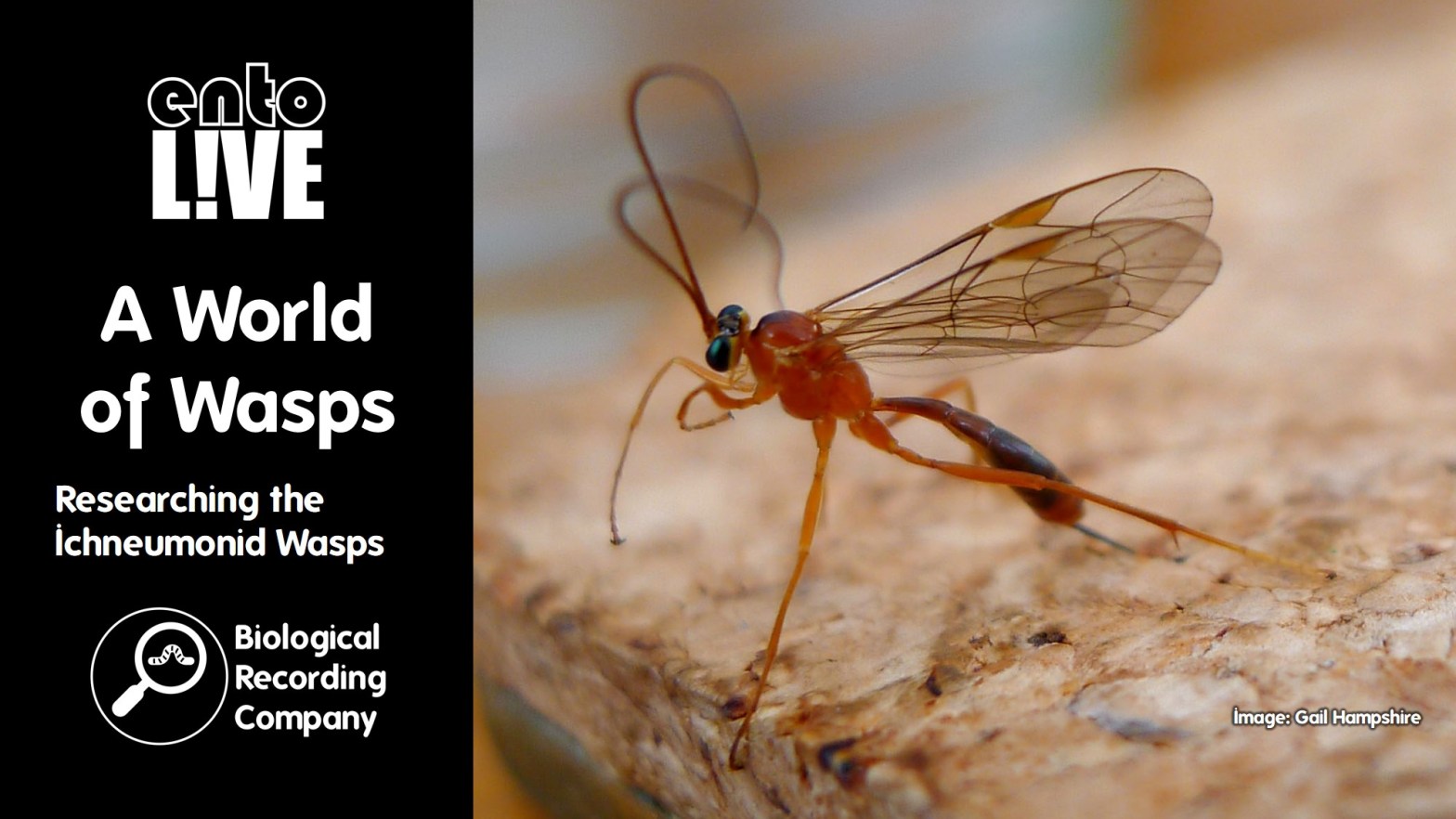
Huge numbers of insects are hosts to parasitoid wasps, and one of the most successful groups of wasps is the Ichneumonoidea, or Darwin Wasps. Despite the ubiquity of Darwin Wasps ,they are comparatively neglected by researchers and naturalists. This talk looks at research on species limits in these wasps and how that basic taxonomic work enables new research areas in ecology and genomics.
Q&A with Dr Gavin Broad
Dr Gavin Broad is a principal curator at the Natural History Museum, London, a taxonomist specialising on Ichneumonidae, and one of the co-investigators on Darwin Tree of Life, an ambitious project to sequence the genomes of all UK species.
Are ichneumonids all very host specific or do you have species that are more generalists?
They are often somewhere in the middle and it’s really hard to generalise. For example, within Netelia each species we know any detail about is probably going for a small range of hosts (though fairly closely related in the right habitat). Pimpla rufipes is a really common wasp that attacks all sorts of pupae that are the right sort of size. And not just Lepidoptera – they’ll sometimes go for other orders as well.
Does length of pupation impact which species different ichneumonids will target?
There are so many different factors. For example, you might get a species that has a six-month lifecycle and it needs two host generations a year. In that case, the potential host they could use in the autumn is really restricted to those that are going to overwinter in the correct stage. That’s a life history trait that can determine whether something’s a host or not. If they’re going to attack a caterpillar that then pupates late autumn, then this wasp will emerge in the winter when there’s nothing available for it.
What kinds of defences do the hosts have against these wasps?
There are lots of techniques. One thing that has been studied quite a bit are viruses that have been co-opted by wasps, enabling the wasp to overcome the host’s immune systembecause many insect larvae have quite robust immune systems that recognise foreign objects and encapsulate them. This results in a sort of arms race taking place inside the body of the host – as to how to stop the encapsulation by the host and being destroyed. There are also much simpler defences, if a Netelia puts its egg in the wrong bit of the caterpillar and the caterpillar can reach it with its mandibles, then it’s gone.
What do you need from the wasp in order to sequence it?
The tree within the presentation is based on barcode sequences so that’s a short 650 base pair fragment of mitochondrial DNA, cytochrome oxidase 1. We sequence that gene because it’s pretty informative at the species level. We usually extract the DNA from a leg of the specimen. For older specimens, we are still sequencing the same gene, but we have to use a very different technique to get the DNA in sufficient quantities because it is tiny and fragmented. We have to use a technique called genome skimming.
For genome sequencing, it is not as simple. The specimen has to be ultra fresh and we need to flash freeze it, using dry ice or a -80 degrees Celcius freezer. They freeze very quickly and they’re kept in deep cold until they are sequenced. At that point, the entire specimen is ground up and all of the available DNA is used. We may still sometimes need a second specimen for a DNA top-up. DNA does degrade quite rapidly and because we are using nanopore sequencing for everything, we need big, long strands of DNA for the whole genome. You’re pulling that DNA strand through a little pore in a film and so you want really big, long strands so that you don’t have too many little bits to knit together into a whole genome.
What percentage of parasitic wasps are ichneumonids and what percentage of these are nocturnal?
That’s a good question. In the UK, we’ve got roughly 6000 parasitoid wasps, and 2500 of those are ichneumonids. So, over a third. Not a lot of them are nocturnal. There are probably only around 150 truly nocturnal ones, not counting the ones that fly around at dusk.
Do we have a lot of species where we have little to no ecological behavioural information?
Yes, we don’t actually have any information on what the majority of Ichneumonids are doing. On the flipside, if you start rearing some interesting hosts, you’re almost guaranteed to find some sort of interesting parasitoid wasp and find a new host relationship. Studying Ichneumonids is frontier science!
How did you end up getting into taxonomy and why specifically the taxonomy of wasps?
Wasps was something I fell into. I wanted to be an ornithologist then I wanted to be a lepidopterist. And then I reared wasps, as an undergraduate, interesting parasitoids, and no one could really tell me what they were. I liked that challenge and decided to get into those. I found it fascinating because the whole biology of these things is amazing.
With taxonomy, I saw the word in a David Attenborough book when I was young, Living Planet or Life on Earth. One of those books that I had when I was too young to understand it really. But anyway, it mentioned taxonomists and I was intrigued. I always wanted to be a taxonomist and even when I found out what exactly it did involve, it didn’t put me off.
Literature References
- Broad & Shaw (2016) The British species of Enicospilus (Hymenoptera: Ichneumonidae: Ophioninae): https://europeanjournaloftaxonomy.eu/index.php/ejt/article/view/310
- Broad et al (2018) Ichneumonid Wasps (Hymenoptera: Ichneumonidae): their Classification and Biology: https://www.royensoc.co.uk/shop/publications/handbooks/hymenoptera/ichneumonid-wasps-hymenoptera-ichneumonidae-their-classification-and-biology/
- Broad et al. (2024) The genome sequence of an icheumonid wasp, Neteli virgata (Geoffroy 1785): https://wellcomeopenresearch.org/articles/9-187
- Johansson & Cedreberg (2019) Review of the Swedish species of Ophion (Hymenoptera: Ichneumonidae: Ophioninae), with the description of 18 new species and an illustrated key to Swedish species: https://europeanjournaloftaxonomy.eu/index.php/ejt/article/view/749
- Jonsonn et al (2021), A century of social wasp occupancy trends from natural history collections: spatiotemporal resolutions have little effect on model performance: https://nora.nerc.ac.uk/id/eprint/530080/1/N530080JA.pdf
Further Info
- Beginner’s Guide to Identifying British Ichneumonids (free download): https://www.nhm.ac.uk/content/dam/nhmwww/take-part/identify-nature/british-ichneumonid-wasps-id-guide.pdf
- Darwin Tree of Life project: https://www.darwintreeoflife.org/
- Unlocking Invertebrate Genomes entoLIVE blog: https://biologicalrecording.co.uk/2023/04/13/sequencing-invertebrates/
- Biodiversity Heritage Library: https://www.biodiversitylibrary.org/
- GBIF Netelia ornata: https://www.gbif.org/species/1281949
entoLIVE
entoLIVE webinars feature guest invertebrate researchers delving into their own invertebrate research. All events are free to attend and are suitable for adults of all abilities – a passion for invertebrates is all that’s required!
- Donate to entoLIVE: https://www.gofundme.com/f/entolive-2025
- Upcoming entoLIVE webinars: https://www.eventbrite.com/cc/entolive-webinars-74679
- entoLIVE blog: https://biologicalrecording.co.uk/category/entolive-blog/
- entoLIVE on YouTube: https://youtube.com/playlist?list=PLuEBNUcfMmE95Re19nMKQ3iX8ZFRFgUAg&feature=shared
entoLIVE is delivered by the Biological Recording Company in partnership with the British Entomological & Natural History Society, Royal Entomological Society and Amateur Entomologists’ Society, with support from Buglife, Field Studies Council and National Biodiversity Network Trust.
The entoLIVE programme is delivered by Biological Recording Company and receives sponsorship from the following organisations:
- British Entomological & Natural History Society
- Royal Entomological Society
- Amateur Entomogists’ Society
More on invertebrates
 Biological Recording