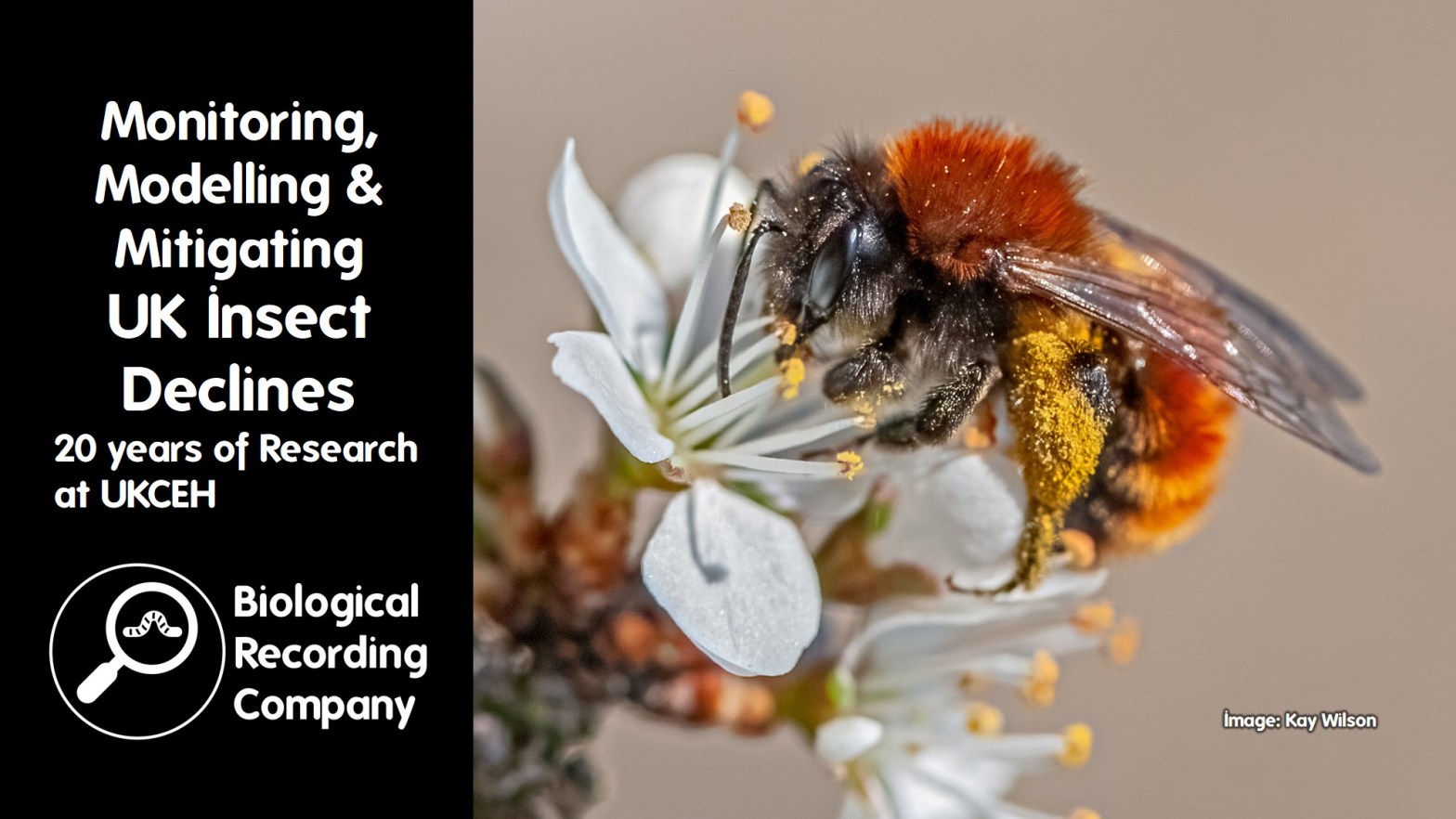
Researchers at UKCEH have played a major role in collating and analysing biological records and survey data to track changes in the status of UK insects. Claire’s talk will highlight some of the insights gained, focusing on the last 20 years, including the latest updates from the UK Pollinator Monitoring Scheme. It will also feature parallel research into management interventions on farmland to better understand how we can mitigate against further insect declines and conserve the critical ecosystem services that insects provide.
Dr Claire Carvell is an internationally renowned expert on pollinator ecology with over twenty years of research and project management experience at UKCEH. She uses a combination of field observations, experiments, molecular genetics, analyses of long-term datasets, community science and modelling approaches, interacting with a range of collaborators in different disciplines to improve environmental policy and practice. Claire’s research began with a focus on bumblebees, and she now leads the UK Pollinator Monitoring Scheme.
Q&A with Dr Claire Carvell
- Which of the PoMS surveys is most suitable for schools?The Flower-Insect Timed (FIT) Count requires a lower level of identification skills, does not involve collecting specimens and can be done anywhere where there are suitable flowers (eg. gardens, school grounds, parks, countryside). PoMS resources have been adapted by the Natural History Museum in 2024 specifically for use with children by educators and this is all available as the Pollinator Count activity on the National Education Nature Park website as a means of engaging students with the biodiversity on school grounds.
- How often should FIT count volunteers aim to undertake surveys?
We’ve purposefully left the timing of FIT Counts fairly flexible as we understand that the weather conditions and availability can make it difficult to commit to continuous and regular surveys. FIT Counts can be done anywhere, including gardens and parks, in warm, dry weather during daylight hours from 1 April to 30 September. We welcome surveys across different sites, but if an individual can regularly undertake surveys at the same location each week (moving to different target flowers if needed or as the season progresses) this improves the quality of the data. - Why did you select pan trapping as part of the 1km square survey methodology over a non-lethal method?
We spent 2 years designing and testing the PoMS survey methods where we considered things like cost, the feasibility of getting people out into the field, the skills of the surveyors and the methods that they would employ. We were aware that the Bumblebee Conservation Trust had launched its Bee Walk Scheme (using regular fixed transects to count bumblebees) so we wanted PoMS to fill gaps in our knowledge of pollinators rather than replicate existing surveys. To get some of the smaller and/or difficult-to-identify species monitored through observational methods would be far too challenging as microscope identification is often the only way of telling species apart, and that too would involve lethal sampling. Previous research has also shown that using observers to monitor many different and diverse insect groups over a large number of sites can introduce biases, due to differing levels of experience, how and what they might ‘spot’. Pan traps provide a standardised method that can be deployed year-on-year whatever the level of surveyor expertise, whilst also allowing us to make use of expanding taxonomic capacity to ID the material following collection. We are trying to make the most of the samples by not just focusing on the bee and hoverfly species that are the main focus of PoMS, but also undertaking DNA analysis to look at a much wider range of species, many of which remain under-recorded in the UK. Pan traps are also supplemented with FIT Counts on the same 1km survey squares. UKCEH is looking to alternative methods of observational ID using cameras and AI so watch this space for this emerging technology. - Have you compared rural and urban data?
Not yet. The pan trapping wouldn’t be very suitable for this as the 1 km square network doesn’t intersect with urban areas, but we can consider this question with the FIT Count data. It is something that we’d like to do and as we gather more data we get closer to being able to do this in a statistically sound manner. - Is it true that insects have declined by over 70%?
This statistic has probably come from the Bugs Matter citizen science survey that is undertaken by Buglife and Kent Wildlife Trust. This study measures the number of insect splats on vehicle number plates and last year they reported that the number of insects (in splats per mile) sampled on vehicle number plates by citizen scientists across the UK reduced by 78% between 2004 and 2023. There has also been a research paper that has reported a decline of over 75% in total flying insect biomass in German nature reserves over the past 27 years that looked at catches from malaise trapping. I can’t comment on if these studies are representative of all insects and it is important that we keep monitoring using standardised methods at large scale to gain a better understanding of what is happening across this large and diverse group of animals.
Literature References
- UK Pollinator Monitoring Scheme (2024) The UK PoMS Annual Report 2023: https://ukpoms.org.uk/sites/default/files/pdf/PoMS-AR-2023-EN-Final.pdf
- Fox et al (2023) The State of the UK’s Butterflies 2022: https://butterfly-conservation.org/sites/default/files/2023-01/State%20of%20UK%20Butterflies%202022%20Report.pdf
- Fox et al (2021) The State of Britain’s Larger Moths 2021: https://butterfly-conservation.org/sites/default/files/2021-03/StateofMothsReport2021.pdf
- Powney et al (2019) Widespread losses of pollinating insects in Britain: https://www.nature.com/articles/s41467-019-08974-9
- Boyd et al (2022) ROBITT: A tool for assessing the risk-of-bias in studies of temporal trends in ecology: https://besjournals.onlinelibrary.wiley.com/doi/10.1111/2041-210X.13857
- Evans et al (2024) Population links between an insectivorous bird and moths disentangled through national-scale monitoring data: https://onlinelibrary.wiley.com/doi/full/10.1111/ele.14362
- Carvell et al (2007) Comparing the efficacy of agri-environment schemes to enhance bumble bee abundance and diversity on arable field margins: https://besjournals.onlinelibrary.wiley.com/doi/10.1111/j.1365-2664.2006.01249.x
- Carvell et al (2017) Bumblebee family lineage survival is enhanced in high-quality landscapes: https://www.nature.com/articles/nature21709
- Lozier (2017) A helping habitat for bumblebees: https://www.nature.com/articles/nature21897
Further info and links
- Biological Records Centre: https://www.brc.ac.uk/
- Britain’s larger moths decline by a third over 50 years: https://www.ceh.ac.uk/news-and-media/news/britain%E2%80%99s-moths-decline-third-over-50-years#:~:text=Populations%20of%20Britain’s%20larger%20moths,Ecology%20%26%20Hydrology%20(UKCEH).
- Modelling long-term trends from monitoring data: https://drnickisaac.weebly.com/blog
- Project DRUID (Drivers & Repercussions of UK Insect Declines): https://druidproject.org.uk/
- Pollinator Monitoring Scheme (PoMS): https://ukpoms.org.uk
- How to take part, links to guides: https://ukpoms.org.uk/taking-part
- New FIT Count projects feature – contact PoMS to sign up: https://ukpoms.org.uk/poms-projects
- PoMS Annual reports: https://ukpoms.org.uk/reports
- PoMS Open access datasets: https://ukpoms.org.uk/data
- PoMS mailing list: https://ukpoms.org.uk/subscribe
- Podcast featuring PoMS and colleagues at the RHS: https://audioboom.com/posts/8517522-what-s-the-buzz-1500
- Natural England LandSpaes project:https://www.ceh.ac.uk/our-science/projects/landspaes
- AgZero+ sustainable agriculture research programme: https://agzeroplus.org.uk/
More for environmental professionals


 Biological Recording
3 thoughts on “Monitoring, Modelling and Mitigating UK Insect Declines: 20 Years of Research at UKCEH”