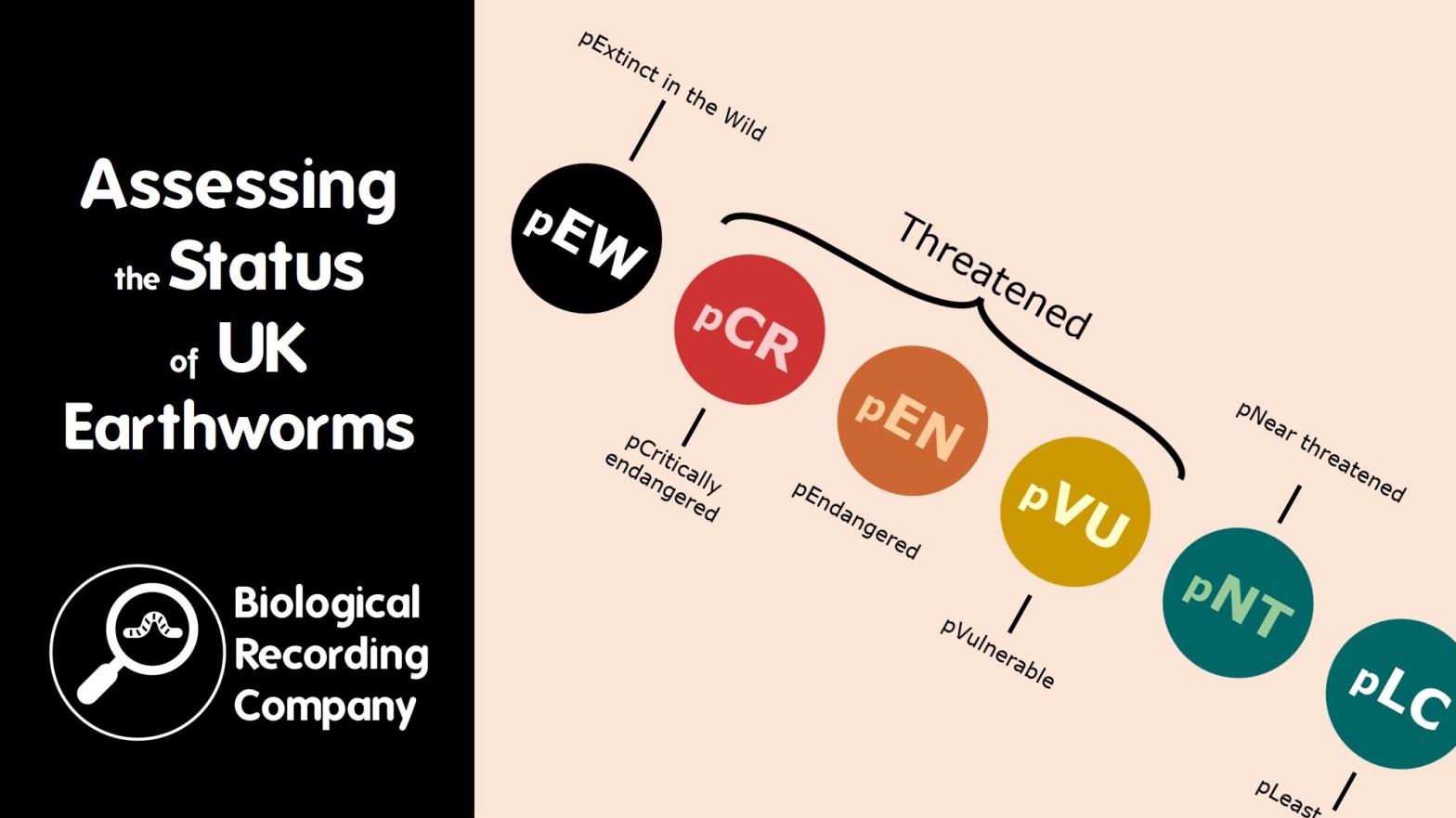
The standard method for determining the conservation status of a species is to assess the species against IUCN Red List criteria and apply an IUCN Red List category. These criteria require species data, and many species can therefore only be classed as ‘data deficient’ based on current record holdings. UK earthworms fall into this category and are rarely considered within site management plans, environmental policy or conservation projects.
The Provisional Earthworm Conservation Status Assessment for the UK aims to apply a provisional version of the IUCN categories for all 31 UK species of earthworm based on the little data that we do have and the opinions of the UK’s leading earthworm specialists. This presentation will explore this experimental approach and highlight the benefits and challenges resulting from this project.
Q&A with Keiron Derek Brown
Keiron Derek Brown has been running the National Earthworm Recording Scheme since it was launched in 2014. He has run over 100 earthworm training courses and events since 2014, covering a wide range of subjects including biology, ecology, surveying, identification and recording.
- How did you get involved with earthworm recording?
I personally became interested following volunteer work at the Natural History Museum, where I was trained to identify earthworms as part of a research project. When I then did some recording in Cumbria and sent the records to the Earthworm Society, I realised the data wasn’t being used or collated in any meaningful way so I volunteered to take on the role of Recording Officer and set up the National Earthworm Recording Scheme (NERS) in 2014. I’ve stuck with it because earthworms are so important ecologically and nobody else was doing this. I’m proud of the difference that I’ve been able to make due to the dirth of data that came before this. - How can others get involved with earthworm recording?
Earthworm identification does take a certain level of skill and use of a microscope. The Biological Recording Company runs Earthworm Identification courses aimed at beginners, but we understand that the fact that you need to collect, kill and preserve specimens plus access to a microscope is always going to limit the number of people willing to get involved. We also host regular Earthworm Sampling Days where we survey sites for earthworms and contribute data to the NERS database – all of which are free. - What is the optimum habit representation within the dataset?
When I speak about habitats being under-represented, what I really mean is that we have too little data on them. We’d expect more records from some habitats as they account for larger proportions of land use. For example, farmland accounts for 70% of the land in England. We need more information on the earthworm communities that inhabit different habitats, so we need to survey all habitats equally until we have that baseline data. Once we have better information across different habitats, the next step would be to address geographic representation (regardless of habitat). - Which species of earthworm are most at threat from development?
In general, earthworms are not at threat from development. Although development may impact species, for example if areas are concreted over, it is unlikely that this is enough to threaten extinction for most species (even locally). However, the earthworm species that are classed as very rare don’t have much data on where they do and do not occur. If a species has a very small number of locations where it occurs it is particularly at risk from local pressures, such as development, agricultural practices and even habitat management practices on nature reserves. I used development as an example of a potential threat to a species with a few isolated populations in the talk but there is no current known threat from development. - Is the classification of species as non/native or invasive based on incomplete information?
To clarify, none of the non-native species of earthworm found in the UK are classed as invasive as we aren’t aware of them causing harm to UK habitats or native species. Information on global distribution is severely lacking. It is even more difficult to establish the native range of a species because earthworms are moved around so much in soil and sold for fishing bait or compost. I’m only suggesting that 4 of the 31 species found within the UK are registered as non-native species, and this is because they belong to taxonomic groups known to originate from other continents. There are a number of other species that may or not be native – we need genetic studies to help us establish their relation to colonies elsewhere in the world and to establish where they originate from. - How would you sum up the status of earthworms in the UK?
Unknown. This report highlights that there is so much that we still don’t know. We still have big gaps in our knowledge of ecology, distribution and global context. We don’t even know what the natural ranges of many species is. Hopefully, this report will lead to some of these knowledge gaps being addressed so that we can conduct a full red listing exercise on UK earthworm species.
Literature References
- Ashwood et al (2024) Earthworm Records and Habitat Associations in the British Isles: https://doi.org/10.1016/j.ejsobi.2024.103642
- Carpenter et al (2012) Mapping of earthworm distribution for the British Isles and Eire highlights the under-recording of an ecologically important group: https://doi.org/10.1007/s10531-011-0194-x
- Jones & Eggleton (2014) Earthworms in England: distribution, abundance and habitats (NECR145): https://publications.naturalengland.org.uk/publication/5174957155811328
- Sims and Gerard (1999) Earthworms. Synopses of the British Fauna (New Series): https://www.field-studies-council.org/shop/publications/earthworms-synopsis/
- Sherlock (2018) Key to the earthworms of the UK and Ireland: https://www.field-studies-council.org/shop/publications/earthworms-aidgap/
- Bottinelli et al (2020) An explicit definition of earthworm ecological categories – Marcel Bouché’s triangle revisited: https://doi.org/10.1016/j.geoderma.2020.114361
- Capowiez et al (2024) Let earthworms be functional – Definition of new functional groups based on their bioturbation behaviour: https://doi.org/10.1016/j.soilbio.2023.109209
Further info and links
- National Earthworm Recording Scheme: https://www.earthwormsoc.org.uk/ners
- Wriggling Into Recording entoLIVE: https://biologicalrecording.co.uk/2023/02/02/earthworms/
- Digging Through the Dust: Rediscovering Historic Earthworm Records in Museums and Publications: https://youtu.be/Cw7MoK07yQs
- UK earthworm datasets on GBIF: https://www.gbif.org/publisher/0b8171d0-6b32-4ccc-bf3d-bf34b56c36d3
- Earthworm ecology: https://www.earthwormsoc.org.uk/earthworm-ecology
- IUCN Red List Categories & Criteria: https://www.iucnredlist.org/resources/categories-and-criteria
More for environmental professionals


 Biological Recording
One thought on “Assessing the Status of UK Earthworms”