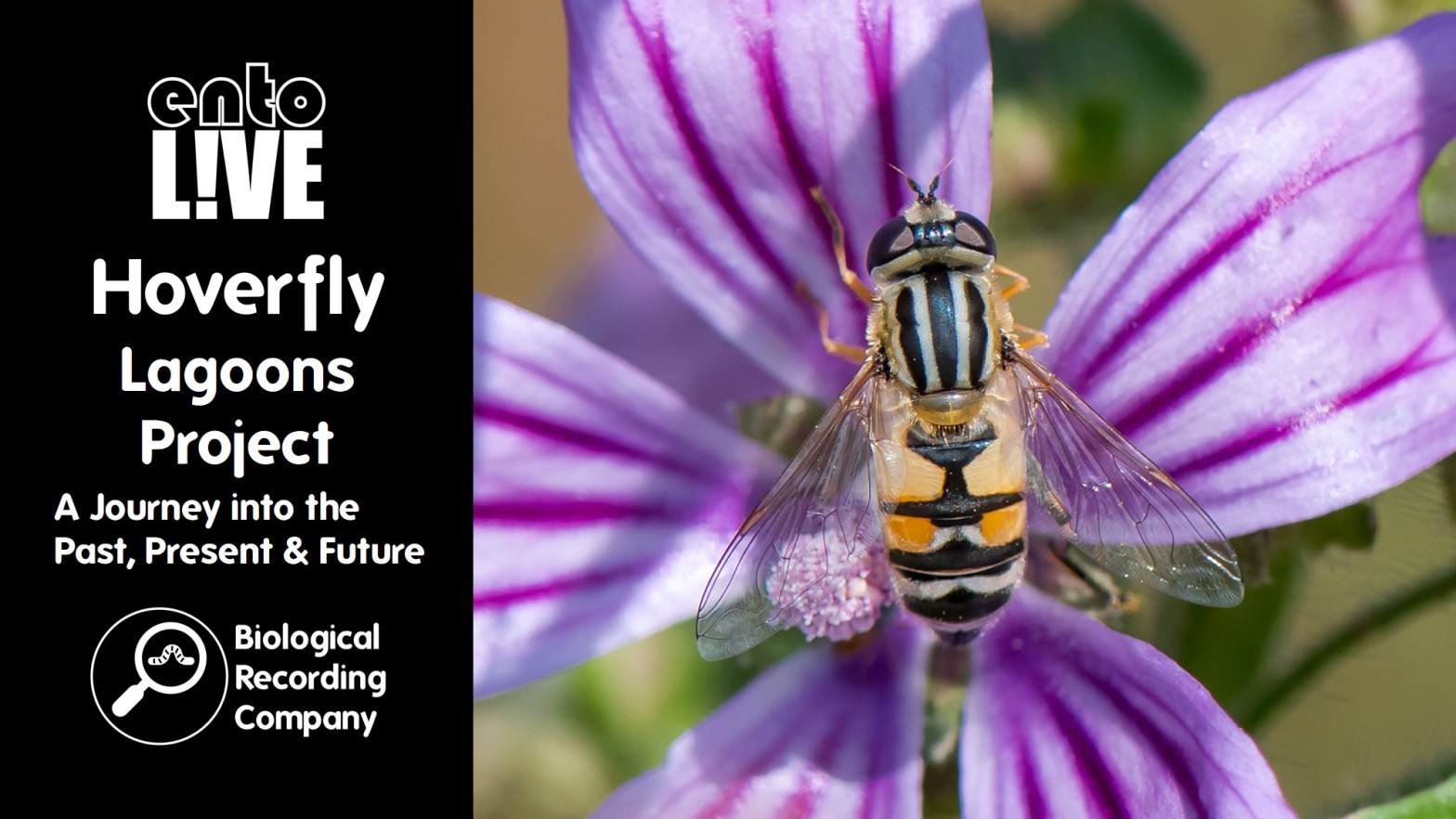
The Hoverfly Lagoons project was invented in 2016 for the University of Sussex’s Buzz Club, a citizen science charity exploring wildlife gardening techniques for insects. The aim was to trial artificial habitats, essentially small water bodies designed for some (magnificent) species of hoverfly which are semi-aquatic. These water bodies may be missing in our urban and rural landscapes due to a lack of natural habitats such as mature trees. The Buzz Club learnt that: Hoverfly Lagoons are very easy to create; size doesn’t matter (much); they’re used by a broad invertebrate community; and they could be a useful tool to investigate biological unknowns and to monitor environmental change. Dr Ellen Rotheray takes us through her lagoons journey – past, present, and plans for the future.
Dr Ellen Rotheray is a senior lecturer in Ecology and Conservation at the University of Sussex, a member of the IUCN Hoverfly Specialist Group, and a member of the Pine Hoverfly Biodiversity Action Plan (BAP) Steering Group. Ellie got her first taste of hoverfly research during her masters degree in 2006, which opened up a new, exciting world of discovery and exploration. What’s more, due to the nature of the project, it was an opportunity to apply scientific findings directly to shape effective conservation management. Inspired by habitat creation efforts trialled during her PhD, Ellie invented the Hoverfly Lagoons project, largely in the hopes that when people caught a glimpse inside this world, it might evoke a desire to protect it.
Q&A with Dr Ellen Rotheray
- Are the hoverfly larvae prone to predation in the lagoons and what would dine on them?
The Muscid flies that I mentioned in the presentation are the main predator, and are like a fox in a henhouse and will empty a lagoon of hoverfly larvae. Larvae will also be predated by vertebrates such as birds, foxes and frogs – essentially they are a little sac of protein and fat. I expect that dragonfly larvae would eat them in a pond, but it is unlikely that dragonflies will colonise the low-oxygen habitat that you find in hoverfly lagoons. There are also parasitoid wasps that specialise on individual species of hoverflies. - Are all hoverflies able to survive as larvae over winter?
It would be cool to study this more. I would imagine that multiple species have developed strategies for surviving in colder areas, such as up in Scotland. We’ve found Pine Hoverflies completely frozen in the ice and within a few seconds of being chipped out of the ice, they would slowly begin to start moving again! I’ve also used temperature-controlled environments to investigate how they behave in colder conditions and I noted that as the water started to freeze, Pine Hoverfly larvae immediately crawled out of the water and sat on the ice! I can’t really comment on other species, but the species that are found in cooler climates seem to have adapted to survive in these conditions. - What other organisms are found in hoverfly lagoons?
There is a whole community of organisms found within the hoverfly lagoons. The hoverflies (and Muscid larvae) are probably the biggest and easiest to see, but there will be other species of fly (such as gnats and mosquitoes) and parasitoids that are associated with the insects inhabiting the lagoon. - What can people do in their gardens to help improve their hoverfly diversity?
The first thing would be to set up a hoverfly lagoon and report their results. Taking part in this project helps us understand more about hoverfly behaviour and ecology, which we can then use to improve our guidance. It’s particularly useful if people do these for several years running so that we have sites where we can compare the data year-on-year. Aside from hoverfly lagoons, allowing areas to grow and so-called weeds to flower is great for adult hoverflies. Ensure that you have plants flowering all through the year to provide habitat for early and late species. Increasing the diversity of habitats is also going to increase your hoverfly diversity – so think about adding a log pile and pond. Finally, avoid using any chemicals – you shouldn’t need to if you have a healthy ecosystem as some hoverflies (not those that inhabit lagoons) will predate aphids!
Literature References
- Rotheray and Rotheray (2021) The puparium and development site of Rhingia rostrata (Linnaeus) and comparison with R. campestris Meigen (Diptera, Syrphidae): https://nms.iro.bl.uk/concern/articles/b1f42219-fdf3-451c-aadc-58062edae0f7
- IUCN SSC HSG/CPSG (2022) European Hoverflies: Moving from Assessment to Conservation Planning: https://cbsg.org/sites/cbsg.org/files/documents/European%20Hoverflies%20Moving%20from%20Assessment%20to%20Conservation%20Planning.pdf
- Vujić et al (2022). Pollinators on the edge: our European hoverflies. The European Red List of Hoverflies: https://wikis.ec.europa.eu/display/EUPKH/European+Red+List+of+Hoverflies?preview=/23462140/102630586/ERL%20Hoverflies.pdf
Further Info
- Hoverfly Lagoons Buzz Club page: https://www.thebuzzclub.uk/hoverfly-lagoons
- Hoverfly Lagoons website: https://hoverflylagoons.co.uk/
- Pine Hoverfly entoLIVE blog: https://biologicalrecording.co.uk/2023/03/23/pine-hoverfly/
- Buzz Club webpage: https://www.thebuzzclub.uk/
entoLIVE
entoLIVE webinars feature guest invertebrate researchers delving into their own invertebrate research. All events are free to attend and are suitable for adults of all abilities – a passion for invertebrates is all that’s required!
- Donate to entoLIVE: https://www.gofundme.com/f/entolive-2025
- Upcoming entoLIVE webinars: https://www.eventbrite.com/cc/entolive-webinars-74679
- entoLIVE blog: https://biologicalrecording.co.uk/category/entolive-blog/
- entoLIVE on YouTube: https://youtube.com/playlist?list=PLuEBNUcfMmE95Re19nMKQ3iX8ZFRFgUAg&feature=shared
entoLIVE is delivered by the Biological Recording Company in partnership with the British Entomological & Natural History Society, Royal Entomological Society and Amateur Entomologists’ Society, with support from Buglife, Field Studies Council and National Biodiversity Network Trust.
The entoLIVE programme is delivered by Biological Recording Company and receives sponsorship from the following organisations:
- British Entomological & Natural History Society
- Royal Entomological Society
- Amateur Entomogists’ Society
More on citizen science

 Biological Recording
3 thoughts on “Hoverfly Lagoons Project: A Journey into the Past, Present and Future”