
Bioacoustics is a cross-disciplinary science that combines biology and acoustics, using the sounds produced by animals to investigate their biology and ecology.
Sound recorders can be positioned within a habitat to record the calls produced by birds and other animals, and these recordings can be analysed to establish their behaviours and which species are present. Artificial intelligence and evolving hardware are helping us to push the boundaries of what we can use this technology for, with the potential to use bioacoustics to establish species abundance and overall ecosystem health on the horizon.
It can be used for short and long-term measurements of biodiversity, including how species richness changes through the seasons and over the years. It also helps understand how birds are using a site, for example using bioacoustics to look at the site preferences of Skylarks.
This blog features two guest presentations:
- How Can We Use Sound to Measure Nature? with Geoff Carss (Wilder Sensing)
- Using Sound to Understand How Biodiversity is Changing: The Story of Honeygar with Joe Hampson (Somerset Wildlife Trust)
How Can We Use Sound to Measure Nature?
Geoff Carss (Wilder Sensing)
Geoff will introduce how the science of bioacoustics is used to monitor and measure biodiversity, delving into the current limitations and potential applications. We will explore how sound has been used to identify species and recent innovations such as Merlin and BirdNET together with scalable approaches for short and long term monitoring. Featured on Springwatch 2024 episode 11.
Useful links
- Book on the follow-up free webinar – Can Passive Acoustic Monitoring of Birds Replace Site Surveys?: https://www.eventbrite.co.uk/e/944096226227
- Moss (2019) Mrs Moreau’s Warbler How Birds Got Their Names: https://www.nhbs.com/mrs-moreaus-warbler-book
- 13 pieces of classical music inspired by birdsong: https://www.classicfm.com/discover-music/classical-music-inspired-by-birdsong/
- Merlin: https://merlin.allaboutbirds.org
- BirdNET: https://birdnet.cornell.edu
- Springwatch 2024 Episode 11 (featuring acoustic monitoring): https://www.bbc.co.uk/iplayer/episode/m00205c3/springwatch-2024-episode-11
- Sound recording devices available through NHBS: https://shorturl.at/jjwuy
- Contact Wilder Sensing: https://wildersensing.com/contact/
Q&A with Geoff Carss
- How can we ensure we have accurate and robust validation of sounds using AI?
The validation is really important. We ran trials for well over a year, with Honeygar being one of them. This has included a lot of work from volunteers undertaking validation, including species-specific validation. Customers have also run their own validation trials. As mentioned in my presentation, there are some species that we know are problematic and more care needs to be taken with interpreting their presence. - How reliable are the confidence scores?
For most species, it is pretty high at around 80% or 85%. This will be variable by species, particularly with species that have lower frequency calls. - Is the use of acoustic monitoring in urban and suburban areas more limited due to the impacts of human-generated noise?
We have one site in the industrial part of Bristol. When you listen to the recordings you can hear the constant sound of lorries and other traffic. However, despite this, we’re still picking up quite a reasonable species list. This has included species that we knew were present but didn’t expect to be picked up, including things like Sparrowhawk. What’s important is that the results are compared like-for-like to give us a picture of what is happening over time. We understand that some species may be missed due to their low-frequency calls, but they will be missed consistently and we can still use the data to look at changes over time. - Do the filters allow for the possibility of species moving outside of the areas where they may have traditionally been due to climate change?
This will depend on the filter that is used. If, for example, we used the British List then this would catch everything but birds that have never been formally recorded in the UK which is unlikely but may happen due to climate change. An option would be to extend the list to include species which may occur. - Can you target surveys at specific species?
Absolutely. We’ve had projects looking specifically at Skylark or Curlew. If a project is targeting a species that is less likely to be picked up, we’d need to fine-tune the model for that species to increase the probability of it being detected when present. - Is there a suggested number of recorders per hectare for similar habitat?
There is a bioacoustic survey guidelines that were published about a year ago. They should be at least 100m apart if not more – up to 250m. This will depend on what you are aiming to analyse. - How easy is it to deploy this system outside of the UK?
It is relatively straightforward. One consideration would need to be which filters you might use. For example, BirdNET would use e-bird so you’d need to check how good the e-bird recording is. You would need to add a local species list as the filter rather than a UK species list. Some regions are going to have less data available, whereas others (such as the Amazon) have relatively good representation. - Are any attempts being made to integrate data on habitat change or weather patterns alongside the species data?
We have got some detailed weather data from some sites such as Honeygar and will start to include it in the analytics to better understand causality and the impact of bird assemblages. This could be the subject of a great PhD. - Are there any case studies available where bioacoustic monitoring has been successfully used on conservation projects in the UK?
The Somerset Wildlife Trust Honeygar example is a great case study as presented below. There are a number of very different sites around the Uk who have installed a number of recorders – Wendling Beck in Norfolk, Leven Carrs in Yorkshire and North Moor in Somerset (Natural England) – we can provide more examples and put you in touch with appropriate contacts – please let us know.
Using Sound to Understand How Biodiversity is Changing: The Story of Honeygar
Joe Hampson (Somerset Wildlife Trust)
Honeygar will be Somerset Wildlife Trust’s first ‘wilded’ site – managed very differently to our nature reserves and a major project for the Trust, which will happen over many years. Over time, we hope it will become a place which inspires those who visit, whether other landowners, local people or visitors from further afield.
Joe will provide a short history of Honeygar and delve into the details of the acoustic project that’s been running there for 18 months and has 1.5 million records uncovering all kinds of insights.
Useful links
- Somerset Wildlife Trust: https://www.somersetwildlife.org/
- Honeygar Nature Reserve: https://www.somersetwildlife.org/honeygar-2023
- Somerset Wildlife Trust’s Approach to Honeygar: Intervention Thresholds: https://www.somersetwildlife.org/sites/default/files/2024-02/Honeygar%20-%20Intervention%20Thresholds%20Doc.pdf
- Introducing Honeygar film on YouTube: https://www.youtube.com/watch?v=M4mbeB0egvA
- Honeygar Report 2022-2023: https://www.somersetwildlife.org/sites/default/files/2024-02/Honeygar%20Report%202023_120423.pdf
Q&A with Joe Hampson
- How much work is it to maintain the equipment?
We’re very fortunate to have volunteers that manage this. With the older model, we needed to change the batteries each week but the newer models have batteries that last around a month. the bottleneck now is the SD cards as we fill a 128GB SD card in almost exactly two weeks so we’re having to change these fortnightly (with every other SD card changed at the same time as the batteries). - Is the data from your recorders submitted to the Local Environmental Records Centre?
All of the data that we get from Honeygar is shared with the Somerset Environmental Records Centre. I think they’ve been scratching their heads a little bit about how much data we are producing on-site, but it’s hopefully helping them to prepare for how this kind of recording may generate large volumes of data in the future. We’re also analysing the data and we hope to publish research based on the data that we’ve generated, to help disseminate the findings beyond the biological recording sector. - Do you aggregate a day’s worth of calls for a single species as one record?
Each call is separate, so it is important that we don’t draw conclusions about the number of individuals based on the number of calls. In the pie chart that I showed, you may have noticed we had lots of Wren calls – this is because they are such noisy birds. We’re not saying we have 500 individual Chiffchaffs because we’ve had 500 Chiffchaff calls. As time goes on and more data is gathered for the site, changes in levels of noise will be useful for commenting on bird activity levels and help us to understand changes on the site. As this technology develops, triangulation of calls may enable us to look at species abundance.
Wilder Sensing ecoTECH blogs
- How Can We Use Sound to Measure Biodiversity: https://biologicalrecording.co.uk/2024/07/09/bioacoustics-1/
- Can Passive Acoustic Monitoring of Birds Replace Site Surveys blog: https://biologicalrecording.co.uk/2024/09/17/bioacoustics-2/
- The Wilder Sensing Guide to Mastering Bioacoustic Bird Surveys: https://biologicalrecording.co.uk/2024/11/26/bioacoustics-3/
- Bioacoustics for Regenerative Agriculture: https://biologicalrecording.co.uk/2025/03/31/bioacoustics-for-regen-ag/
- AI-powered Bioacoustics with BirdNET: https://biologicalrecording.co.uk/2025/07/08/birdnet/
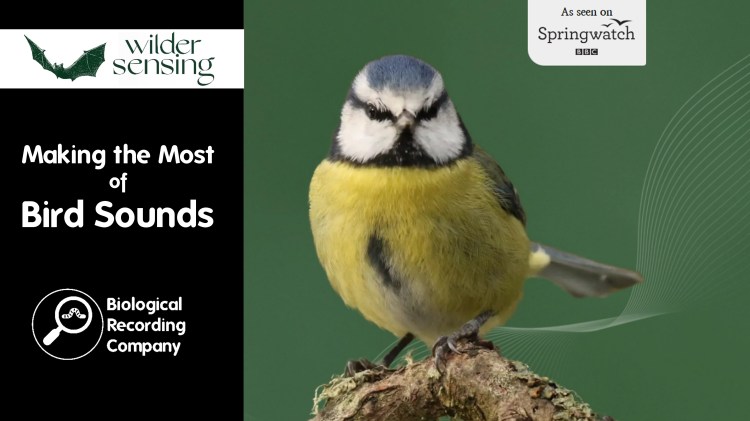
- Making the Most of Bird Sounds: https://biologicalrecording.co.uk/2026/03/11/making-the-most-of-bird-sounds/
Event partners
This blog was produced by the Biological Recording Company in partnership with Wilder Sensing, Wildlife Acoustics and NHBS.
- Sign up for the Wilder Sensing e-newsletter: https://2e428x.share-eu1.hsforms.com/2XxP8d_6lRSmBIKH7uwruXQ
- Wildlife Acoustics Song Meter Micro 2: www.nhbs.com/song-meter-micro-2
- Wildlife Acoustics Song Meter SM5: https://www.nhbs.com/song-meter-sm5-acoustic-recorder
- Check out the NHBS Field Guide Sale: www.nhbs.com/spring-promotions

More for environmental professionals


 Biological Recording
3 thoughts on “How Can We Use Sound to Measure Biodiversity?”