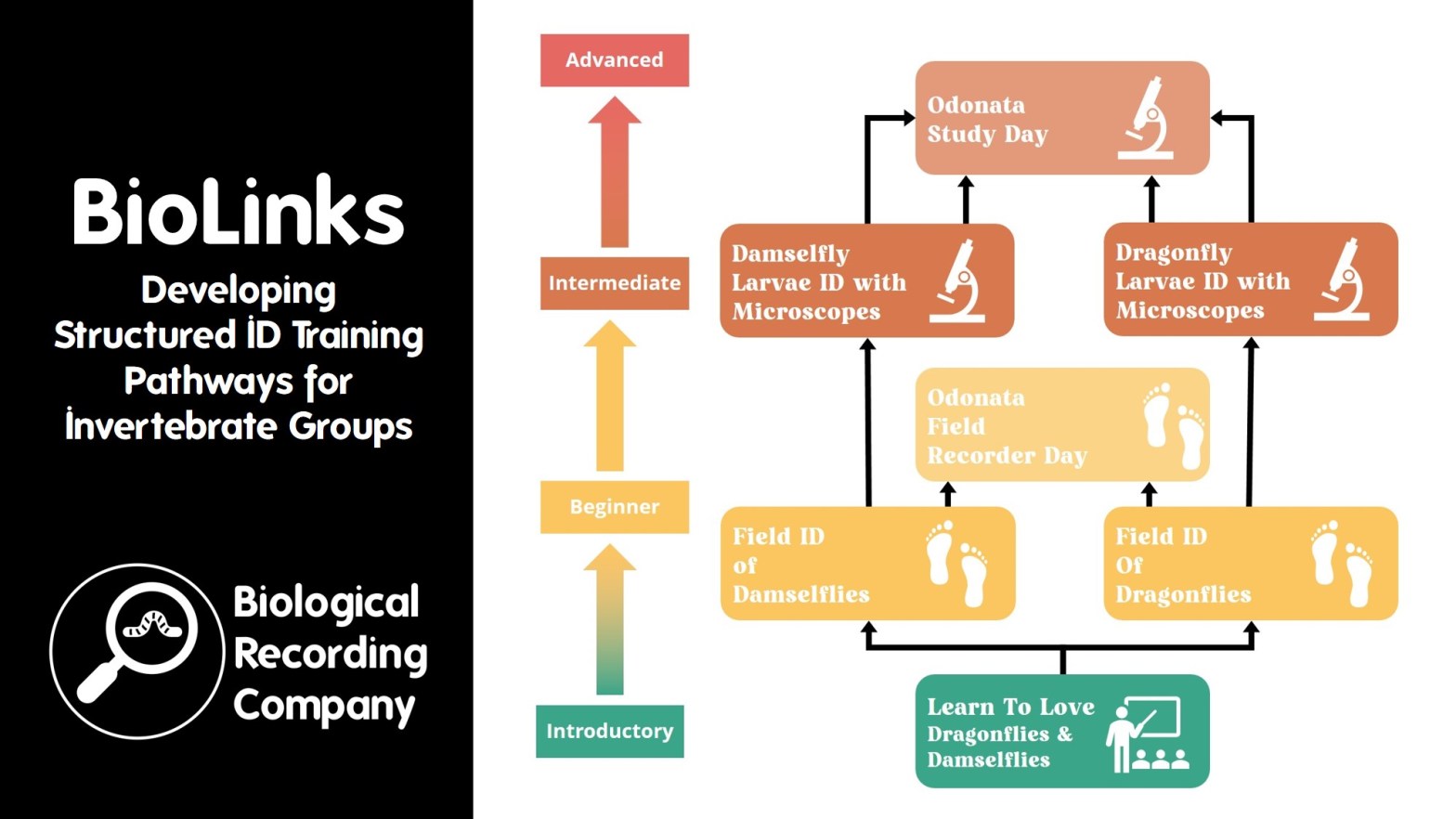
The FSC BioLinks project aimed to address the shortage of biological recorders for under-recorded and difficult-to-identify invertebrate groups through a substantial training programme based on structured ID training pathways for each focus species group. This presentation will focus on the classroom, field and lab-based training courses delivered through BioLinks, and discuss the challenges and successes demonstrated by BioLinks in relation to developing species ID skills in the biological recording community.
Keiron Derek Brown has been running the National Earthworm Recording Scheme since its launch in 2014. He has been working as a biological recording professional since 2017 when he joined the Field Studies Council where he developed and then delivered the FSC BioLinks invertebrate recording project. Following the completion of this project, Keiron set up the Biological Recording Company to support the environmental sector through training and consultancy.
Q&A with Keiron Derek Brown
- Did learner inexperience in using microscopes decrease bookings for microscope-based courses?
Not at all. The microscope courses were the most popular of all the 1-day courses. Some learners were already experienced, but we checked this with the participants at the beginning of each course and the project staff member would support the specialist tutor by providing inexperienced learners with an introduction to setting up and using the microscope. We also run 1-day courses that were designed specifically to give confidence in the use of microscopes and identification keys for identifying invertebrates. The Identifying Terrestrial Invertebrates course is a course that I can provide through the Biological Recording Company if organisations or projects are looking to include it within their training programmes. - What are the pros and cons of delivering in-person versus online courses?
I think that both are really important as they both have advantages and limitations. Online courses are great for delivering courses at relatively low cost and for reaching much larger audiences. They enable you to reach a much larger geographic area and access people who wouldn’t be able to attend in-person courses (for example if they have limited mobility, insufficient financial capacity to afford the travel or work/family commitments that prevent them from taking the day out to attend). In-person courses are fantastic for building relationships between the tutor and students, as well as between students. There is also no substitute for the tutor support that takes place on in-person ID courses, and the equipment (such as microscopes and ID guides) can be made available to students. It can be very difficult (possibly impossible) for tutors to give specimen-specific feedback to online students that they can give on in-person courses. - Did your courses allow for different learning styles and account for neurodivergent people?
Many natural history tutors are not professional educators, so not all were aware of learning styles and adapting their teaching methods to these. The project team provided feedback and guidance to the specialist tutors as much as possible and I co-designed the Teaching Natural History course with Charlie Bell to address this issue. It teaches the tutors that different people learn in different ways and advises tutors to introduce a range of different teaching styles to account for this. I can provide it through the Biological Recording Company if organisations or projects are looking to include it within their training programmes. Regarding neurodiversity, this was something that we also tried to address by contracting the National Autistic Society to review one of our online courses, provide the FSC with guidance for improving teaching materials for individuals with autism and to deliver a webinar about autism to FSC staff and associate tutors. You can read more about this in the FSC BioLinks Audiences Engagement Report. - Were your students subsidised or self-funded?
Students were responsible for covering any travel expenses, but the spaces were highly subsidised. One-day courses were £5 initially and £10 towards the end, and the 3-day residentials were £50 (including food and accommodation). We learned pretty early on that we needed to charge something as we initially had a lot of no-shows. There is an argument that if you offer things for free people don’t value them, and I think that you still get this with subsidising to the extent that we did. When natural history courses are full price, many people complain that they are too expensive – but we need to be honest and clear that natural history courses should be valued at the same comparable courses from other sectors. - Did you find that your learners were mainly professionals or non-professionals?
We had a real mix. We were careful not to target professionals as the target audience was potential and existing biological recorders. Professionals should really be paying full price for the training, rather than getting it through a funded project and we didn’t want to undermine existing training provision for professionals (delivered by the FSC or externally). However, we did not police who attended and we people with all sorts of motivations: professionals, early career ecologists, students, amateur naturalists, existing biological recorders and conservation volunteers. Likewise, the skill level was often variable even within a course. We did make it clear in course descriptions where existing skills and experience were necessary (for intermediate and advanced courses) and every course was clearly labelled with the level from the BioLinks Learning Pathway. Check out the FSC BioLinks Development Plan for Training Provision for more info about the levels. - Did you look at the diversity of attendees?
All project participants were asked to complete an anonymous demographics survey that enabled us to gather information on age, gender and ethnicity. BioLinks specifically aimed to ensure that women were not underrepresented (which they were not – they were actually overrepresented) and that young adults were targeted (which we did through various initiatives), there’s much more info on this work and what the results were in the FSC BioLinks Audiences Engagement Report. - Is there a possibility of developing a postgraduate or higher level course incorporating all this specialist training?
The training programme was designed as single units within taxonomic frameworks, so the courses could be combined and incorporated into either (or both) postgraduate training or a higher-level course. I’d love to see this! The obvious candidate would be the PgC/PgD/MSc Biological Recording and Analysis that is delivered by Harper Adams University and the Field Studies Council. However, there is absolutely no reason why this type of training couldn’t be incorporated into more higher education courses.
Literature References
- FSC BioLinks: Biological Recording & Training Consultation (Biological Recording Company blog): https://biologicalrecording.co.uk/2023/09/16/biolinks-consultation/
- Brown (2017) FSC BioLinks Consultation Report: https://www.britishecologicalsociety.org/applied-ecology-resources/document/20203291194/
- Brown (2018) FSC BioLinks Development Plan For Training Provision: https://www.britishecologicalsociety.org/applied-ecology-resources/document/20230081529/
- Brown, K. D. (2017) FSC Biolinks Activity Plan: https://www.britishecologicalsociety.org/applied-ecology-resources/document/20230030033/
- Brown et al (2023) FSC BioLinks Project Activity Report: https://www.britishecologicalsociety.org/applied-ecology-resources/document/20230362629/
- Brown et al (2023) FSC BioLinks Audiences Engagement Report: https://www.britishecologicalsociety.org/applied-ecology-resources/document/20230081523/
- King & Smith (2023) FSC BioLinks Strategic Evaluation Report: https://www.britishecologicalsociety.org/applied-ecology-resources/document/20230082207/
Further info and links
- FSC BioLinks: Biological Recording & Training Consultation (Biological Recording Company blog): https://biologicalrecording.co.uk/2023/09/16/biolinks-consultation/
- Natural History Online Training Virtual Symposium: https://www.eventbrite.co.uk/e/natural-history-online-training-virtual-symposium-tickets-876671436867
- entoLIVE webinars: https://www.eventbrite.co.uk/cc/entolive-webinars-74679
entoLEARN webinars: https://www.eventbrite.co.uk/cc/entolearn-webinars-1574569 - Skills For Ecology webinars: https://www.eventbrite.co.uk/cc/skills-for-ecology-webinars-3278889
- Field Recorder Days: https://www.eventbrite.co.uk/cc/field-recorder-days-1485759
More for environmental professionals
 Biological Recording
One thought on “BioLinks: Developing Structured ID Training Pathways for Invertebrate Groups”