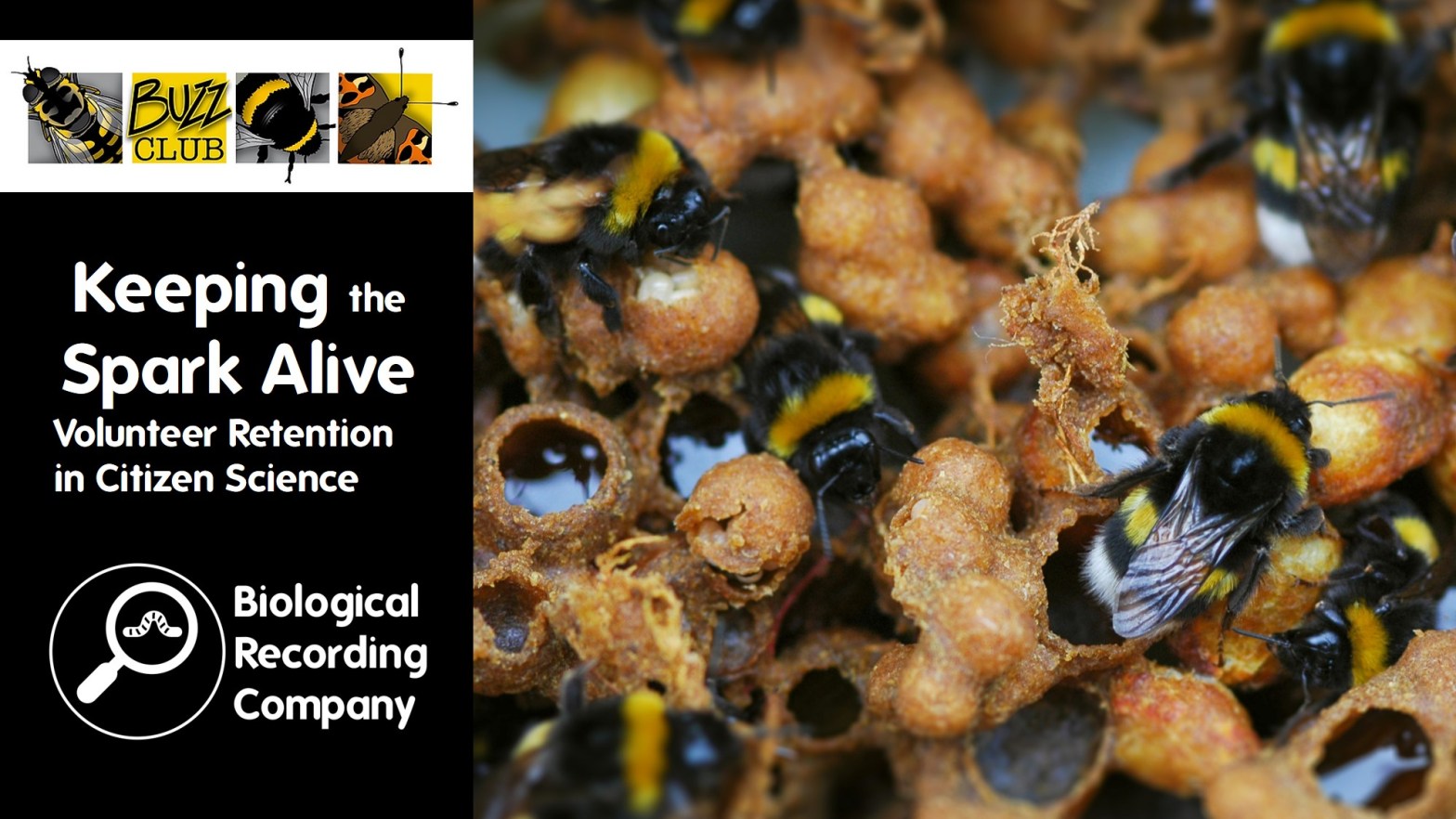
Citizen science relies on the data returned by volunteers – thus, such projects need to maximise the chances of that happening. Clear communication, transparency about methods and objectives, and fostering a sense of ownership and community are all extremely important to keeping volunteers engaged, and invested in the success of a project. Dr Linda Birkin will delve into her experience of striking this balance, from her PhD ‘Bees & Beans’ and into the Buzz Club’s current roster of projects.
Dr Linda Birkin is a Citizen Science Specialist, with a particular interest in urban entomology and outreach. After completing her PhD at the University of Sussex, Linda has been working for the Buzz Club since 2019.
Q&A with Dr Linda Birkin
- Did the data gathered have a direct impact on the volunteers?
The feedback that I received from volunteers as the project progressed (and I got better at retaining volunteers for it!) was that it helped them to ‘get their eye in’ for the insects that were visiting their garden. The project was teaching them about pollination and the bees that they were observing, and this led to them noticing other insect groups and they would look them up. So what they got from the project was less about their ability to grow beans and more about the organisms they were observing. This gave them a better understanding of aspects like insect ID and generally becoming more connected with the wildlife in their own garden environment. I don’t have any analysis that proves that this improved retention, but I think it is highly likely that it did! - How do you balance communicating with volunteers versus bombarding them with too much content?
When communicating about updates to a specific project, I think a monthly update is about right during the active period for the project (e.g. when bees are active for a project about pollinators). If it was once per week it is more likely that people will see the email and think “Another email from the Buzz Club, I’ll read that later” and then won’t. You can also put out more content more frequently through social media. I also make it clear when people sign up that they may get additional emails if there is an urgent or sudden update, for example, if we’ve learned that something wasn’t working and needs to be changed or there were some unforeseen circumstances. I’ve not had any complaints regarding the frequency of emails that I sent to volunteers, but it is definitely a balance to walk… you want people to remain engaged while not feeling bombarded.
Literature References
- Birkin (2018) Pollination ecosystem services and the urban environment: https://hdl.handle.net/10779/uos.23455604.v1
- Birkin & Goulson (2015) Using citizen science to monitor pollination services: https://resjournals.onlinelibrary.wiley.com/doi/10.1111/een.12227
- Dickinson et al (2012) The current state of citizen science as a tool for ecological research and public engagement: https://esajournals.onlinelibrary.wiley.com/doi/full/10.1890/110236
- Cooper et al (2007) Citizen Science as a Tool for Conservation in Residential Ecosystems: https://www.jstor.org/stable/26267884
- Kleinke et al (2018) Identifying Barriers to Citizen Scientist Retention When Measuring Pollination Services: https://theoryandpractice.citizenscienceassociation.org/articles/10.5334/cstp.99
- Roos et al (2012) UK Hedgehog Datasets and their potential for long-term monitoring: https://www.bto.org/our-science/projects/gbw/publications/papers/monitoring/btorr598
- Pocock et al (2014) A Strategic Framework to Support the Implementation of Citizen Science for Environmental Monitoring: https://www.ceh.ac.uk/sites/default/files/Citizen%20Science%20-%20A%20Strategic%20Framework%20to%20support%20implementation%20for%20environment%20monitoring.pdf
- Eveleigh et al (2013) “I want to be a Captain! I want to be a Captain!”: Gamification in the Old Weather Citizen Science Project: https://dl.acm.org/doi/pdf/10.1145/2583008.2583019
- Roy et al (2012) Understanding citizen science and environmental monitoring: final report on behalf of UK Environmental Observation Framework: https://www.brc.ac.uk/biblio/understanding-citizen-science-and-environmental-monitoring-final-report-behalf-uk
- Bell et al (2008) What counts? Volunteers and their organisations in the recording and monitoring of biodiversity: https://link.springer.com/article/10.1007/s10531-008-9357-9
- Wolcott et al (2008) Sustainability of a long-term volunteer-based bird monitoring program: recruitment, retention and attrition: https://www.researchgate.net/publication/277857825_Sustainability_of_a_long-term_volunteer-based_bird_monitoring_program_recruitment_retention_and_attrition
- Cohn (2008) Citizen Science: Can Volunteers Do Real Research?: https://academic.oup.com/bioscience/article/58/3/192/230689
- Tweddle et al (2012) Guide to citizen science: developing, implementing and evaluating citizen science to study biodiversity and the environment in the UK: https://www.ceh.ac.uk/sites/default/files/citizenscienceguide.pdf
- Schmeller et al (2009) Advantages of Volunteer-Based Biodiversity Monitoring in Europe: https://www.jstor.org/stable/29738730#:~:text=Volunteer-Based%20Biodiversity%20Monitoring%20with%20state-of-the-art%20survey%20designs%20or,schemes%20rather%20than%20by%20volunteer%20involvement%20per%20se.
- Evans et al (2005) The Neighbourhood Nestwatch Program: Participant Outcomes of a Citizen-Science Ecological Research Project: https://www.researchgate.net/publication/229786182_The_Neighborhood_Nestwatch_Program_Participant_Outcomes_of_a_Citizen-Science_Ecological_Research_Project
- Oberhauser & Prysby (2008) Citizen Science: Creating a Research Army for Conservation: https://academic.oup.com/ae/article/54/2/103/2474890
Further info and links
- Buzz Club webpage: https://www.thebuzzclub.uk/
More for environmental professionals

 Biological Recording
2 thoughts on “Keeping the Spark Alive: Volunteer Retention in Citizen Science”