
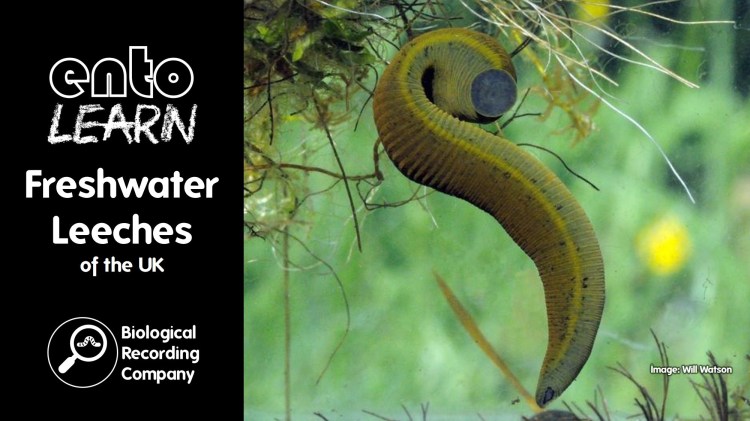
Despite their gruesome reputation leeches are fascinating animals. This talk will explore their natural history and cultural significance, including why leech conservation is important and what it involves. Craig will also give an overview of British leech diversity and provide information on some of the different species of leech and how to identify them.
As Conservation Director, Craig Macadam heads up the Conservation team at Buglife – The Invertebrate Conservation Trust. He leads Buglife’s freshwater work and is particularly interested in developing conservation action for less well-known species such as leeches.
Q&A with Craig Macadam
- Why are there relatively fewer species of leech in the UK compared to Europe?
We tend to have lower diversity of most groups in the UK. This is typical island biogeography. Great Britain has been harder to colonise for species since the last ice age because it involves crossing the English Channel and we will be further from the source population than our neighbours on mainland Europe. Climate change may impact this in the future too, as we’re seeing some species moving north through Europe as conditions change and new areas are now within the climatic envelope in which they can survive – but getting across the English Channel is still going to be a challenge for these species! - Have the leech species been mapped in the UK?
There was a leech atlas produced during the 80’s, but this is now obviously out of date as there have been changes. I’ve been working on a status review of leeches for Natural England and this will contain the most up-to-date data for leeches that we have and will be published by Natural England once it is complete. Most of this data comes from government agencies like the Scottish Environment Protection Agency (SEPA), Natural Resources Wales and the Environment Agency, meaning that there is a big focus on running water. So we need more people looking at leeches in still waters. - What is the size range of leeches in the UK?
Adult leeches range in size from about 10 mm to 200 mm, depending on the species. Measuring leeches is not easy because each individual leech will have a contracted length and an extended length. To measure Medicinal Leeches, we use the size of the rear (posterior) sucker as a proxy for its size. - How much can a leech see with its eyes?
the eyes are very primitive so leeches will not be able to see the kind of detail that insects can see with compound eyes or that we can see with our eyes. they’ll be able to detect the difference between light and dark only. - How long do leeches live?
Longer than you think! Some species do have an annual life cycle, but some of the larger species can live for 3-5 years and possibly even longer. - Are any leeches used as indicator species for the environments that they are found within?
Due to their diet, leech populations are likely to be closely linked to the organisms that they feed on. Therefore, leeches that prey on molluscs are going to follow the same patterns as the molluscs in an ecosystem. One thing that they can be a good indicator for, would be pollution from veterinary worming treatments such as avermectins. As worms, they are sensitive to these pollutants and we believe one of the drivers causing issues for the Medicinal Leech was the rise in worming treatment in the mid-1900s (as leeches would feed on livestock and be poisoned by the worming treatments within the blood). - Where can we submit records of leech observations?
We ask people to submit their leech observations through iRecord as this is where we are collating data for the Leech Recording Scheme. Photos are really useful for helping us to confirm the species, and these can be submitted with the record on iRecord. If you have a decent photo but aren’t sure of the species, you can still submit the record and choose the ‘Uncertain’ option in the certainty field and we’ll see if we can help with the ID. - How long would the leeches last as stock in pharmacies?
Typically they were transported in sacks of vegetation and then stored in the jars on the pharmacy counter. Within the jars, they would be stored in water and they would be starved so they were ready to use. Leeches can last a relatively long time between meals and would be fine until they were sold. - Do you know what species of leech has been feeding on amphibians in Hampshire?
This is quite a gruesome story! there have been reports of leeches feeding on the eyes of live toads and frogs on the Isle of Wight and spreading into Hampshire. We think that it is a new species of leech to the UK and are working on confirming this. We believe it is a species from Southern Europe that has managed to colonise and hope to have more news on this soon.
Literature references
- Macadam and Davies (2024) Guide to the Freshwater leeches of Britain and Ireland: https://www.field-studies-council.org/shop/publications/freshwater-leeches/
- Elliott and Dobson (2015) Freshwater Leeches of Britain and Ireland SP69: https://www.fba.org.uk/shop/p/book-43
- Elliott and Kutschera (2011) Medicinal leeches: Historical use, ecology, genetics and conservation: https://www.researchgate.net/publication/312940593_Medicinal_leeches_Historical_use_ecology_genetics_and_conservation
- Elliott & Tullet (1982) Provisional atlas of the freshwater leeches of the British Isles: https://aquadocs.org/handle/1834/22790
Further info
- Leech Recording Scheme website https://leechrecordingscheme.co.uk/
- Freshwater Leeches – Identification and Ecology blog by Rachel Davies: https://www.field-studies-council.org/2022/10/26/freshwater-leeches-identification-and-ecology/
- Species on the Edge (main webpages) – https://www.nature.scot/scotlands-biodiversity/species-edge
- Species on the Edge (Buglife projects) – https://www.buglife.org.uk/projects/species-on-the-edge/?gclid=CjwKCAiAq4KuBhA6EiwArMAw1AGzJrS5nnPm-D0baDJIq3FuJTUzVwN75SBeqttnekEKyONc7wYfNxoCngMQAvD_BwE
- Submit your leech records to iRecord: https://irecord.org.uk/
entoLIVE
entoLIVE webinars feature guest invertebrate researchers delving into their own invertebrate research. All events are free to attend and are suitable for adults of all abilities – a passion for invertebrates is all that’s required!
- Donate to entoLIVE: https://www.gofundme.com/f/entolive-2025
- Upcoming entoLIVE webinars: https://www.eventbrite.com/cc/entolive-webinars-74679
- entoLIVE blog: https://biologicalrecording.co.uk/category/entolive-blog/
- entoLIVE on YouTube: https://youtube.com/playlist?list=PLuEBNUcfMmE95Re19nMKQ3iX8ZFRFgUAg&feature=shared
entoLIVE is delivered by the Biological Recording Company in partnership with the British Entomological & Natural History Society, Royal Entomological Society and Amateur Entomologists’ Society, with support from Buglife, Field Studies Council and National Biodiversity Network Trust.
The entoLIVE programme is delivered by Biological Recording Company and receives sponsorship from the following organisations:
- British Entomological & Natural History Society
- Royal Entomological Society
- Amateur Entomogists’ Society
More on invertebrates
 Biological Recording