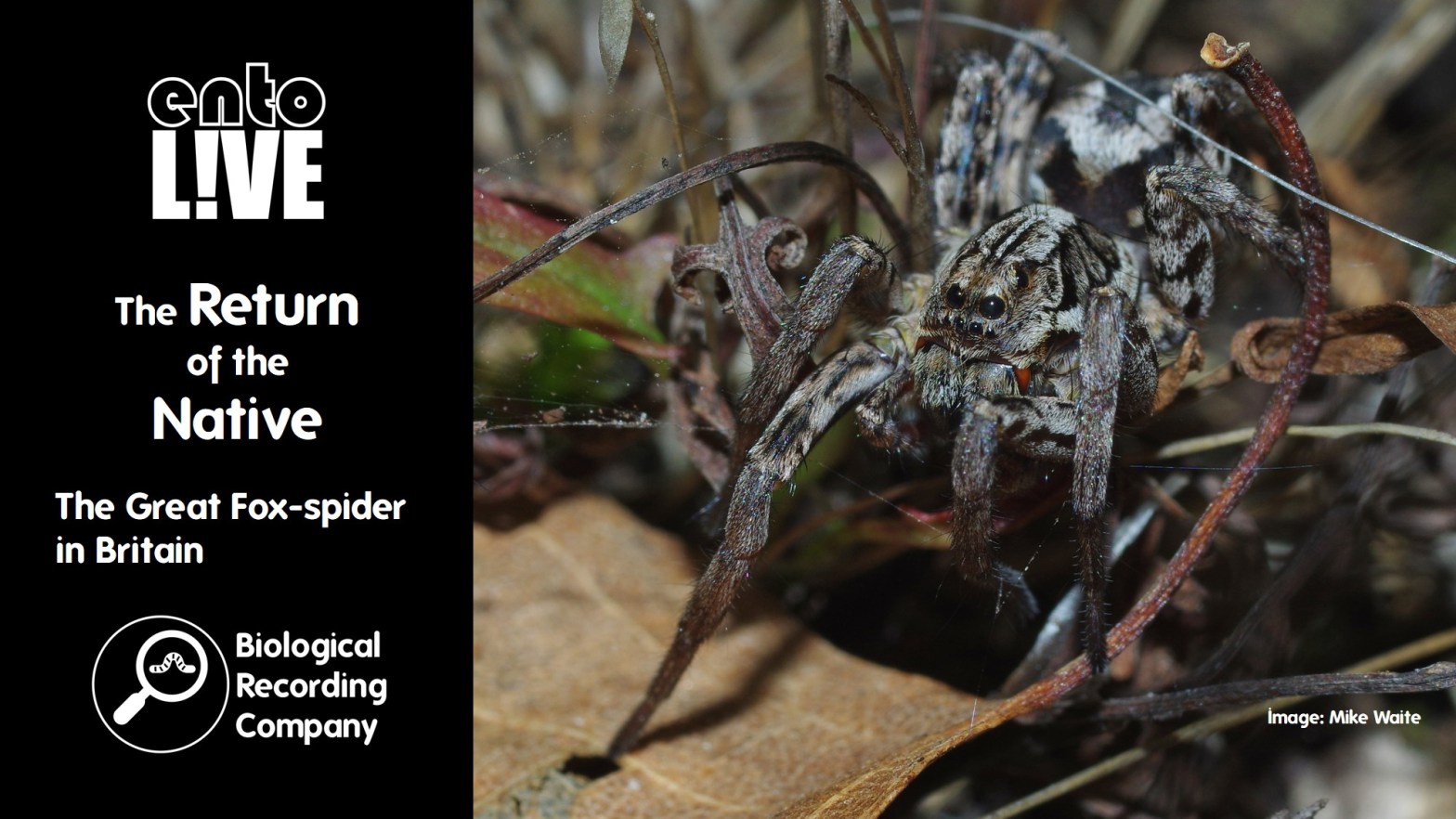
With excellent eyesight, camouflage and speed, the Great Fox-Spider (Alopecosa fabrilis) is one of the largest of the Wolf-Spider family (Lycosidae) of spiders. An opportunistic predator which hunts at night, it is named for its wolf-like habit of chasing down its prey, across sandy terrain, over gravel and rocks before pouncing and capturing insects on the run. The Great Fox-Spider is Red-listed as ‘Critically Endangered’ and was feared to no longer exist in the UK as it had only ever been found at three sites but hadn’t been seen since 1999. This presentation will provide a status report on the rediscovery of the Great Fox-spider in the UK and provide autecological observations of the spider, contrasted with research in continental Europe. Modern threats to the species on its two present British sites will also be discussed.
Mike Waite is Director of Research & Monitoring at the Surrey Wildlife Trust. He is an experienced ecologist and naturalist, having worked previously with the Nature Conservancy Council, private consultancy, the London Ecology Unit and the GLA. His interest in spiders is a relatively new one, but no less intense for that.
Q&A with Mike Waite
- How big is the Great Fox-spider?
Spiders are measured from the tip of the head to the spinnerets on the end of the abdomen. Females are about 18 mm and males are slightly smaller (about 16 mm). With the legs, they look a lot bigger. - What was the name of the spider-hunting wasp referenced in the presentation?
It was a wasp from the family Pompilidae called Arachnospila rufa and more information about this species can be found on the species page on the BWARS website. - How do these spiders dig?
They dig with their forelegs and then reverse and use their back legs to shovel out material. - How many Great Fox-spiders make it through to adulthood?
This is a great question and one we still know very little about. Spiders often have lots of young due to the risks of high-risk predation on spiderlings. These spiders take 2 years to reach maturity which means that young Great Fox-spiders have a relatively long period where they are exposed to predation risks and not producing young. It is a fair assumption that this species may have smaller numbers reaching sexual maturity, making it more vulnerable. - Where else can you find Great Fox-spiders?
Their global distribution extends as far as China, though I don’t believe that this is continuous. They are certainly widespread across Europe and the studies I mentioned in the presentation were from the dune systems of Belgium and France. I think it would certainly be worth looking at potential sites across the UK where the habitat is suitable and searching using night-time surveys. I wouldn’t discount the dune systems across the North Sea coast. - Can we reintroduce this species to new sites to conserve this species in the UK?
There are strict guidelines from the IUCN regarding reintroductions to consider before this is attempted, such as establishing that reintroducing this species would not have any negative impacts on other threatened species. It would also be important to establish what the extinction drivers are for this species, as we wouldn’t want to reintroduce these animals to a site where the population would face the same issue. We would first look for sites with ideal habitat, i.e. 100% similar to the known sites. We would then put some extra effort into figuring out the ecological communities of these sites to assess the risk on other species, with the idea being that it matched the ecological community of the existing sites. In terms of ongoing management of the site, we would be recommending the standard management practices for a dry heathland habitat. For example, managing a site for heathland reptiles includes ensuring plenty of bare ground scrapes are present and this is ideal for the great Fox-spider.
Literature references
- Bonte (2004) Distribution of spiders in coastal grey dunes: spatial patterns and evolutionary-ecological importance of dispersal (PhD Thesis): https://www.vlaanderen.be/publicaties/distribution-of-spiders-in-coastal-grey-dunes-spatial-patterns-and-evolutionary-ecological-importance-of-dispersal
- Bonte et al (2002) Spider assemblage structure & stability in a heterogeneous coastal dune system (Belgium): https://www.biodiversitylibrary.org/part/227125
- Bonte & Maelfait (2005) Spatial association between a spider wasp and its host in fragmented dune habitats: https://pureportal.inbo.be/en/publications/spatial-association-between-a-spider-wasp-and-its-host-in-fragmen
- Goldenberg et al (2021) Substrate thermal properties influence ventral brightness evolution in ectotherms: https://www.nature.com/articles/s42003-020-01524-w
- Harvey et al (2017) A review of the scarce and threatened spiders (Araneae) of Great Britain: Species Status No.22.: https://naturalresources.wales/media/683018/nrw-evidence-report-11-spider-status-review.pdf
- Hughes (2012) Investigation & survey into the records of Altella lucida and Alopecosa fabrilis at Morden Bog National Nature Reserve. Natural England.
- Waite (2017) The State of Surrey’s Nature: https://www.surreywildlifetrust.org/sites/default/files/2017-12/State%20of%20Nature%20in%20Surrey%20Web.pdf
Further info
- Surrey Wildlife Trust Rediscovers Great Fox-Spiders news article: https://www.surreywildlifetrust.org/news/surrey-wildlife-trust-rediscovers-great-fox-spiders
- British Arachnological Society: https://britishspiders.org.uk/
entoLIVE
entoLIVE webinars feature guest invertebrate researchers delving into their own invertebrate research. All events are free to attend and are suitable for adults of all abilities – a passion for invertebrates is all that’s required!
- Donate to entoLIVE: https://www.gofundme.com/f/entolive-2025
- Upcoming entoLIVE webinars: https://www.eventbrite.com/cc/entolive-webinars-74679
- entoLIVE blog: https://biologicalrecording.co.uk/category/entolive-blog/
- entoLIVE on YouTube: https://youtube.com/playlist?list=PLuEBNUcfMmE95Re19nMKQ3iX8ZFRFgUAg&feature=shared
entoLIVE is delivered by the Biological Recording Company in partnership with the British Entomological & Natural History Society, Royal Entomological Society and Amateur Entomologists’ Society, with support from Buglife, Field Studies Council and National Biodiversity Network Trust.
The entoLIVE programme is delivered by Biological Recording Company and receives sponsorship from the following organisations:
- British Entomological & Natural History Society
- Royal Entomological Society
- Amateur Entomogists’ Society
More on invertebrates
 Biological Recording