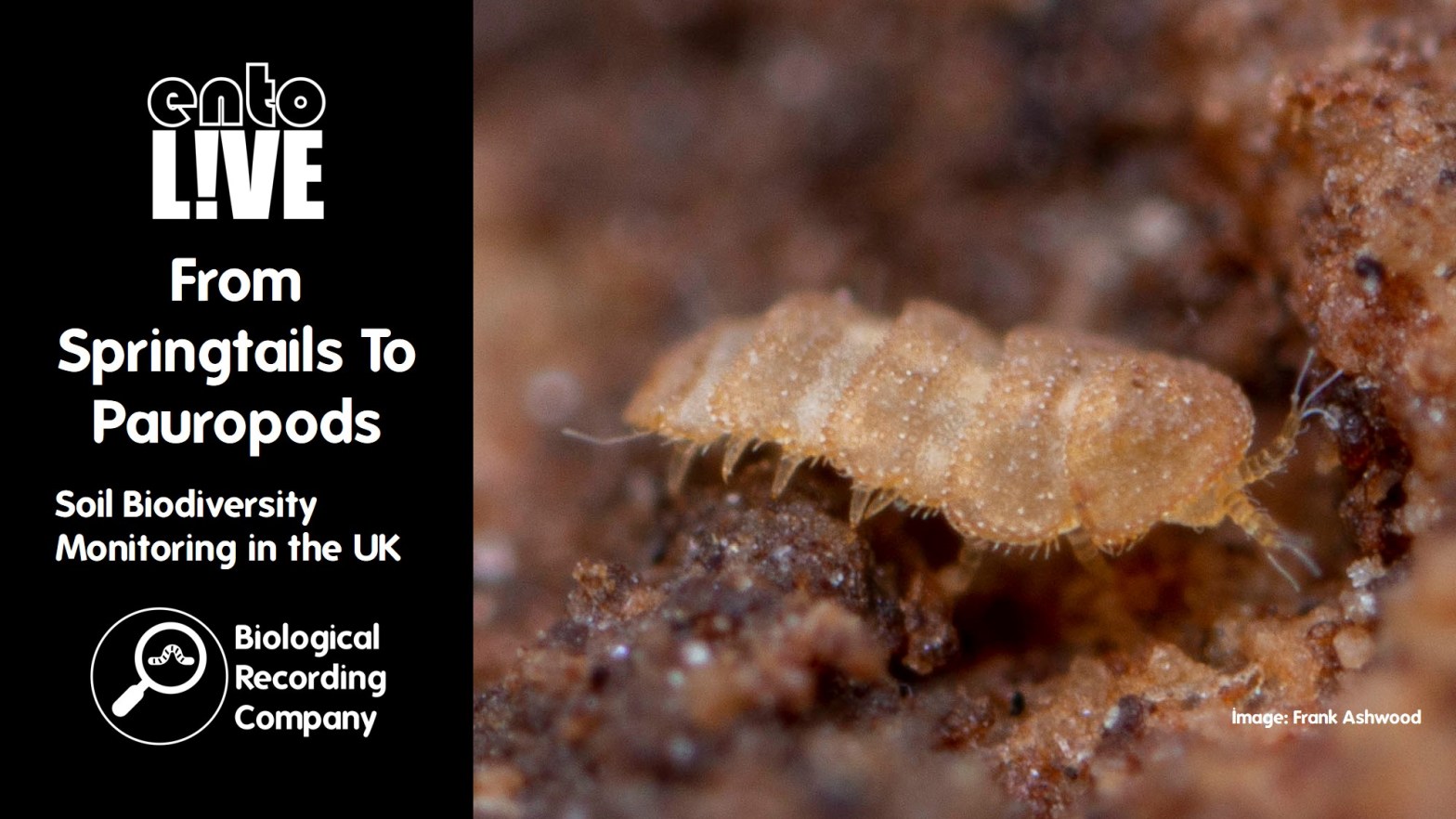
Beneath our feet, soils are home to a diverse variety of invertebrates. These range from familiar animals (such as earthworms) to less familiar organisms (such as pauropods and two-pronged bristletails). Understanding which species are present (and which are absent) within a specific soil ecosystem can help us better understand the condition and health of soils. Frank will give an overview of the major soil biodiversity monitoring projects currently being undertaken in the UK and globally.
Dr Frank Ashwood is a soil ecologist working for Forest Research, specialising in soil fauna such as earthworms and microarthropods. His research studies the links between soil fauna and soil functions, and the environmental drivers of soil animal communities in the UK.
Q&A with Dr Frank Aswood
- How far down should you sample for soil invertebrates?
Some soil organisms do go down quite deep – with some earthworms going down several metres for example. However, most soil organisms are found within the top 10-15 cm of soil (and in the litter layer), so most sampling tends to occur there. There are also sampling technique limitations, with sampling deeper being more difficult and/or resource intensive. - Does the UK’s contribution to European soil biodiversity monitoring initiatives come from academics, biological recorders or consultants?
The bulk of records come from academic/governmental research. It really depends on who the call for data is sent to, and when data is collated at this scale it is most likely to be gathered at the institute level rather than by individuals. Coverage of soil organisms in terms of biological recording is very patchy within the UK, with the centipede, millipede and woodlouse recording schemes being relatively active and long-running, while other groups have no recording scheme at all (such as potworms and nematodes). - What kind of surveys would you recommend for managing soils for conservation work?
Soil biodiversity surveys would be useful to inform conservation. You would most likely want to focus on a group that helps you measure specific improvements. For example, if converting farmland to grassland you may want to measure the change in earthworm diversity, abundance and biomass. I’ve found that microarthropods (such as springtails and mites) can be useful as they are very reactive to the environment conditions, particularly to disturbance. Once you understand the ecology of these groups, they can be really effective bioindicators. However, we have a relatively small pool of people skilled in the taxonomic identification of these groups because they are technically difficult, so we need to get more people skilled in the ID of springtails and mites! - Are we at the stage where we can use soil biodiversity to measure the health of the soil?
People are looking at the ecology of these invertebrate groups (sometimes in their spare time) and we tend to know which tropic guilds different species belong to. So, the basic ecological understanding is there, but the challenge to using them as indicators of soil health is building up a pool of people that can undertake the identification of these groups. - Are there fossil records that enable us to understand how long different species of soil invertebrates have been around?
Yes – some of the earliest terrestrial invertebrate fossils are of springtails and mites. There is a piece of flint-like rock formation near Aberdeen called the ‘Rhynie Chert’, which is a 400-million-year-old snapshot of early Earth that has fossils of springtails, and they are pretty much unchanged from what we have today! - What is the response of soil invertebrates to climate change?
There will certainly be impacts, related to flooding and soil drought for example, but tolerance will depend on each species or group. - What can people do in their gardens to help soil biodiversity?
Do nothing! Soil biodiversity does best when humans do less. So my advice is to leave your garden alone and manage it less. Organic matter is important, so let leaves fall where they fall. Adopt a “no dig” policy if possible.
Literature references
- Anthony et al (2023) Enumerating soil biodiversity: https://doi.org/10.1073/pnas.2304663120
- Bottinelli et al (2020) An explicit definition of earthworm ecological categories–Marcel Bouché’s triangle revisited: https://www.sciencedirect.com/science/article/abs/pii/S0016706119322323?via%3Dihub
- Buchkowski et al (2023) Soilfoodwebs: An R Package for Analyzing and Simulating Nutrient Fluxes Through Food Webs: https://papers.ssrn.com/sol3/papers.cfm?abstract_id=4451229
- Kestel et al (2022) Applications of environmental DNA (eDNA) in agricultural systems: Current uses, limitations and future prospects: https://pubmed.ncbi.nlm.nih.gov/35882340/
- Morriën (2016) Understanding soil food web dynamics, how close do we get?: https://doi.org/10.1016/j.soilbio.2016.06.022
- Orgiazzi et al (2016) Global soil biodiversity atlas: https://op.europa.eu/en/publication-detail/-/publication/c54ece8e-1e4d-11e6-ba9a-01aa75ed71a1/language-en
- Potapov (2020) Towards a global synthesis of Collembola knowledge: challenges and potential solutions: https://soil-organisms.org/index.php/SO/article/view/135
- Potapov (2022) Multifunctionality of belowground food webs: resource, size and spatial energy channels: https://doi.org/10.1111/brv.12857
- White et al (2020) Methods and approaches to advance soil macroecology: https://doi.org/10.1111/geb.13156
Further info
- Frank Ashwood Macrophotography: https://www.frankashwood.com/macrophotography
- Global Soil Biodiversity Initiative: https://www.globalsoilbiodiversity.org/
- EUdaphobase: https://www.eudaphobase.eu/
- National Earthworm Recording Scheme Bulletin: https://shorturl.at/ejkT0
- Earthworm AIDGAP from the FSC: https://www.field-studies-council.org/shop/publications/earthworms-aidgap/
- Springtail AIDGAP from the FSC: https://www.field-studies-council.org/shop/publications/springtails-aidgap/
entoLIVE
entoLIVE webinars feature guest invertebrate researchers delving into their own invertebrate research. All events are free to attend and are suitable for adults of all abilities – a passion for invertebrates is all that’s required!
- Donate to entoLIVE: https://www.gofundme.com/f/entolive-2025
- Upcoming entoLIVE webinars: https://www.eventbrite.com/cc/entolive-webinars-74679
- entoLIVE blog: https://biologicalrecording.co.uk/category/entolive-blog/
- entoLIVE on YouTube: https://youtube.com/playlist?list=PLuEBNUcfMmE95Re19nMKQ3iX8ZFRFgUAg&feature=shared
entoLIVE is only possible due to contributions from our partners.
- Find out about more about the British Entomological & Natural History Society: https://www.benhs.org.uk/
- Browse the list of identification guides and other publications from the Field Studies Council: https://www.field-studies-council.org/shop/
- Check out environmentjob.co.uk for the latest jobs, volunteering opportunities, courses and events: https://www.environmentjob.co.uk/
- Check out the Royal Entomological Society‘s NEW £15 Associate Membership: https://www.royensoc.co.uk/shop/membership-and-fellowship/associate-member/
More on invertebrates
 Biological Recording