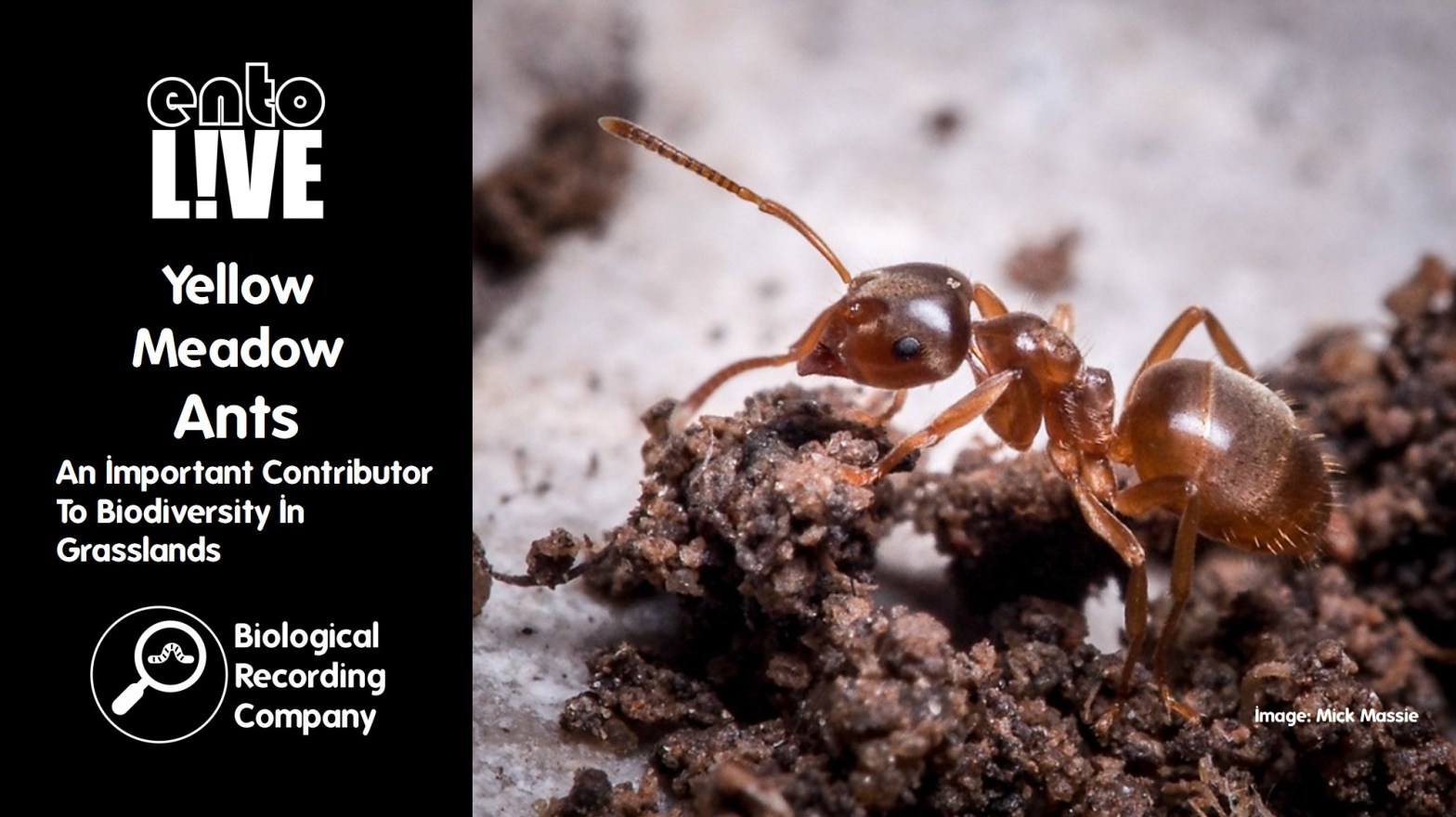
The subterranean Yellow Meadow Ant (Lasius flavus) dominates the soil of many old grasslands; their long-lived mounds gain volume with time and their underground influence extends as adjacent colonies coalesce. The mounds often support a different plant community from the surrounding grassland and plant species lacking elsewhere. The ants support many specialist aphids on underground roots, the warm bare soil provides oviposition sites, and several specialist invertebrates live with the ants or prey on them. The sides of the convex mounds facing north, south, east and west considerably increase the range of microhabitats. Much of the surrounding grassland was ex-anthill.
Dr Tim King, based in Oxford, has been accumulating information on the yellow meadow ant for over 55 years. Originally he was interested in the reasons why the mounds have a distinct plant community. Recently he has spent much time in investigating associated invertebrates, examining whether mounds can be used to age grasslands, reading the literature and spreading the word to conservationists about the role of this important, but neglected, ant species.
Q&A with Dr Tim King
- Do Yellow Meadow Ants (Lasius flavus) and Black Garden Ants (Lasius niger) co-exist at a site or will one species eventually dominate?
The Yellow Meadow Ant will eventually dominate. These species occupy habitats at different stages of succession. Lasius niger is a tramp species that will colonise early on and feeds on invertebrates above ground. The specialised aphids will migrate in eventually and the Yellow Meadow Ant will follow. - Are the ant hills in grasslands always created by Yellow Meadow Ants?
They are certainly the main producers of ant hills. However, occasionally you will find temporary mounds in flood meadows that have been created by Lasius niger. They only last for a short period as flood meadows are usually mown for hay or grazed by cattle. These mounds can be created remarkably rapidly, but don’t last for more than a year or two. - What mowing regime is recommended where ant hills are present?
At Brompton Cemetery there are thousands of ant hills. Rather than mowing over the mounds and flattening the ant colonies, the site is managed by using strimmers and stimming over the top of the ant hills. We need to preserve the surface of ant hills and be aware of the damage that mowing can do. Scything the surface is an alternative. - Do Yellow Meadow Ants require a dry environment?
In many areas that flood regularly, there are no Lasius flavus mounds. If the ants are flooded for more than 6 hours the colony will usually die out. There are places, such as the Old Hall Marshes in Norfolk, where the ants’ colonies survive between the tide marks as part of salt marshes, that are frequently flooded (twice per day) but for less than 6 hours at a time. Ants can also sometimes survive if they are trapped in air pockets during flooding events. - Are queens produced at a specific time of year?
A vigorous mound will produce up to 500 queens within a year (though usually around 200). These appear from the beginning of July onwards. The nuptial flight for Lasius flavus tends to be around the end of August or the beginning of September. This is later than the Lasius niger nuptial flight, which tends to take place at the beginning of July. Timings will vary by year and be impacted by the weather and temperature.
Literature references
- King (2006) The value of ant-hills in grasslands: https://www.britishwildlife.com/article/article-volume-17-number-6-page-392-397/
- King and Balfour (2020) A technique for the translocation of ant colonies and termite mounds to protect species and improve restoration efforts: https://doi.org/10.1111/csp2.154
- King (2020) The persistence of Lasius flavus ant-hills and their influence on biodiversity in grasslands: https://ora.ox.ac.uk/objects/uuid:57fbce82-4488-4745-b065-cf860e6d32af
- King (2021) Ant-hill heterogeneity and grassland management: https://doi.org/10.1002/2688-8319.12037
entoLIVE
entoLIVE webinars feature guest invertebrate researchers delving into their own invertebrate research. All events are free to attend and are suitable for adults of all abilities – a passion for invertebrates is all that’s required!
- Donate to entoLIVE: https://www.gofundme.com/f/entolive-2025
- Upcoming entoLIVE webinars: https://www.eventbrite.com/cc/entolive-webinars-74679
- entoLIVE blog: https://biologicalrecording.co.uk/category/entolive-blog/
- entoLIVE on YouTube: https://youtube.com/playlist?list=PLuEBNUcfMmE95Re19nMKQ3iX8ZFRFgUAg&feature=shared
entoLIVE is only possible due to contributions from our partners.
- Find out about more about the British Entomological & Natural History Society: https://www.benhs.org.uk/
- Browse the list of identification guides and other publications from the Field Studies Council: https://www.field-studies-council.org/shop/
- Check out environmentjob.co.uk for the latest jobs, volunteering opportunities, courses and events: https://www.environmentjob.co.uk/
- Check out the Royal Entomological Society‘s NEW £15 Associate Membership: https://www.royensoc.co.uk/shop/membership-and-fellowship/associate-member/

More on invertebrates
 Biological Recording
One thought on “Yellow Meadow Ants: An Important Contributor To Biodiversity In Grasslands”