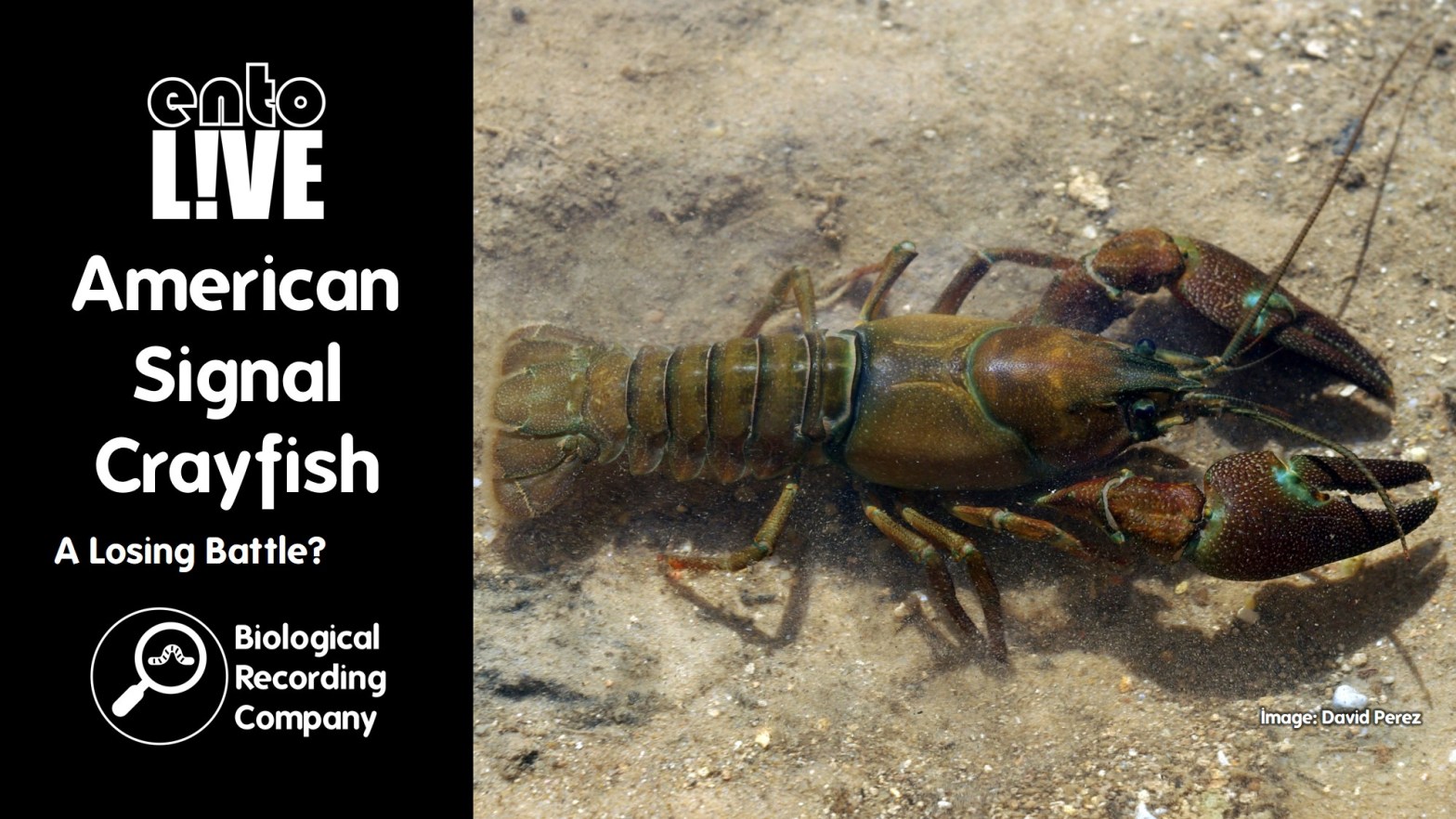
American Signal Crayfish (Pacifastacus leniusculus) have been widely established in the UK since the 1970s and have had many adverse impacts including the near extinction of the native White-clawed Crayfish (Austropotamobius pallipe). This presentation discusses efforts to control this invasive species in southwest England.
Q&A with Dr Nicky Green
Dr Nicky Green has been working with crayfish since 2003 and has recently completed a PhD on the control of American signal crayfish. She focuses on practical and effective methods to control invasive crayfish and has worked on Exmoor and elsewhere since 2015 trialling new and innovative techniques.
Does the addition of refuges possibly help Signal Crayfish populations?
No, the refuges are being used as a trap. The refuges are checked regularly and the crayfish you find are removed. So the crayfish are not in the refuges long enough to benefit from this habitat.
Are Signal Crayfish able to get around the crayfish barriers by moving over land?
It’s part of the recommended design that the vertical slippery-sided walls are present (such as non-rusting metal sides like copper). If a barrier is poorly designed, the crayfish will bypass the barrier and it will not be effective.
How were the crayfish sterilised in your study?
We used a mechanical method where the gonopods (used to transfer sperm from the male to the female during mating) were removed. These are removed using scissors and is a quick and painless procedure. Our study had high survival rates and did not lead to mortalities.
What happens to American Signal Crayfish once they are caught?
As a non-native invasive species, American Signal Crayfish should be dispatched when caught. The most ethical method of dispatching a crayfish is to make a cut through the carapace from front to back (as this is where its heart, brain and nervous system are) and it is very quick. It used to be advised to freeze them but this takes a while for them to die and involves transporting them around in a bucket all day until you get them to the freezer which causes stress and is not practical in the field. It is now illegal to transport live crayfish so you must dispatch them bankside.
What should long-term management be resourced and who is responsible?
There have been discussions about the creation of a crayfish strategy and funding of crayfish control. I’ve advised that there is little point in taking this forward until we understand what works and what impact control has. I don’t believe there is any point in throwing money at something that is not guaranteed to work. Crayfish control can be very expensive and may even be futile. The current situation involves a lot of grassroots organisations doing what they can on a shoestring budget, but we’re not yet at the stage where large amounts of central funding would be effective.
Do you think that it is a losing battle or is their hope for Signal Crayfish control?
I think that there is hope down the line. There is a real need for dissemination and concerted effort. The recently created GB invasive crayfish steering group aims to review current invasive crayfish control efforts and provide recommendations to relevant stakeholders. I’m also teamed up with the Biological Recording Company to host the Signal Crayfish Virtual Symposium to facilitate the sharing of crayfish control research from across Europe and taught their Crayfish & Surveys training webinars.
What is the one thing that naturalists can do to help when it comes to American Signal crayfish?
The key thing is to make sure that we are reporting all instances where we come across crayfish. That includes reporting sightings of the invasive American Signal Crayfish and the native White-clawed Crayfish – or any other type of crayfish! I recommend photographing the crayfish and sending your record to iRecord or the Local Environmental Records Centre, and also.
Literature references
- Chadwick et al (2020) A novel ‘triple drawdown’ method highlights deficiencies in invasive alien crayfish survey and control techniques: https://www.researchgate.net/publication/344627314_A_novel_’triple_drawdown’_method_highlights_deficiencies_in_invasive_alien_crayfish_survey_and_control_techniques
- Faller et al (2016) River bank burrowing by invasive crayfish: spatial distribution, biophysical controls and bio geomorphic significance: https://www.sciencedirect.com/science/article/abs/pii/S0048969716313651?via%3Dihub
- Green et al (2018) Trapping for invasive crayfish: comparisons of efficacy and selectivity of baited traps versus novel artificial refuge traps: https://www.researchgate.net/publication/323731462_Trapping_for_invasive_crayfish_Comparisons_of_efficacy_and_selectivity_of_baited_traps_versus_novel_artificial_refuge_traps
- Green et al (2020) Dominance, reproductive behaviours and female mate choice in sterilised versus non-sterilised invasive male crayfish: https://link.springer.com/article/10.1007/s10452-020-09779-5
- Green (2022) Evaluating the population control of invasive crayfish using removals and male sterilisation (Doctoral dissertation, Bournemouth University): https://eprints.bournemouth.ac.uk/36522/
- Green et al (2022). Mechanical male sterilisation in invasive signal crayfish Pacifastacus leniusculus: persistence and functionality in captive and wild conditions: https://www.kmae-journal.org/articles/kmae/full_html/2022/01/kmae220026/kmae220026.html
- Hein et al (2007) Intensive trapping and increased fish predation cause massive population decline of an invasive crayfish: https://onlinelibrary.wiley.com/doi/abs/10.1111/j.1365-2427.2007.01741.x
- Krieg & Zenker (2020) A review of the use of physical barriers to stop the spread of non-indigenous crayfish species: https://www.researchgate.net/publication/341913315_A_review_of_the_use_of_physical_barriers_to_stop_the_spread_of_non-indigenous_crayfish_species
- Marshall & Nightingale (2022) Crayfish Conservation Manual: https://www.nhbs.com/crayfish-conservation-manual-book
- McFarlane et al (2018) CRISPR-based gene drives for pest control: https://pubmed.ncbi.nlm.nih.gov/29221716/
- Peay et al (2019) Biocide treatment of invasive signal crayfish: successes, failures and lessons learned: https://www.mdpi.com/1424-2818/11/3/29
- Rice (2014) Diel patterns of suspended sediment flux and the zoogeomorphic agency of invasive crayfish: https://www.researchgate.net/publication/265395392_Diel_patterns_of_suspended_sediment_flux_and_the_zoogeomorphic_agency_of_invasive_crayfish
Further info
- Crayfish Surveys and Conservation online training course: https://courses.biologicalrecording.co.uk/courses/crayfish
- All About Crayfish in-pperson training course: https://crayfishuk.org/wp/training/
- Signal Crayfish Virtual Symposium content: https://courses.biologicalrecording.co.uk/courses/signal-crayfish-virtual-symposium
- Nicky Green Associates website: https://crayfishuk.org/wp/
entoLIVE
entoLIVE webinars feature guest invertebrate researchers delving into their own invertebrate research. All events are free to attend and are suitable for adults of all abilities – a passion for invertebrates is all that’s required!
- Donate to entoLIVE: https://www.gofundme.com/f/entolive-2025
- Upcoming entoLIVE webinars: https://www.eventbrite.com/cc/entolive-webinars-74679
- entoLIVE blog: https://biologicalrecording.co.uk/category/entolive-blog/
- entoLIVE on YouTube: https://youtube.com/playlist?list=PLuEBNUcfMmE95Re19nMKQ3iX8ZFRFgUAg&feature=shared
entoLIVE is only possible due to contributions from our partners and supporters.
- Find out about more about the British Entomological & Natural History Society: https://www.benhs.org.uk/
- Browse the list of identification guides and other publications from the Field Studies Council: https://www.field-studies-council.org/shop/
- Check out environmentjob.co.uk for the latest jobs, volunteering opportunities, courses and events: https://www.environmentjob.co.uk/
- Learn more about the Nurturing Nature project: https://cranbornechase.org.uk/chaseandchalke/nurturing-nature/
- Check out the Royal Entomological Society‘s NEW £15 Associate Membership: https://www.royensoc.co.uk/shop/membership-and-fellowship/associate-member/

More on freshwater biology




 Biological Recording
One thought on “American Signal Crayfish: A Losing Battle?”