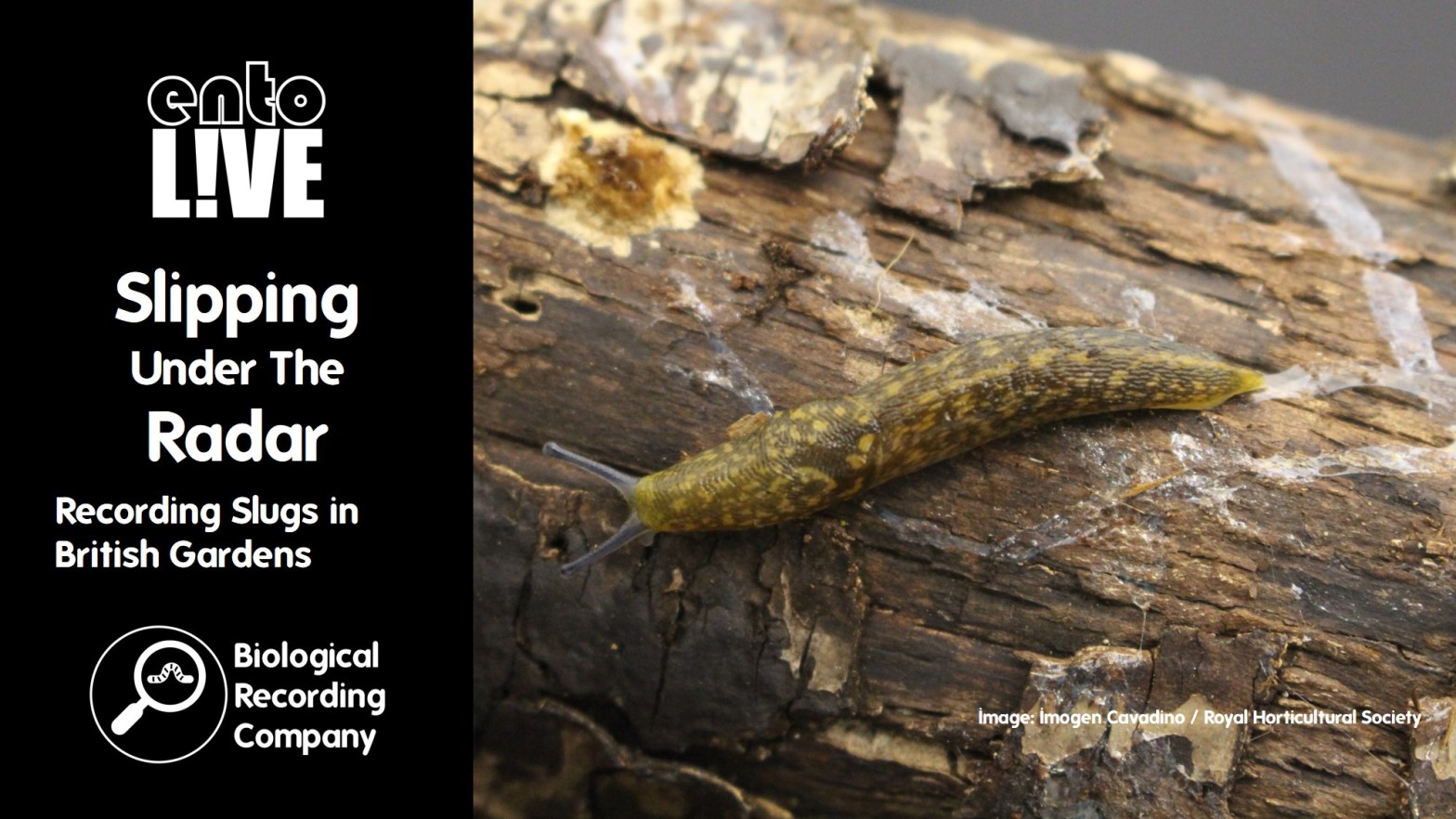
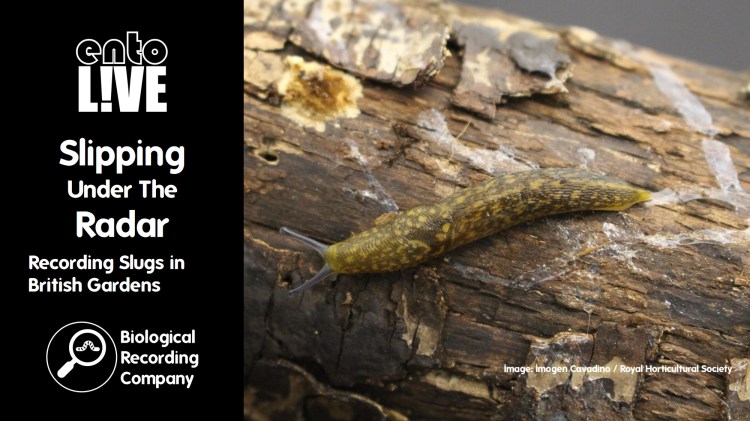
Slugs are widely known as a problem for gardener’s, but surprisingly little recording has been done in UK gardens for them. In this talk we hear about the citizen science research Imogen has been running; from the species-specific Cellar Slug survey, to “Slugs Count” the first in-depth study of the British garden slug fauna since the 1940s. We’ll hear how over 22,000 new slug records made by the public have helped inform our understanding of the slug fauna in Britain and evidence the large scale changes we are seeing over recent decades.
Imogen Cavadino looked at the slug species diversity and ecology in UK gardens as part of her PhD with Newcastle University and the Royal Horticultural Society. She is ordinary committee member for the Conchological Society of Britain and Ireland, council member for National Forum for Biological Recording and acts as a verifier for terrestrial mollusc records on iRecord. She is a keen advocate for this often unloved and overlooked fascinating group of terrestrial invertebrates.
Q&A with Dr Imogen Cavadino
- If I have photos of possible cellar slugs, where can I send them for identification?
It’s best to submit your record with photos to iRecord and Chris or I will try to give some helpful feedback. We welcome records where the recorder has made their best guess – just indicate with the certainty field that you are ‘uncertain’. If you’re really not sure which species it is, you can always submit it to genus level only (i.e. a record of Limacus) and we’ll try our best to get it to species from the photo. You can also submit to the Facebook group to get a second opinion, or just Tweet it to me and I’ll reply there. - There seem to be gaps in some parts of the UK, such as southwest Scotland. Is this due to a lack of species present in these areas or did you not get full coverage of the UK?
We tried to get as much coverage of the UK as possible, but there were gaps. We had coverage from the applications, but some of these weren’t able to take part. We started recruitment just as Covid hit the UK so it was quite a challenging time for people. Although the project is finished, records for these areas can still be submitted through iRecord to help the recording scheme fill some of these gaps. I’m always happy to undertake freelance courses in these areas for any projects or organisations that have funding for delivering training. - Is the Budapest Slug pests of anything and should we consider thinking about how to conserve them?
They are considered a pest of root vegetables and are quite common in semi-natural habitats. As a non-native species, we usually wouldn’t prioritise them for conservation. For molluscs, we only consider species that have been here since the last ice age. What constitutes a native species is highly debated. - Are the hybrid slugs fertile or are they unable to reproduce sexually?
As far as we are aware, the hybrid slugs are all fertile and able to breed. Hybridisation is highly complicated and appears to be more common in some genera than others. - Was the Barnes and Weil research driven by the ‘Dig For Victory’ campaign or just for an interest in slugs?
Barnes was definitely into his slugs! Barnes did another study that you definitely wouldn’t get away with today. He introduced a highly pestiferous pest species (Deroceras reticulatum) into the garden of a property he owned to see how the population fared – and it grew exponentially! - What is it that attracts slugs into houses?
Some cases will be purely accidental, but some cases may be due to certain things that they are attracted to. They like things that are damp and can be attracted by foodstuffs, like animal feed or damp cereals – so you do get them attracted to pet bowls. they used to enter my parent’s kitchen regularly but all of a sudden stopped – I think partly because my parents installed underfloor heating! - Do Leopard Slugs eat other slugs?
There is evidence that Leopard Slugs (Limax maximus) will attack other slug species. It’s likely that this is territorial rather than predatory. They will also feed on dead slugs. We don’t have strong evidence to show that they attack and eat other slugs as a common behaviour as most of the cases where this has been observed are under unnatural laboratory conditions.
Literature references
- Cavadino (2022) A review of terrestrial slug and snail species of potential threat to plant health in Britain – PH04103: https://randd.defra.gov.uk/ProjectDetails?ProjectId=20744
- Barnes & Weil (1944) Slugs in Gardens: Their Numbers, Activities and Distribution. Part I: https://www.jstor.org/stable/1449
- Barnes & Weil (1945) Slugs in Gardens: Their Numbers, Activities and Distribution. Part 2: https://www.jstor.org/stable/1386
- Barnes (1953) The absence of slugs in a garden and an experiment in re-stocking: https://doi.org/10.1111/j.1096-3642.1953.tb00154.x
- Bjørn A. Hatteland et al (2015) Introgression and Differentiation of the Invasive Slug Arion vulgaris from Native A. ater: https://doi.org/10.4002/040.058.0210
- Davey (1994) Self-reported fears to common indigenous animals in an adult UK population: The role of disgust sensitivity: https://bpspsychub.onlinelibrary.wiley.com/doi/10.1111/j.2044-8295.1994.tb02540.x
- Driscoll (1995) Attitudes Towards Animals: Species Ratings paper: https://www.animalsandsociety.org/wp-content/uploads/2015/10/wileydriscoll.pdf
- Rollo (1978) The behavioural ecology of terrestrial slugs: https://open.library.ubc.ca/collections/ubctheses/831/items/1.0094516
- Rollo (1983) Consequences of competition on the time budgets, growth and distributions of three species of terrestrial slugs: https://doi.org/10.1007/BF02528783
- Rowson et al (2014) The Slugs of Britain and Ireland: Undetected and Undescribed Species Increase a Well-Studied, Economically Important Fauna by More Than 20%: https://journals.plos.org/plosone/article?id=10.1371/journal.pone.0091907
- Rowson et al (2014) Slugs of Britain and Ireland AIDGAP: https://www.field-studies-council.org/shop/publications/slugs-aidgap/
Further info
- Slugs of Britain & Ireland ID guide from the FSC: https://www.field-studies-council.org/shop/publications/slugs-aidgap/
- RHS Cellar Slug Hunt: www.rhs.org.uk/slugsurvey
- RHS Slugs Count: https://www.rhs.org.uk/science/help-our-research/slug-count
- Join Imogen for a 2-day Slugs Workshop with the Tanyptera Project: https://www.northwestinvertebrates.org.uk/event/slugs-2/
- Conchological Society of Britain and Ireland: www.conchsoc.org
- iRecord: https://irecord.org.uk/
- Amgueddffa Cymru, The Long Reach of the Ghost Slug: https://museum.wales/articles/1021/The-Long-Reach-of-the-Ghost-Slug/
- Land & Freshwater Mollusca, Britain & Europe Facebook Group: https://www.facebook.com/groups/LaFMoll/
entoLIVE
entoLIVE webinars feature guest invertebrate researchers delving into their own invertebrate research. All events are free to attend and are suitable for adults of all abilities – a passion for invertebrates is all that’s required!
- Donate to entoLIVE: https://www.gofundme.com/f/entolive-2025
- Upcoming entoLIVE webinars: https://www.eventbrite.com/cc/entolive-webinars-74679
- entoLIVE blog: https://biologicalrecording.co.uk/category/entolive-blog/
- entoLIVE on YouTube: https://youtube.com/playlist?list=PLuEBNUcfMmE95Re19nMKQ3iX8ZFRFgUAg&feature=shared
entoLIVE is only possible due to contributions from our partners and supporters.
- Find out about more about the British Entomological & Natural History Society: https://www.benhs.org.uk/
- Browse the list of identification guides and other publications from the Field Studies Council: https://www.field-studies-council.org/shop/
- Check out environmentjob.co.uk for the latest jobs, volunteering opportunities, courses and events: https://www.environmentjob.co.uk/
- Learn more about the Nurturing Nature project: https://cranbornechase.org.uk/chaseandchalke/nurturing-nature/
- Check out the Royal Entomological Society‘s NEW £15 Associate Membership: https://www.royensoc.co.uk/shop/membership-and-fellowship/associate-member/

More on molluscs


 Biological Recording