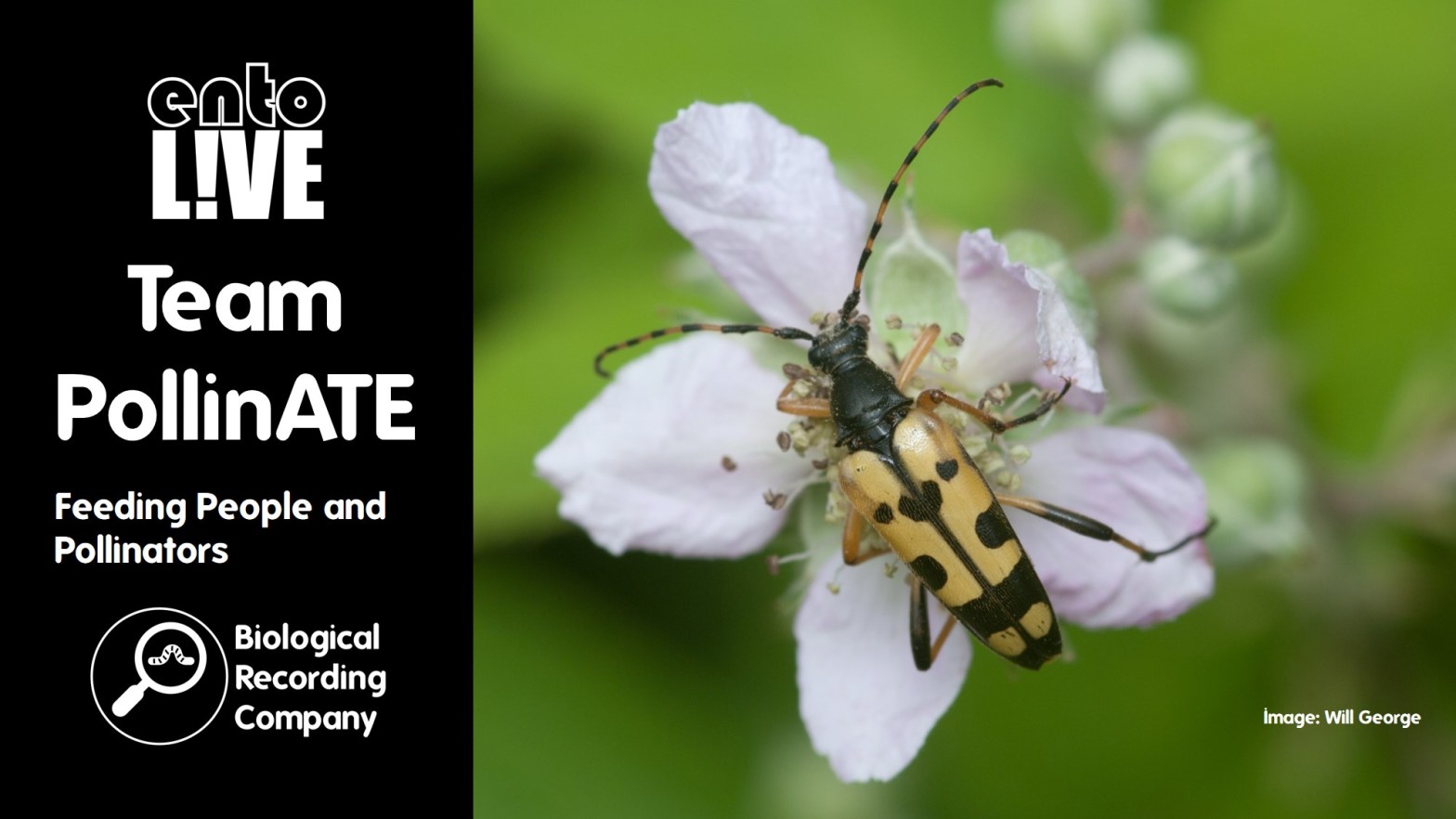
Over one-third of all the food we eat relies on insects for pollination. While there is increasing interest in urban food growing as a more sustainable option for meeting the nutritional needs of city dwellers, we currently know very little about pollinator populations in urban areas. Beth reports the results of a recent study that harnessed the power of citizen science and engaged urban growers themselves in collecting data on the bees, beetles, butterflies and flies that pollinate fruit and vegetable crops in urban areas.
Q&A with Dr Beth Nicholls
Dr Beth Nicholls is a research fellow at the University of Sussex with over ten years of experience studying the ecology and behaviour of bees. A major motivation for her research is to contribute solutions for the dual challenges of halting insect declines and producing food more sustainably.
- Were there any differences between surveys conducted by you personally and the surveys conducted by citizen scientists?
Yes – I separated out bumblebees, honeybees and solitary bees, whereas the citizen scientists only distinguished bumblebees from other bees. the paper that I’m working on at the moment is comparing my data with the citizen scientist data and look forward to publishing the results of this comparison in full soon! - Did any of the allotment sites have beekeepers on site and, if so, did you see any difference in visiting insects?
Honeybees on allotments can be quite a controversial topic. We did note down where these were present, but honeybees can fly over such a long distances anyway and there was no way for us to know if there were nearby hives in gardens etc. that the bees may be coming from. As an urban area and with urban beekeeping on the rise (see the London Bee Situation entoLIVE for more on this), Brighton likely has a high density of honeybee hives. Honeybees were the most observed insects across all of the plots regardless of onsite hives. - How can we distinguish if an insect is a pollinator or pest?
Insects may act as both, just at different parts of their life cycle. Larval stages may feed on parts of the plant and then the adults may provide pollination services. Some larvae may also act as predators of herbivorous insects. there’s a lot we don’t know about individual species, particularly at larval stage, and it can be really difficult to tell species apart. For example, people often mistake hoverfly larvae (which will grow into pollinating adults) for mosquito larvae. Really we want to strive for balanced ecosystems with healthy populations of predators of species that can become pests. - Following this study, will the research continue and be expanded into other areas?
A nutritionist PhD student is continuing the work in Brighton, looking at community growing and what impact this has on diet choices, food availability, health and wellbeing. A second PhD student is taking the research beyond Brighton to other urban areas, focusing on perennial crops (such as hedgerows and trees) and looking at the impact on other benefits such as the heat island effect and flooding.
Literature references
- Nicholls et al. (2020) The contribution of small-scale food production in urban areas to the sustainable development goals: a review and case study: https://link.springer.com/article/10.1007/s11625-020-00792-z
- Nicholls et al. (2023) Crop–pollinator interactions in urban and peri-urban farms in the United Kingdom: https://nph.onlinelibrary.wiley.com/doi/full/10.1002/ppp3.10376
- Baldock et al. (2019) A systems approach reveals urban pollinator hotspots and conservation opportunities: https://www.nature.com/articles/s41559-018-0769-y
- Corfe (2018) What are the barriers to eating healthily in the UK?: https://www.smf.co.uk/publications/barriers-eating-healthily-uk/#:~:text=In%20particular%2C%20the%20report%20focuses,household%20budgets%20in%20the%20UK
- Garibaldi et al. (2013) Wild Pollinators Enhance Fruit Set of Crops Regardless of Honey Bee Abundance: https://www.science.org/doi/10.1126/science.1230200?url_ver=Z39.88-2003&rfr_id=ori:rid:crossref.org&rfr_dat=cr_pub%20%200pubmed
- Hallman et al. (2017) More than 75 percent decline over 27 years in total flying insect biomass in protected areas: https://journals.plos.org/plosone/article?id=10.1371/journal.pone.0185809
- McDougall et al. (2018) Small-scale urban agriculture results in high yields but requires judicious management of inputs to achieve sustainability: https://www.pnas.org/doi/10.1073/pnas.1809707115
Further info
- The Buzz Club Citizen Science Virtual Symposium: https://www.eventbrite.co.uk/e/the-buzz-club-citizen-science-virtual-symposium-tickets-773643988997
- The Buzz Club: https://www.thebuzzclub.uk/
- The Nicholls Lab at the University of Sussex: https://www.sussex.ac.uk/research/labs/nicholls-lab/
- Garden shop calculator: https://www.thebuzzclub.uk/garden-shop
- Interactive network widget: https://bethbees.github.io/Nichollslab/Rspeciesnew.html
- Britain’s Hoverflies from BENHS: https://www.benhs.org.uk/publications/british-hoverflies-an-illustrated-identification-guide-second-edition/
- Pollinator Pack from the FSC: https://www.field-studies-council.org/shop/publications/pollinator-pack-urban-meadow/
- RES Pollination Special Interest Group: https://www.royensoc.co.uk/membership-and-community/special-interest-groups/pollination/
entoLIVE
entoLIVE webinars feature guest invertebrate researchers delving into their own invertebrate research. All events are free to attend and are suitable for adults of all abilities – a passion for invertebrates is all that’s required!
- Donate to entoLIVE: https://www.gofundme.com/f/entolive-2025
- Upcoming entoLIVE webinars: https://www.eventbrite.com/cc/entolive-webinars-74679
- entoLIVE blog: https://biologicalrecording.co.uk/category/entolive-blog/
- entoLIVE on YouTube: https://youtube.com/playlist?list=PLuEBNUcfMmE95Re19nMKQ3iX8ZFRFgUAg&feature=shared
entoLIVE is only possible due to contributions from our partners.
- Find out about more about the British Entomological & Natural History Society: https://www.benhs.org.uk/
- Browse the list of identification guides and other publications from the Field Studies Council: https://www.field-studies-council.org/shop/
- Check out environmentjob.co.uk for the latest jobs, volunteering opportunities, courses and events: https://www.environmentjob.co.uk/
- Check out the Royal Entomological Society‘s NEW £15 Associate Membership: https://www.royensoc.co.uk/shop/membership-and-fellowship/associate-member/
More on citizen science

 Biological Recording
One thought on “Team PollinATE: Feeding People and Pollinators”