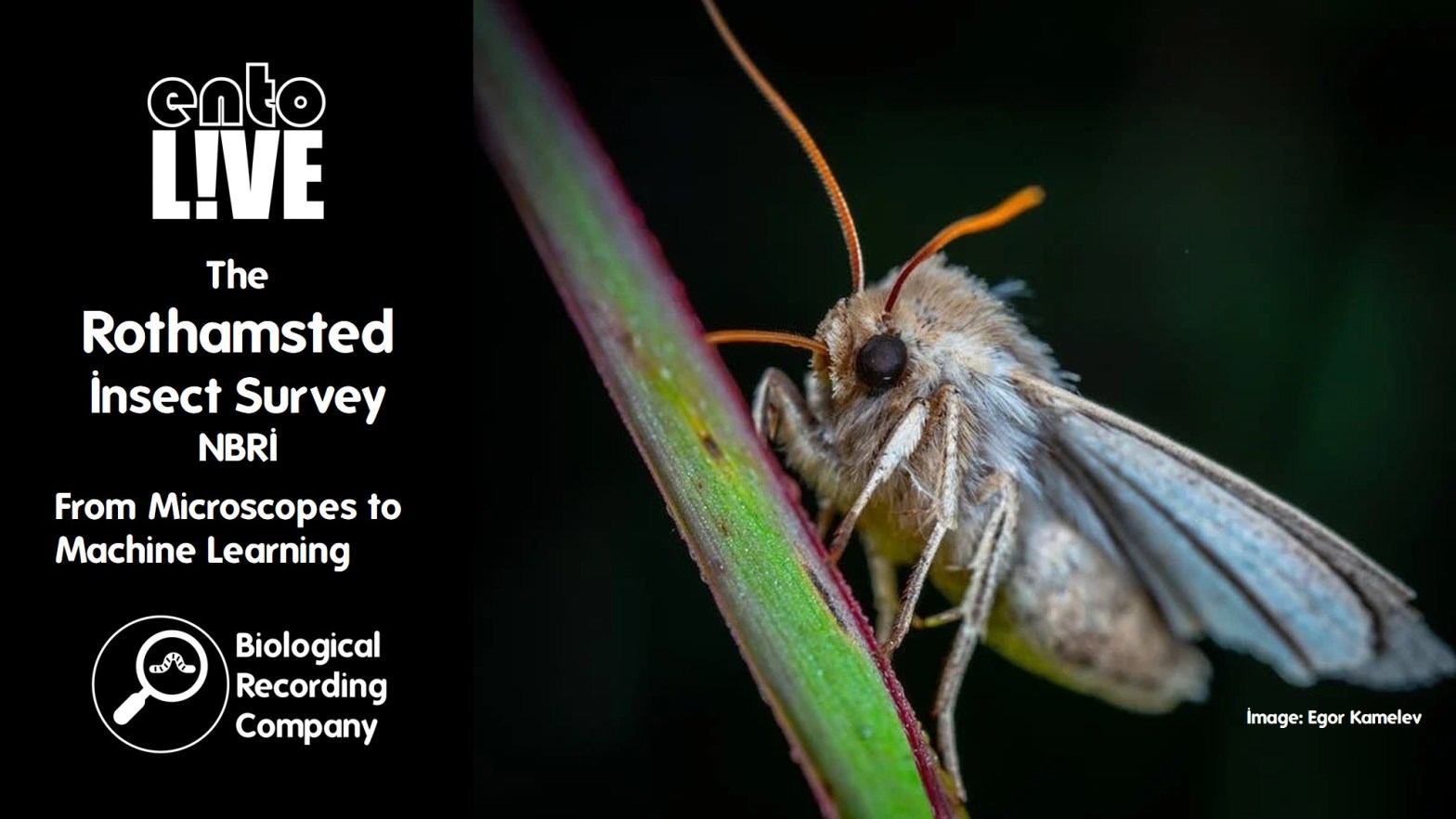
The story of the Rothamsted Insect Survey (RIS) starts back in 1964 at a time when the Beetles released Can’t Buy Me Love’ and that finishes sometime in the future when entomology might look quite different. The RIS monitors many groups of insects using its 12.2 m suction-trap and light-trap data networks. James discusses insect declines and the work of the RIS. James is joined by Dr Yoann Bourhis who talks about the DRUID (Drivers and Repercussions of UK Insect Declines) NERC-funded project and demonstrates a citizen science app that uses machine learning to predict where species might be, extending our knowledge about current species distributions.
Q&A with Dr James Bell
Dr James R. Bell is a Principal Scientist and Head of the RIS, a BBSRC National Bioscience Research Infrastructure. James is a quantitative ecologist with expertise in entomology having published widely on beetles, spiders, aphids, moths and many other things besides. James is senior author on Practical Field Ecology: A Project Guide which offers a comprehensive, accessible introduction to experimental design, field monitoring skills for plants and animals, data analysis, interpretation and reporting. The book is now in its second edition.
- How are aphids able to develop resistance to insecticides when they reproduce asexually through parthenogenesis?
It’s a complex story. They may have metabolic resistance, meaning they have a way of dealing with insecticides inside their guts so that there is no overbearing negative effect on their performance. They may have target-site resistance. This is quite complicated to explain. These two mechanisms mean that aphids can adapt very quickly. For example, the Peach Potato Aphid (Myzus persicae) is the species that transmits the viruses in sugar beet and it is remarkable in that there is almost no insecticide that it can’t evolve resistance to. This complicated story can only be unravelled by studying the genetics of aphids. Regarding the parthenogenetic component, this is part of the story but aphid reproduction is often more complex. For example, peach is the primary host of the Peach Potato Aphid where it overwinters and reproduces sexually, enabling the population to acquire resistance. Any individuals that are susceptible to an insecticide would pass this on to any daughters (and subsequent generations) produced through parthenogenesis as the genome is not really changing (aside from small changes occurring due to mutations). - Where is the best place to look for research/observations that have been made about the symbiotic relationship between aphids and other insects?
there is a book by A. F. G. Dixon title Aphid Ecology An optimization approach that provides an introduction to aphids. The issue with learning materials about aphids is that there isn’t much in the way of aphid citizen science so the literature tends to be aimed at an academic audience. I’m not aware of a resource where you could access this data, so all I can recommend is trawling through the data. Alternatively, you could grow broad beans in your garden and you’ll get the Black Bean Aphid (Aphis fabae) and the associated ants so you can observe them yourself! - What proportion of the sugar beet crop is for human rather than cattle consumption?
Great question. Each field that is used for sugar beet crops is contracted by British Sugar by the field, so we know about every field that is used for this crop. At the moment 80,000 hectares of sugar beet are grown across East Anglia. The best sugar beet will achieve a sugar content of 16%. If the sugar content is too low, a farmer may decide to send it to fodder (or take a penalty on their contract). Therefore, it is hard to answer this question as it is up to individual farmers what happens to the fodder crop and it will also depend on the season. We can only comment on the proportion that was rejected and not what the end use of that crop was. - How much do we know about aphids outside of agricultural research?
I’m only aware of a single person in the world who is actively trying to conserve aphids. Everyone else that I know is trying to understand how we can control them and limit their population growth. Interestingly, they are different from other groups where the species diversity decreases towards the tropics. We don’t really understand why. There are still lots of avenues for interesting research when it comes to studying aphids outside of agricultural systems.
Dr Yoann Bourhis is an ecosystems modeller, with expertise in machine learning. Yoann’s main activity is as a post-doc on the DRUID project, funded by NERC. DRUID will take an unprecedented amount of citizen science data to underpin evidence-based policies to help nature. A key paper relating to Yoann’s presentation was published in Methods in Ecology and Evolution earlier this year and demonstrates how it is possible to use machine learning to understand the distribution of insects using their life history traits (e.g. wing length, host plants etc) and environmental drivers (temperature, rainfall etc) to predict new distributions of insects. It is hoped that this new knowledge will guide recorders to sites where the species is predicted but no survey has yet confirmed the presence of that species. Yoann has developed an app and we invite you to contribute your experience and expertise.
Literature references
- Bell et al (2020) Are insects declining and at what rate? An analysis of standardised, systematic catches of aphid and moth abundances across Great Britain: https://doi.org/10.1111/icad.12412
- Blumgart et al (2022) Moth declines are most severe in broadleaf woodlands despite a net gain in habitat availability: https://doi.org/10.1111/icad.12578
- Boyes et al (2019) Bucking the trend: the diversity of Anthropocene ‘winners’ among British moths: https://doi.org/10.21425/F5FBG43862
- Bourhis et al. (2023) Explainable neural networks for trait-based multispecies distribution modelling—A case study with butterflies and moths: https://doi.org/10.1111/2041-210X.14097
- Dennis et al (2021) The State of Britain’s Larger Moths 2021: https://butterfly-conservation.org/sites/default/files/2021-03/StateofMothsReport2021.pdf
- King et al. (2010) Prey choice by carabid beetles feeding on an earthworm community analysed using species- and lineage-specific PCR primers: https://doi.org/10.1111/j.1365-294X.2010.04602.x
- Sheppard et al (2005) Detection of secondary predation by PCR analyses of the gut contents of invertebrate generalist predators: https://doi.org/10.1111/j.1365-294X.2005.02742.x
Further info
- UK Insect Distributions Survey app: https://yo-b.shinyapps.io/landing_page_survey/
- Rothamsted Insect Survey (RIS): https://insectsurvey.com/
- RIS Suction Trap data network: https://insectsurvey.com/suction-trap
- RIS light trap data network: https://insectsurvey.com/moth-data
- Moth data trends: https://insectsurvey.com/trends
- Weekly Aphid Incidence Bulletin: https://insectsurvey.com/aphid-bulletin
- Apid Text Alerts for your local area: https://insectsurvey.com/aphid-alert
- Download the RIS data: https://insectsurvey.com/get-data
- NERC funding to help protect UK insect populations: https://www.ukri.org/news/nerc-funding-to-help-protect-uk-insect-populations/
- UK Carabid Distributions Survey: https://yo-b.shinyapps.io/survey_carabids/
- UK Odonata Distributions Survey: https://yo-b.shinyapps.io/survey_odonates_GB/
- UK Orthoptera Distributions Survey: https://yo-b.shinyapps.io/survey_orthoptera/
- UK Bee Distributions Survey: https://yo-b.shinyapps.io/survey_bees/
- Field Guide to the Smaller Moths of Great Britain and Ireland from BENHS: https://www.benhs.org.uk/publications/british-lepidoptera/
entoLIVE
entoLIVE webinars feature guest invertebrate researchers delving into their own invertebrate research. All events are free to attend and are suitable for adults of all abilities – a passion for invertebrates is all that’s required!
- Donate to entoLIVE: https://www.gofundme.com/f/entolive-2025
- Upcoming entoLIVE webinars: https://www.eventbrite.com/cc/entolive-webinars-74679
- entoLIVE blog: https://biologicalrecording.co.uk/category/entolive-blog/
- entoLIVE on YouTube: https://youtube.com/playlist?list=PLuEBNUcfMmE95Re19nMKQ3iX8ZFRFgUAg&feature=shared
entoLIVE is only possible due to contributions from our partners.
- Find out about more about the British Entomological & Natural History Society: https://www.benhs.org.uk/
- Browse the list of identification guides and other publications from the Field Studies Council: https://www.field-studies-council.org/shop/
- Check out environmentjob.co.uk for the latest jobs, volunteering opportunities, courses and events: https://www.environmentjob.co.uk/
- Check out the Royal Entomological Society‘s NEW £15 Associate Membership: https://www.royensoc.co.uk/shop/membership-and-fellowship/associate-member/
More on invertebrates
 Biological Recording