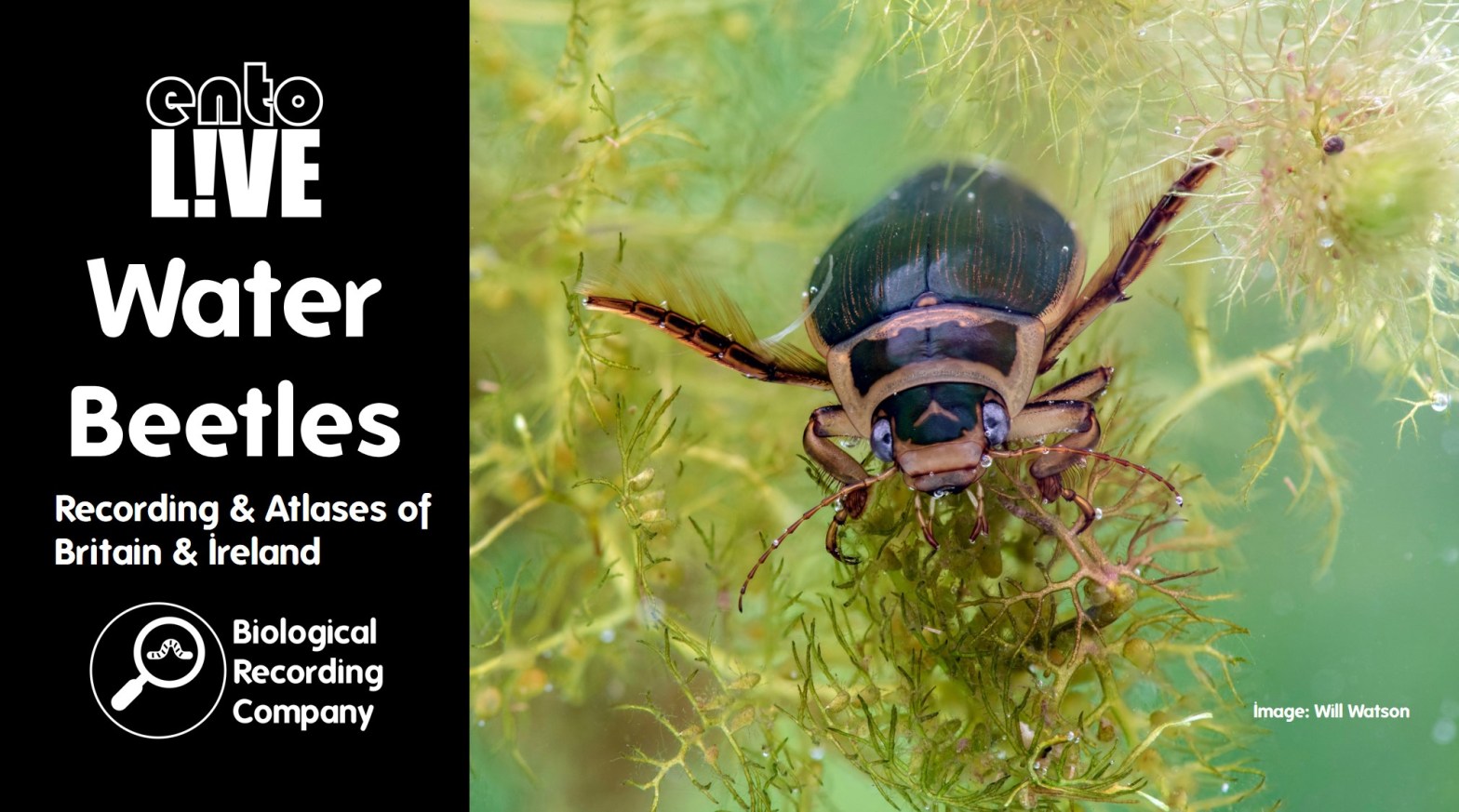
Water beetles have a long history of biological recording, with the first scheme starting in 1904 and the earliest recorders including Charles Darwin. Garth will provide a brief introduction to the history of water beetle recording, before discussing the recent publication of three volumes of the water beetle atlas for Britain and Ireland, illustrated by anecdotes about some recent records. We’ll end the talk with a call to action for the next generation of water beetle recorders and details about how to get involved.
Q&A with Prof Garth Foster
Prof Garth Foster has been studying water beetles for sixty years or more. He has co-authored books covering the atlas of water beetles in Britain and Ireland, based on over 600,000 records acquired as part of the recording schemes.
Has Riolus nitens ever been found in the Thames Estuary?
The Environment Agency has records for Oxfordshire. R. nitens likes fast-running pristine water. The site that I know best for this species is in the Wye at Symonds Yat. The water runs very fast on both sides of an island there and it is a fantastic site for this species as well as for canoeists.
Has Dytiscus circumflexus made it to north Scotland since 2000?
The northernmost record site that I’m aware of for this beetle is beside Holy Island in Northumberland. Our coverage is far from comprehensive, so it could be further north and we just don’t have records. Ivan Lang in an RSPB reserve in Wigtownshire (southwest Scotland) has been trapping it quite recently in the salt lagoons there.
Can you use pheromones to collect water beetles?
Beetles are more effectively attracted to food, such as sachets of fish-based catfood used in bottle traps. I’m not aware of pheromone traps being used for water beetles, so the answer (at least for now) is no. Konrad Dettner has pioneered to study of steroids and other complex molecules as pheromones and defensive substances in diving beetles, but I don’t think anyone has tried using them to lure water beetles.
Are there plans for a Part 3 to the RES water beetle ID series that would cover Elmidae etc.?
Yes there is. I’ve been working on this for some time, and even considered ditching it at one point. David Bilton has agreed to take it on using more photographs than drawings
Do you get records from the Moth Trap Intruders group and other iRecord activities?
I do try to keep up with iRecord, but the sheer number of records makes it difficult to keep up. There is a backlog of about 7,000 records. Kev Rowley is helping with iRecord verification. He’s told me there could be 110,000 records, which is quite significant considering we have around 800,000 records in the recording scheme in total. An issue with iRecord records is that there is a real mix of useful records and unusable records, so it takes a long time to sort through them. One of the biggest parts of the backlog is the Donacia as these are bright, metallic, pretty beetles so people assume that they are easily identified from a photograph when it’s not as simple as that.
How much evidence is there of species spreading north (possibly as a result of climate change)?
We certainly have evidence for this, but the coverage of water beetles is not as good as for popularly recorded groups such as butterflies. But we can propose something about the ways in which that northern spread is happening, for example Nartus grapii getting into the west of Scotland from Northern Ireland or the Isle of Man rather than from England. In an ideal world, we would have a set of fixed sampling points that are sampled annually in a structured manner. Unfortunately, we simply don’t have the resources to manage this. The more data that we have, the better… so please send your water beetles to the Aquatic Coleoptera Recording Scheme at latissimus@btinternet.com
Literature references
- Foster, G.N. (2010) A review of the scarce and threatened Coleoptera of Great Britain. Part 3: Water beetles of Great Britain. Species Status No. 1. JNCC, Peterborough. https://hub.jncc.gov.uk/assets/e80beaf2-456c-4178-8f91-16c2ef01368d
- Foster, G. N. & Friday, L. E. (2011) Keys to the Adults of the Water Beetles of Britain and Ireland: Part 1 (Handbooks for the Identification of British Insects). Royal Entomological Society. https://www.field-studies-council.org/shop/publications/water-beetles-1/
- Foster, G. N., Bilton, D. T. & Friday, L.E. (2014) Keys to the Adults of the Water Beetles of Britain and Ireland: Part 1 (Handbooks for the Identification of British Insects). Royal Entomological Society. https://www.field-studies-council.org/shop/publications/water-beetles-2/
- Foster, G. N., Bilton, D. T. & Nelson, B. H. (2016) Atlas of the Predaceous Water Beetles (Hydradephaga) of Britain and Ireland. UK Centre for Ecology & Hydrology. https://www.field-studies-council.org/shop/publications/predaceous-water-beetles-atlas/
- Foster, G. N., Bilton, D. T., Hammond, M. & Nelson, B. H. (2018) Atlas of the Hydrophiloid Beetles of Britain and Ireland. UK Centre for Ecology & Hydrology. https://www.field-studies-council.org/shop/publications/hydrophiloid-beetles-atlas/
- Foster, G. N., Bilton, D. T., Hammond, M. & Nelson, B.H. (2018) Atlas of Water Beetles of Britain and Ireland – Smaller Families of Polyphaga. UK Centre for Ecology & Hydrology. https://www.field-studies-council.org/shop/publications/water-beetles-atlas-smaller-families-of-polyphaga/
Further info
- The Aquatic Coleoptera Conservation Trust: https://www.latissimus.org/
- Balfour-Browne Club: https://www.latissimus.org/?page_id=24
- Check out the latest jobs, volunteering opportunities, courses and events on environmentjob: https://www.environmentjob.co.uk/
- Water beetle ID guides and atlases from the FSC: https://shorturl.at/FIKT9
- Freshwater ecology courses from the FSC: https://www.field-studies-council.org/courses-and-experiences/subjects/freshwater-ecology-courses/
- Aquatic Insects Special Interest Group from the RES: https://www.royensoc.co.uk/membership-and-community/special-interest-groups/aquatic-insects/
entoLIVE
entoLIVE webinars feature guest invertebrate researchers delving into their own invertebrate research. All events are free to attend and are suitable for adults of all abilities – a passion for invertebrates is all that’s required!
- Donate to entoLIVE: https://www.gofundme.com/f/entolive-2025
- Upcoming entoLIVE webinars: https://www.eventbrite.com/cc/entolive-webinars-74679
- entoLIVE blog: https://biologicalrecording.co.uk/category/entolive-blog/
- entoLIVE on YouTube: https://youtube.com/playlist?list=PLuEBNUcfMmE95Re19nMKQ3iX8ZFRFgUAg&feature=shared
entoLIVE is only possible due to contributions from our partners.
- Find out about more about the British Entomological & Natural History Society: https://www.benhs.org.uk/
- Browse the list of identification guides and other publications from the Field Studies Council: https://www.field-studies-council.org/shop/
- Check out environmentjob.co.uk for the latest jobs, volunteering opportunities, courses and events: https://www.environmentjob.co.uk/
- Check out the Royal Entomological Society‘s NEW £15 Associate Membership: https://www.royensoc.co.uk/shop/membership-and-fellowship/associate-member/
More on freshwater biology




 Biological Recording