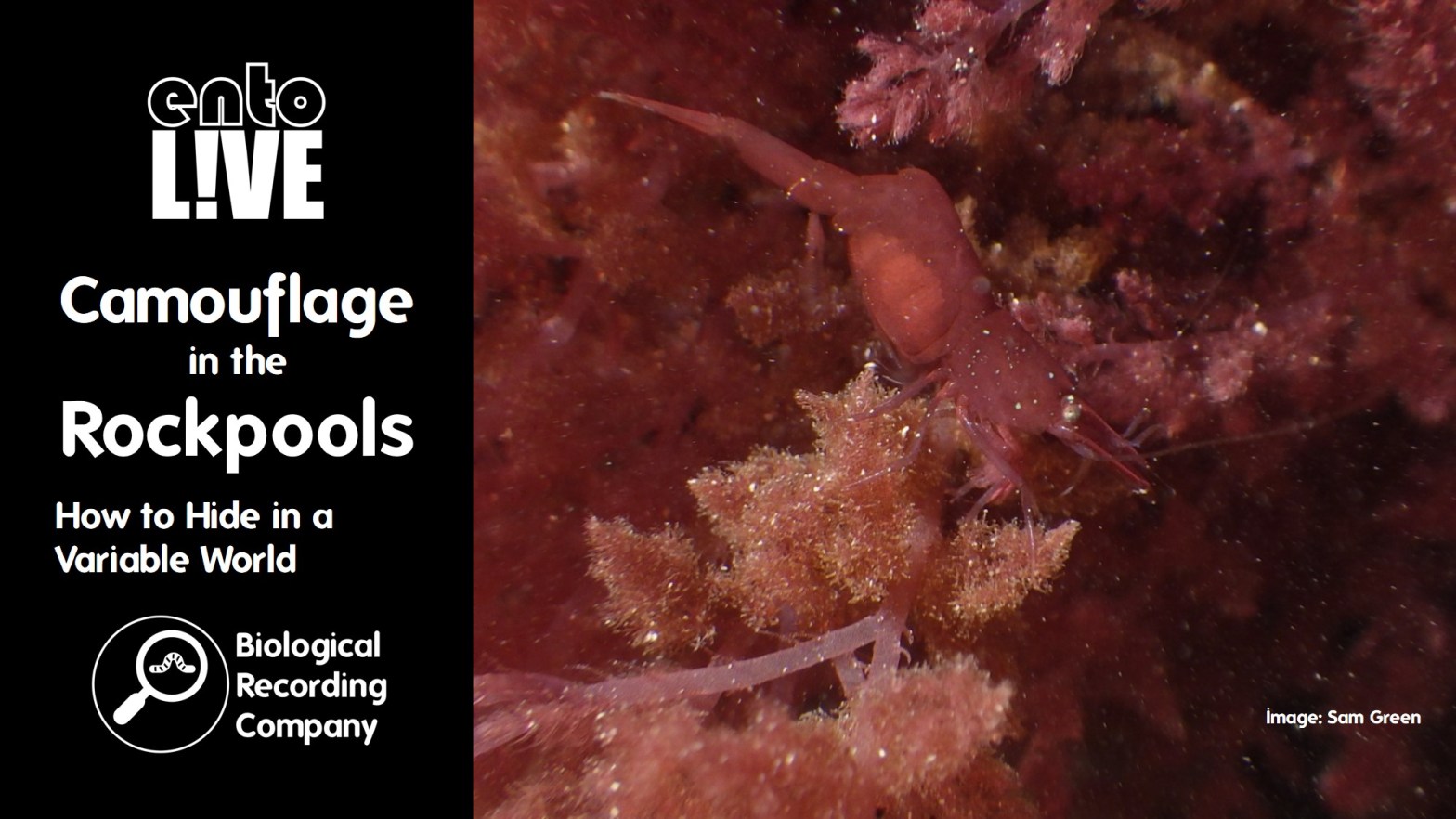
For many animals camouflage is a matter of life or death. Successful concealment hinges on a close association between an animal’s appearance and the visual aspects of its surroundings. However, patches of microhabitat in nature are highly variable in terms of colour, shape, and texture. Furthermore, animals may need to move through multiple patches when seeking resources (e.g., food or mating opportunities) or the habitat itself may change around them (e.g., seasons or tidal cycles). This blog explores the strategies by which animals attempt to maximise camouflage in space and time in order to remain hidden in such a visually variable world with a focus on behaviours, colour change, and transparency in the chameleon prawn (Hippolyte varians). Additionally, Sam covers some more recent work looking at how anthropogenic changes to the natural world, such as pollution, may impact animal camouflage.
Dr Sam Green is an ecologist often found pottering around in the rockpools of Cornwall. His research interests focus on adaptive colouration, animal vision, and behaviour. In addition, he has a keen interest in restoration ecology and anthropogenic impacts on sensory ecology. He currently works in the Animal Perception and Behaviour Group at the University of Exeter (Penryn Campus) researching perceptual processing and visual acuity in freshwater fish.
Q&A with Dr Sam Green
- What happens to the colour of the prawns at night when the threat from visual predators is likely to be diminished?
This is actually the final chapter of my PhD and I had to leave it out of the talk due to time constraints. They take a couple of weeks to shift colour between green and red, but every night all of them turn blue within an hour. We don’t really understand why this happens, but it could be that they are more active at night and the bluey-transparent colour may give some kind of silhouette concealment. It’s important to remember that there are nocturnal predators with effective nocturnal colour vision, so colour can still be important at night. - What is the cue that causes a prawn to change colour?
We haven’t figured this out yet. The colour change is quite complex and involves three different layers of chromatophores. We made plastic seaweeds that were the same colour as the real ones and the data suggested that the prawns did not change their colour to match these fake seaweeds and the behavioural choices showed no preference between the two. Therefore it doesn’t seem like colour is the cue and we think it could be something like diet. Hopefully, future research will answer this question… - How do the chemicals in sunscreen physiologically affect the prawns?
My work was purely looking at the behavioural choices that the prawns made, rather than their ability to change colour. The colour change is regulated by hormones and chemicals such as oxybenzone are endocrine-disrupting chemicals, so we think it is likely that these chemicals will impact the colour change ability as well as the behavioural abilities (i.e. host seaweed preference). - How can people reduce our impact on the Chameleon Prawn?
Based on my research, I think it is about considering the impact that we have when we directly interact with rockpools. So if you are covered in factor 50 sunscreen that contains oxybenzone and put your feet or hands in a rockpool, be aware that those chemicals will contaminate that habitat. Marine-friendly sunscreen does exist, but a simple solution is to cover up before entering the water and wear a long sleeve top or wetsuit! - Is there a reason that the green prawns are more likely to choose green seaweed than the red prawns are to choose red seaweed?
Yes, I think so. We need to remember that animals see colour very differently. The visual systems for Pollock and Goby are sensitive to different wavelengths to us, meaning their world is a lot more brown than ours. So, the green prawns are very well camouflaged against the green background but would stand out on the red background. The red prawns would be well camouflaged against the red background (though not as strongly camouflaged as green on green) but would not stand out as much on a green background as a green prawn would on a red background. So, in summary, green prawns have the best camouflage against their matching background but stand out more on their non-matching background.
Literature references
- Green et al (2019) Colour change and behavioural choice facilitate chameleon prawn camouflage against different seaweed backgrounds: https://www.nature.com/articles/s42003-019-0465-8
- Camacho et al (2020)Experimental evidence that matching habitat choice drives local adaptation in a wild population: https://royalsocietypublishing.org/doi/10.1098/rspb.2020.0721
- Carter et al (2020) Ship noise inhibits colour change, camouflage, and anti-predator behaviour in shore crabs: https://www.cell.com/current-biology/fulltext/S0960-9822(20)30014-2?_returnURL=https%3A%2F%2Flinkinghub.elsevier.com%2Fretrieve%2Fpii%2FS0960982220300142%3Fshowall%3Dtrue
- Chiao (2009) The scaling effects of substrate texture on camouflage patterning in cuttlefish: https://www.sciencedirect.com/science/article/pii/S0042698909001308?via%3Dihub
- Cuthill (2019) Camouflage: https://zslpublications.onlinelibrary.wiley.com/doi/full/10.1111/jzo.12682
- Dominioni et al (2020) Why conservation biology can benefit from sensory ecology: https://www.nature.com/articles/s41559-020-1135-4
- Duarte et al (2016) Shape, colour plasticity, and habitat use indicate morph-specific camouflage strategies in a marine shrimp: https://bmcecolevol.biomedcentral.com/articles/10.1186/s12862-016-0796-8
- Johnsen (2001) Hidden in plain sight: the ecology and physiology of organismal transparency: https://pubmed.ncbi.nlm.nih.gov/11751243/
- Kang et al (2014) Camouflage through behavior in moths: the role of background matching and disruptive coloration: https://academic.oup.com/beheco/article/26/1/45/2261406
- Mendonça (2014) Habitat use of inter-tidal chitons – role of colour polymorphism: https://onlinelibrary.wiley.com/doi/abs/10.1111/maec.12205
- Nokelainen et al (2019) Improved camouflage through ontogenetic colour change confers reduced detection risk in shore crabs: https://www.ncbi.nlm.nih.gov/pmc/articles/PMC6559319/
- Palm & Bowmaker (2006) Spectral sensitivity of the two-spotted goby Gobiusculus flavescens (Fabricius): a physiological and behavioural study: https://journals.biologists.com/jeb/article/209/11/2034/16149/Spectral-sensitivity-of-the-two-spotted-goby
- Price et al (2019) Background matching and disruptive coloration as habitat-specific strategies for camouflage: https://www.nature.com/articles/s41598-019-44349-2
- Shand et al (1988) Spectral absorbance changes in the violet/blue sensitive cones of the juvenile pollack, Pollachius pollachius: https://link.springer.com/article/10.1007/BF00603854
- Smithers et al (2018) Rock pool fish use a combination of colour change and substrate choice to improve camouflage: https://www.sciencedirect.com/science/article/pii/S0003347218302471
- Stevens et al (2014) Rockpool Gobies Change Colour for Camouflage: https://journals.plos.org/plosone/article?id=10.1371/journal.pone.0110325
- Stevens et al (2015) Phenotype–environment matching in sand fleas: https://royalsocietypublishing.org/doi/full/10.1098/rsbl.2015.0494
- Troscianco & Stevens (2015) Image calibration and analysis toolbox – a free software suite for objectively measuring reflectance, colour and pattern: https://besjournals.onlinelibrary.wiley.com/doi/10.1111/2041-210X.12439
- Zylinski & Johnsen (2011) Mesopelagic cephalopods switch between transparency and pigmentation to optimize camouflage in the deep: https://pubmed.ncbi.nlm.nih.gov/22079113/
Further info
- Brains Vs Prawns game: https://www.visual-ecology.com/prawngame-info/
- Top 6 Major Threats To Biodiversity article: https://www.bioexplorer.net/threats-to-biodiversity.html/#:~:text=Below%2C%20we%20discuss%20six%20of,of%20biodiversity%20in%20our%20planet.
- Skincare Chemicals and Coral Reefs article: https://oceanservice.noaa.gov/news/sunscreen-corals.html
- Marine ecology courses with the FSC: https://www.field-studies-council.org/courses-and-experiences/subjects/marine-ecology-courses/
- Marine Invertebrates ADGAP from the FSC: https://www.field-studies-council.org/shop/publications/marine-invertebrates-aidgap/
entoLIVE
entoLIVE webinars feature guest invertebrate researchers delving into their own invertebrate research. All events are free to attend and are suitable for adults of all abilities – a passion for invertebrates is all that’s required!
- Donate to entoLIVE: https://www.gofundme.com/f/entolive-2025
- Upcoming entoLIVE webinars: https://www.eventbrite.com/cc/entolive-webinars-74679
- entoLIVE blog: https://biologicalrecording.co.uk/category/entolive-blog/
- entoLIVE on YouTube: https://youtube.com/playlist?list=PLuEBNUcfMmE95Re19nMKQ3iX8ZFRFgUAg&feature=shared
entoLIVE is only possible due to contributions from our partners.
- Find out about more about the British Entomological & Natural History Society: https://www.benhs.org.uk/
- Browse the list of identification guides and other publications from the Field Studies Council: https://www.field-studies-council.org/shop/
- Check out environmentjob.co.uk for the latest jobs, volunteering opportunities, courses and events: https://www.environmentjob.co.uk/
- Check out the Royal Entomological Society‘s NEW £15 Associate Membership: https://www.royensoc.co.uk/shop/membership-and-fellowship/associate-member/
More on marine biology


 Biological Recording