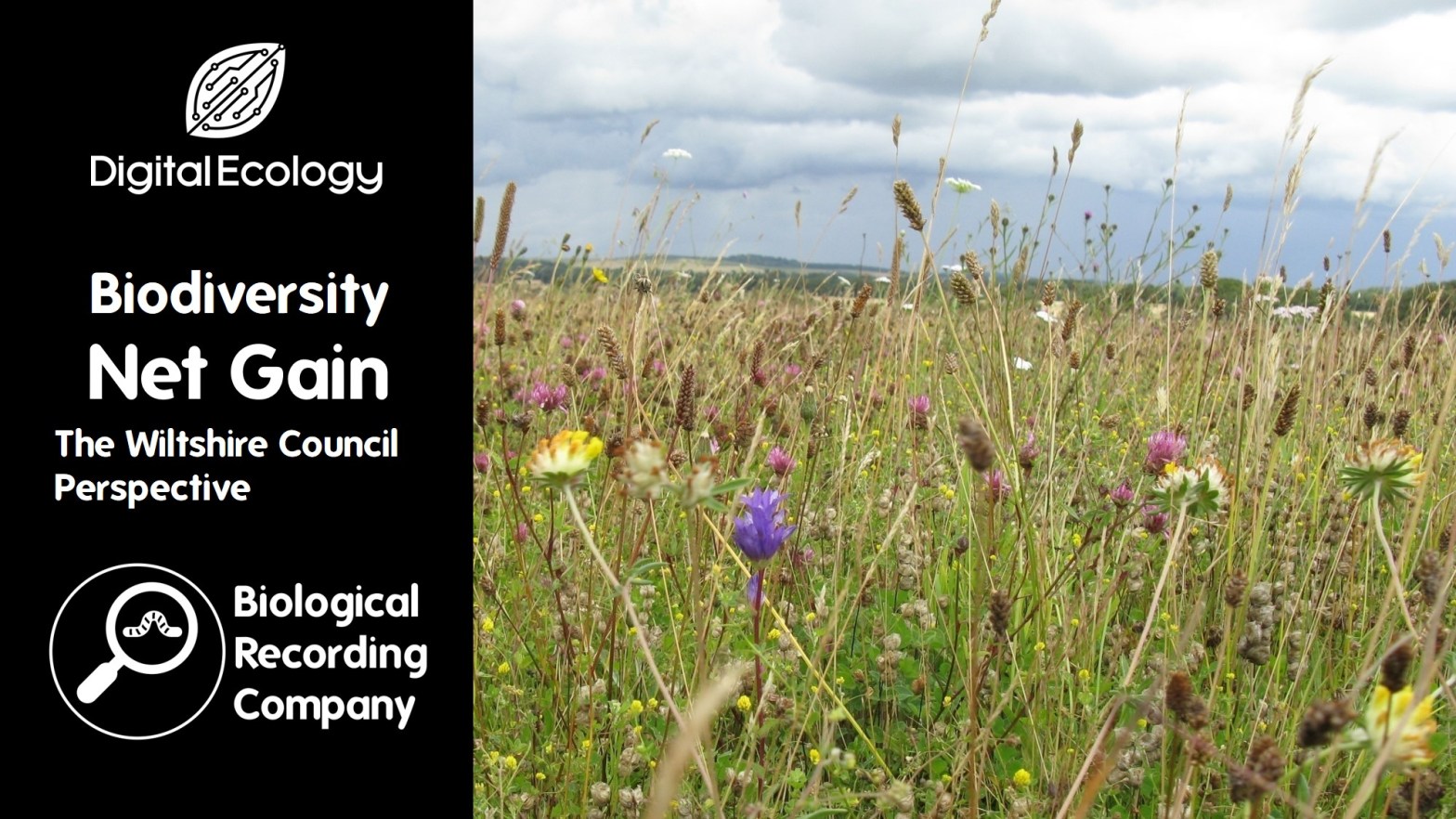
Wiltshire Council have been moving from securing no net loss to net gain and offering solutions to developers to help deliver nature recovery across Wiltshire. Rachel Jones will discuss Wiltshire Council’s approach to Biodiversity Net Gain and how they have been offering solutions to developers to help deliver nature recovery across Wiltshire. These solutions include opportunities on our own land holding, working with wider landowners and farmers for strategic sites, and securing on-site enhancements on development sites. Wiltshire Council are also looking at how to combine solutions with wider community and environmental benefits and how to address the expected resourcing implications for the Council.
Q&A with Rachel Jones
Rachel Jones is the Ecology Manager at Wiltshire Council, leading on the Council’s strategy for Biodiversity Net Gain and Local Nature Recovery Strategy. This work covers development management, local plan review and advising on the Council on opportunities to work with the Council’s own land holding, as well as other land owners in the County. Rachel is also currently on secondment with the Planning Advisory Service as a principal consultant advising on nutrient neutrality.
Will your policy that refers to the integrity of local ecological networks mean that off-site delivery is going to be more likely to be delivered locally rather than elsewhere in England?
Hopefully. Our current local plan policy secures no net loss within the local ecological network, and for major development, net gain is required. Our current policy does not stipulate a percentage level. We will be updating that policy within our local plan review to specify a level of net gain and ensure that the integrity of the local ecological network is maintained. Regarding how we draft our policy going forward, from an ecology perspective we would want to try and really focus on local nature recovery and ecological networks. As a council, we will need to wait for statutory guidance, and the local plan policy to be reviewed to ensure that local function is maintained. From my perspective, having a supply of projects in the right areas, certainly for our mitigation solutions, means that people are generally willing to deliver locally.
How much conversation is there with neighbouring counties regarding landscape-scale delivery considering some important habitats cross administrative boundaries?
We are aware that we need to think regionally for nature recovery and it will be critical. For example, with nutrient neutrality a lot of councils have experience of working across boundaries to meet the legal requirements due to the fact that this encompasses catchments that go beyond local authority boundaries. We will need a similar mechanism for BNG/planning in terms of those larger-scale projects.
Is the requirement for additional resource going to be a shift from application scrutiny to monitoring and compliance, and how do you see that changing over time as BNG develops?
I think that over time efficiency will improve in both how we assess metrics (as everyone gets more familiar with it) and the way the information gets submitted. Having more resource, monitoring and tracking is what is likely to be needed from the legislation as historically this has not been an area that is a statutory function. I don’t see it being a shift – I think we will simply require more resource.
As the land owned by Wiltshire Council and the other landowners that you are working with will need to go on the national register, do you still believe there is a need for a local register?
We are still waiting for guidance on the monitoring of the national register, and if this will be local authorities checking the monitoring. From our local perspective, we will be signposting local sites (on the national register) on our website to steer developers. We obviously won’t be able to use them exclusively.
Further info and links
- Phosphorus and nitrogen mitigation – Wiltshire Council: https://www.wiltshire.gov.uk/article/6209/Phosphorus-and-nitrogen-mitigation
- A Framework for Landscape-scale Conservation in Wiltshire and Swindon (wiltshirewildlife.org): https://www.wiltshirewildlife.org/sites/default/files/2022-08/landscape_conservation_framework_wiltshire_swindon2013%20%281%29.pdf
- Upcoming free entoLIVE webinars: https://www.eventbrite.co.uk/cc/entolive-webinars-74679
- Full list of courses and events from the Biological Recording Company: https://www.eventbrite.co.uk/o/the-biological-recording-company-35982868173
- Proposed Condition Assessment Method for BNG by Digital Ecology: https://digital-ecology.co.uk/condition-assessment-method.html
More on Biodiversity Net Gain

 Biological Recording
2 thoughts on “Biodiversity Net Gain: The Wiltshire Council Perspective”