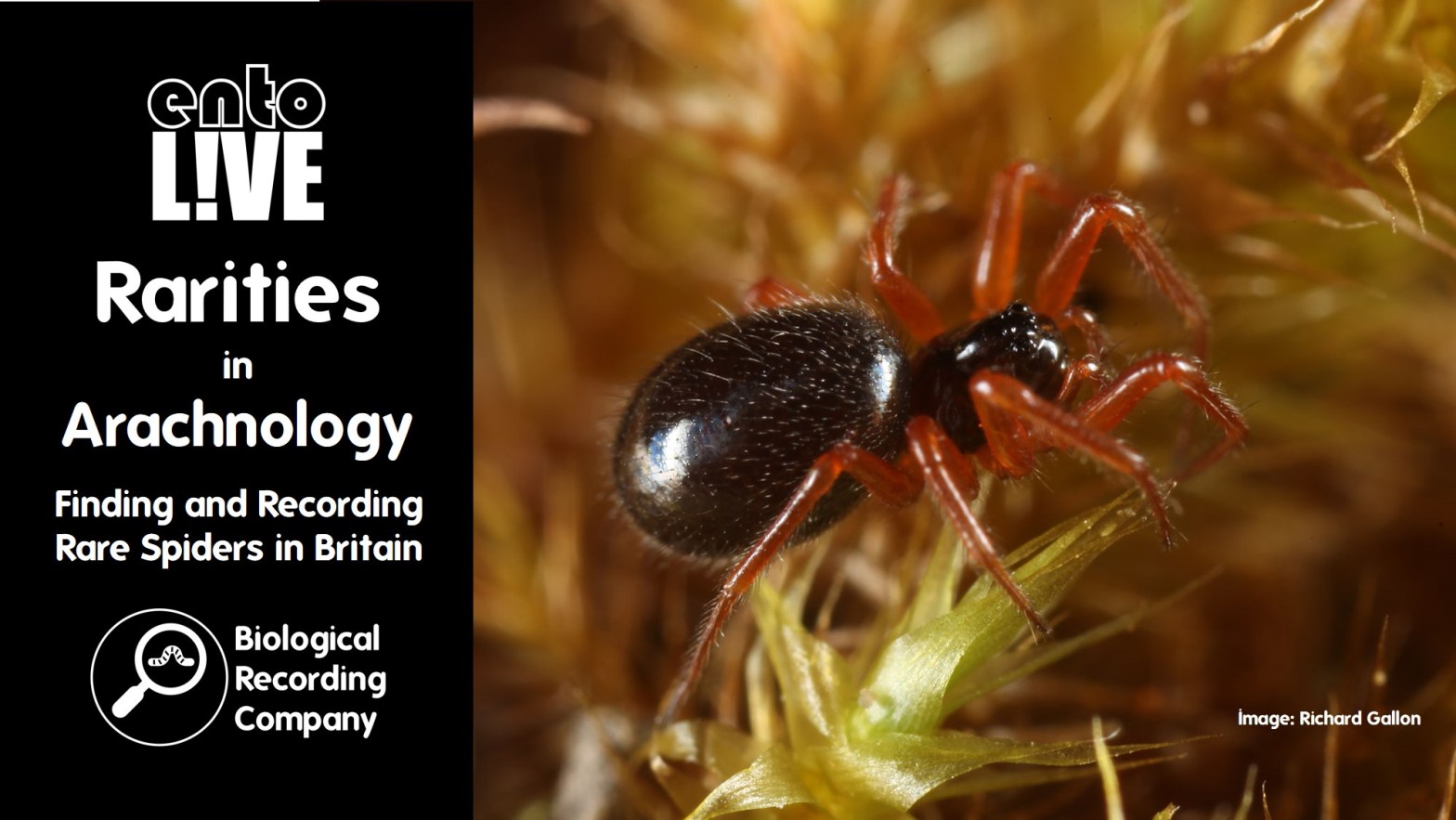
It’s easy to find and record common spiders in Britain. However, finding rare ones is obviously much harder. Richard takes us on a virtual mission to locate interesting species, highlighting tips and methods which may apply to other invertebrate groups too.
Richard Gallon is the Spider Recording Scheme Organiser for the British Arachnological Society. He has undertaken ecological surveys for many rare British spiders over the years and has been interested in them since childhood.
Q&A with Richard Gallon
- How are you identifying these spiders in the field?
Some ID can be done in the field and you start to notice if things look different from the species that you are used to seeing more regularly. Photographs can be helpful but microscopy is often needed to confirm the species so you need to take specimens as it can be tricky to see the very small morphological features that you need to identify them. Some spiders even require dissection to get an accurate species ID. Furthermore, some ID features are only really visible once they are preserved and are pretty much impossible to see on the live specimen. - Will taking specimens of spiders that are rare have any negative impact on the population?
It’s difficult to explain rarity – what do we mean by rare? We have to judge how rare a species is based on the data that we have. Some of these “rare” spiders are really tricky to find at sites where they occur because the microhabitats that they inhabit are difficult to sample. When spiders are considered rare nationally, they often still have healthy populations locally at the sites they are present and taking a small number of specimens to identify them won’t have a significant impact on the population. You would not target the same site repeatedly or take lots of specimens of the things that look the same. Vacuum sampling is good for this as you sort through the catch live and only take the specimens you need to identify from the catch. Recording rare spiders is the only way to gather the data we need to get them protected. the real threat to spiders is habitat degradation – not spider recorders! Where we have gathered sufficient data to get a rare spider protected, such as with the Fen Raft Spider (Dolomedes plantarius) and the Ladybird Spider (Eresus sandaliatus), you would only be able to collect these if you were granted a licence. - Are rarities only rarities because the species are difficult to identify?
Yes and no. Not all rare spiders are hard to identify. For example, Rhysodromus fallax is a decent size and its markings are fairly distinctive. Other “rare” species are really tricky to identify, so it may only be advanced spider recorders that are ever going to report them. There are one or two spiders that are frequently misidentified, for example where dissection is required, and common species have been misidentified as the rarity – making the rare species appear more common than it is. I’ve seen cases where 90% of the specimens for a species in museum collections have been misidentified. - How do you ensure that the ecological and behavioural notes that you’ve made are not lost and included in future guides?
the surveys that I’ve conducted will all result in reports. The work on Rhysodromus fallax was published in a report by the Tanyptera Trust. The other reports will be publicly available through Natural Resources Wales in the future. They are not quite ready yet, but when they are ready we’ll add them to the list of links in this blog. The British Arachnological Society also has a wealth of information on our website for members, including species pages. We have a lot of species to cover but the pages will be updated in due course with any relevant information that I’ve picked up during my survey work. - Do you ever do sweep netting?
I do but I don’t tend to find many rarities through this method. Sweep netting involves using a net to sweep vegetation to collect any spiders you would find living on the vegetation. When you are looking for spiders that inhabit more unusual habitats on the ground, you need a vacuum sampler to find them – and this is often where the rarities are as they are more difficult to survey for. - What sparked your interest in spiders?
I’ve been fascinated by spiders since I was a kid. I grew up in South Africa and I’d see huge spiders wandering into the house. All kids start off with an interest in invertebrates, I just never grew up out of it!
Literature references
- Gallon, R. (2022) Spiders of mobile sand dunes on the Sefton Coast in 2021, with particular reference to Rhysodromus fallax and Baryphyma maritimum: https://www.northwestinvertebrates.org.uk/document/spiders-of-mobile-sand-dunes-on-the-sefton-coast-in-2021-with-particular-reference-to-rhysodromus-fallax-and-baryphyma-maritimum/
- Locket, G. H. & Millidge, A. F. (1951) British Spiders. Volume I. Ray Society, London (OUT OF PRINT)
- Locket, G. H. & Millidge, A. F. (1953) British Spiders. Volume II. Ray Society, London (OUT OF PRINT)
- Locket, G. H., Millidge, A. F. & Merrett, P. (1974) British Spiders. Volume III. Ray Society, London (OUT OF PRINT)
Further info
- Spider Recording Scheme maps: https://srs.britishspiders.org.uk/portal.php
- British Arachnological Society: https://britishspiders.org.uk/
- Tanyptera Trust survey reports (relates to Rhysodromus fallax report): https://www.northwestinvertebrates.org.uk/publications/survey-reports/
- Eschenbach Maxdetail Magnifying Glasses (X2 magnification): https://www.cromwell.co.uk/shop/measuring-and-test-equipment/eye-loupes-and-pocket-comparators/maxdetail-magnifying-glasses-2x-magnification/p/EHB3161016L
- Spiders Wild ID Guide from the FSC: https://www.field-studies-council.org/shop/publications/spiders-guide/
- Discovering Spiders online course from the FSC: https://www.field-studies-council.org/courses-and-experiences/static-courses/discovering-spiders-online/

entoLIVE
entoLIVE webinars feature guest invertebrate researchers delving into their own invertebrate research. All events are free to attend and are suitable for adults of all abilities – a passion for invertebrates is all that’s required!
- Donate to entoLIVE: https://www.gofundme.com/f/entolive-2025
- Upcoming entoLIVE webinars: https://www.eventbrite.com/cc/entolive-webinars-74679
- entoLIVE blog: https://biologicalrecording.co.uk/category/entolive-blog/
- entoLIVE on YouTube: https://youtube.com/playlist?list=PLuEBNUcfMmE95Re19nMKQ3iX8ZFRFgUAg&feature=shared
entoLIVE is only possible due to contributions from our partners.
- Find out about more about the British Entomological & Natural History Society: https://www.benhs.org.uk/
- Browse the list of identification guides and other publications from the Field Studies Council: https://www.field-studies-council.org/shop/
- Check out environmentjob.co.uk for the latest jobs, volunteering opportunities, courses and events: https://www.environmentjob.co.uk/
- Check out the Royal Entomological Society‘s NEW £15 Associate Membership: https://www.royensoc.co.uk/shop/membership-and-fellowship/associate-member/

More on biological recording




 Biological Recording