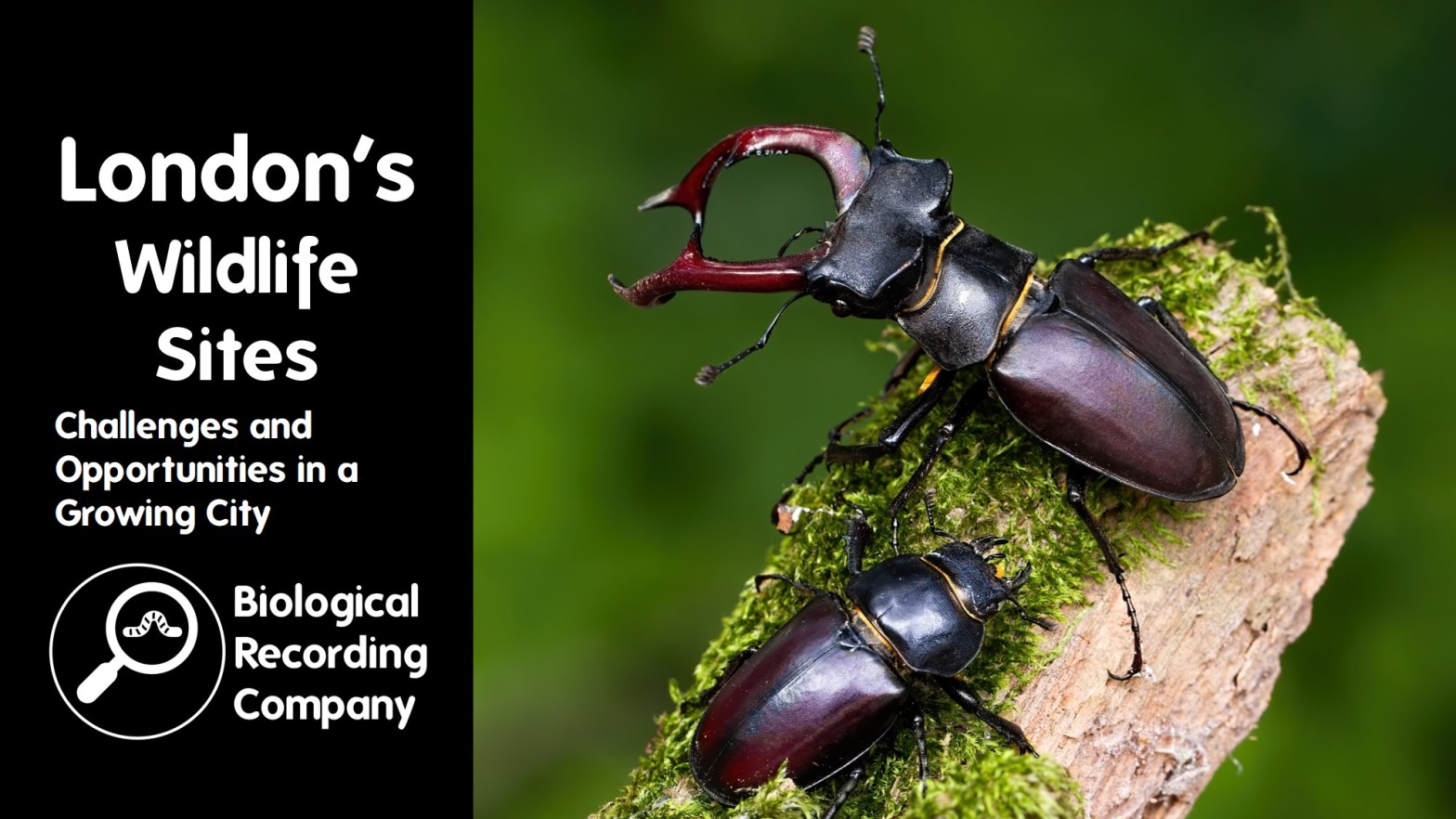
The criteria to identify Sites of Importance for Nature Conservation (SINCs) in London and the policies to best protect and enhance them have been in place for over 35 years. There are now 1660 of them covering c19% of the area of Greater London, but they face challenges from a growing London (with a projected population of 10 million by 2030). This looks at the SINCs origins, how they have fared to help conserve habitats and species, and how they might prove to serve critical purposes for the (re)wilding of the city and its climate change resilience.
An urban ecologist with an interest in the relationship between nature and society in towns and cities, Mathew Frith has over 30 years experience in nature conservation policy and practice. He has worked for public and voluntary organisations, to develop and promote a better understanding of biodiversity conservation in urban areas. Mathew currently oversees London Wildlife Trust’s strategic conservation oversight and development of research, policy & practice to advocate the protection, creation and promotion of a wilder city. His favourite bird is the magpie.
Q&A with Mathew Frith
- If you were advising conservationists in an area that has no designated Local Wildlife Sites, what would you advise should be the priorities?
I presume that there would be a reasonable understanding of the ecological assets of the county – this is essential for making evidence-based decisions. If this information is unknown, the first step would be to undertake a county-wide survey on that. From that, you could use the various Local Wildlife Site criteria from around the country to determine which sites merit consideration as a Local Wildlife Site. When London started working on this there was no guidance at all, so any area starting from scratch now can at least borrow from other areas. There will be local nuances that need to be taken into consideration. As we’ve heard from the talk about Devon, it is quite a laborious process and it requires a lot of work – but you have to start somewhere and you’d probably need to start with sites that are well known to the local naturalist – especially the botanist – community (who you could ask to help survey). - How do you survey railway sites and are you able to access them?
It’s certainly not easy as many of these sites are inaccessible for Health & Safety reasons. A lot of the survey work on these sites has been monitored from bridges, through fences and on trains themselves – travelling at key flowering times and trying to get some form of assessment. There are some tracks that are more accessible for visual assessment than others. To be fair, there doesn’t tend to be a great diversity of habitats when it comes to these sites – though there are always exceptions. We also have the benefits of digital aerial photography which we didn’t have in the 80s and 90s, and these are becoming increasingly important for surveying these inaccessible sites. However, lack of access is a problem, particularly as some of these sites have been targeted for sale for development so it is important that we don’t underestimate their value through lack of survey data. - Do Local Wildlife Sites (otherwise known as Sites Important for Nature Conservation in London) such as Perivale Wood have less protection with regards to planning than Sites of Special Scientific Interest (SSSIs)?
Unfortunately, yes, but the two have slightly different purposes. In the case of Perivale Wood, it was initially designated as a SSSI back in 1957 as an example of a habitat worthy of legal protection (SSSIs are but a selection of nationally important habitats and features meriting protection). …and for reasons I’m not aware of it was de-notified as a SSSI and declared as a Local Nature Reserve at the same time (24th October 1974) instead. Perhaps it was felt it was – and still is – in safe hands, but I don’t think that would happen these days given that the site is probably the best bluebell site in London. HS2 posed a threat to Perivale Wood as it was planned to adversely impact the southern edge of the site – but it was probably the costs of demolishing nearby housing rather than the biodiversity value of Perivale Wood that led to that plan being changed. The truth is that a SSSI designation should afford more protection than a LWS/SNC designation, as it is designated through primary legislation. LWS/SINC designations (ideally of all – not a selection of – sites at a county scale meeting the minimum criteria of habitat type and condition) are identified through planning policy. - Could green roofs or green walls or green roos potentially be considered and designated as Local Wildlife sites in urban environments in the future?
We undertook a review of SINCs (i.e. Local Wildlife Sites) in the ‘Square Mile’ of the City of London and we actually looked at a couple of green roofs. We believe that one of those green roofs actually merited SINC status. If you think about the square mile itself, there really isn’t much there that equates to SINCs elsewhere in London. This poses the question: what would the SNC status mean with a roof on a building? We actually recommended it was considered and believe that there are a load of things that need greater investigation when considering the criteria in such a developed area. This is a conversation that we are looking to have with the GLA (Greater London Authority) and it may be that after this has all been looked at in a lot more detail that we do have green roofs designated as SINCs in the future. I’m less convinced about green walls personally. Another question that has come up is the consideration of clusters of gardens being considered as SINCs – but this gets extremely complicated as you have multiple landowners and most garden loss is down to owners themselves rather than through planning (e.g. paving over a garden or laying down decking or plastic lawns).
Further info and links
- London SINC criteria: https://www.london.gov.uk/sites/default/files/sinc_selection_process_2019_update_.pdf
- Spaces Wild guidance: http://live-twt-d8-london.pantheonsite.io/sites/default/files/2019-05/spaces-wild-london-wildlife-trust-oct2015.pdf
- GiGL website (the LERC for London): https://www.gigl.org.uk/
- The London Plan: https://www.london.gov.uk/programmes-strategies/planning/london-plan
- Valuing London’s Urban Forest https://www.london.gov.uk/programmes-and-strategies/environment-and-climate-change/environment-publications/valuing-londons-urban-forest
- Cool Spaces: https://www.london.gov.uk/programmes-strategies/environment-and-climate-change/climate-change/climate-adaptation/cool-spaces
- The Rewild London Fund: https://www.wildlondon.org.uk/rewildlondon
- Environmental Improvement Plan 2023: https://assets.publishing.service.gov.uk/government/uploads/system/uploads/attachment_data/file/1168372/environmental-improvement-plan-2023.pdf
- Hackney Nature Recovery Plan: https://consultation.hackney.gov.uk/chief-executives/green-infrastructure-strategy/supporting_documents/Local%20Nature%20Recovery%20Plan.pdf
- London: Garden City? report: http://live-twt-d8-london.pantheonsite.io/sites/default/files/2019-05/London%20Garden%20City%20-%20full%20report%281%29.pdf
- Upcoming free entoLIVE webinars: https://www.eventbrite.co.uk/cc/entolive-webinars-74679
- Field Recorder Days in London: https://www.eventbrite.co.uk/cc/field-recorder-days-1485759
- Identification Training Courses in London: https://www.eventbrite.co.uk/cc/training-courses-2403189
Learn more about British wildlife

 Biological Recording