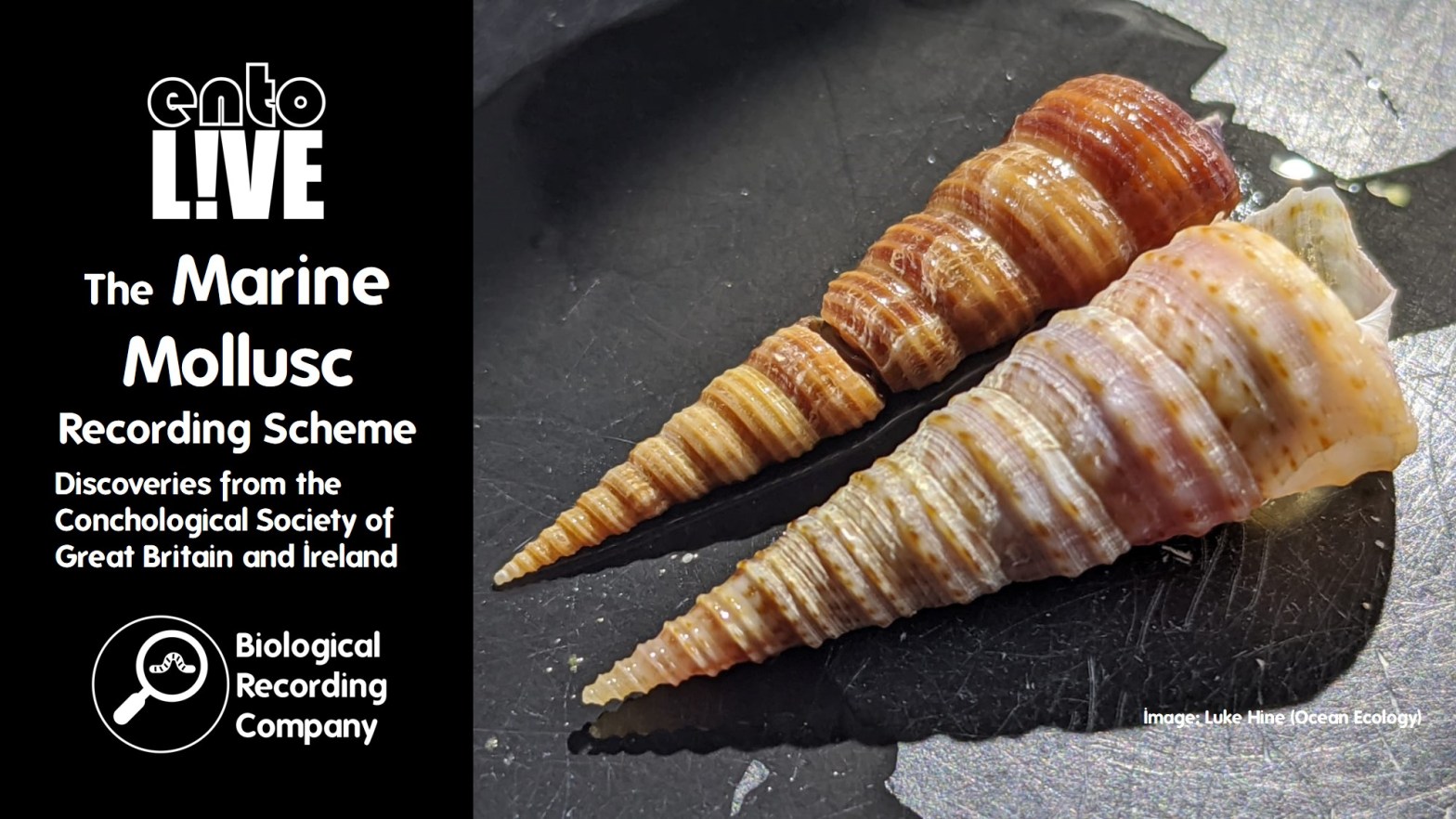
The Conchological Society‘s marine recording scheme will be 100 years old in 2023 yet is as relevant now as it has ever been. Current scheme coordinator Simon will outline what is involved and how data is gathered, verified, stored and shared.
Q&A with Simon Taylor
Simon has been the Hon. Marine Recorder for the Conchological Society since 2013. As well as maintaining the Society’s marine mollusc record dataset (>200,000 species occurrences) the role involves conducting, coordinating and promoting survey activity and closely monitoring developments in the marine mollusca fauna of the study area.
- Do you get data from the Wildlife Trusts Shoresearch recording project?
Yes, sometimes and this is often via iRecord. These types of projects are often, and understandably, run by people with broad knowledge of the wildlife that are likely to be encountered, rather than the specific mollusc knowledge that the Conchological Society brings. They often welcome the verification skills that we can provide and add data to iRecord to make use of the expert verifiers active on the platform for molluscs. In return, we welcome their data into our datasets! - What was the reason behind the destruction of records due to changes in data protection legislation?
I wasn’t party to it myself, but quite a significant number of records were lost. I believe it was due to people being told to sign things stating that the data belonged to the Society. These were different times and there was a lot of confusion regarding the new legislation. Thanks to things like the National Biodiversity Network, we have a much better understanding and most recorders are very happy to share their records and get their data put to good use. Biological recording is a collaborative effort. - Do you have a relationship with the Porcupine Marine Natural History Society or the British Marine Life Studies Society?
We do have a relationship with the Porcupine Marine Natural History Society and have a number of members in common. They cover all marine life and they have their own recording scheme for gathering marine records, and we’re happy for others to record and manage marine mollusc data as long as it is shared and available for use. However, as we specialise in molluscs, we consider our datasets the gold standard for molluscs in the UK. We also work quite closely with Seasearch, which gets volunteer divers to record the wildlife that they see when diving. - Why/how did Jeffreys’s material end up in the Smithsonian?
Money. I think the estate was selling the collection of voucher specimens and the Natural History Museum (London) was simply outbid. The Smithsonian are very helpful in letting naturalists access the type material. - How did you get involved with the society and are there opportunities to be involved in Cumbria?
As a child, my parents used to take me to Mersea Island (an interesting place connected by a B-road causeway which floods on spring tides) where I would pick up and look at shells and my parents enlisted me a junior member of the society back then. Later in life I renewed my interest, started getting more involved and started taking it more seriously. We are a national organisation, even international – but we are a relatively small society so we don’t have activities in every part of the UK. We host a week-long field excursion for marine recording each year as part of our field meetings programme. It’s also worth looking into getting involved with Shoresearch schemes run by local wildlife trusts. - Are there trends for warmer water species starting to appear?
Yes – there is no doubt about this with marine molluscs. We are seeing species that were at the southern limit of their range retreating north and quite regularly new species that prefer warmer waters expanding their range northwards into our waters. New species tend to be recruited into the southwest of England (i.e. Cornwall and the Scilly Isles). Other species that are limited by winter minimum temperature, which impacts breeding viability, are now starting to colonise the North Sea. - Do you have a project on iNaturalist to upload marine mollusc records to?
The best method for submitting records to us is via iRecord. The competitive nature of iNaturalist has led to a deluge of records of the same species from the same place, for example, dead mussel shells from every 5 steps they take along a sandy shore. Records submitted to iRecord are verified by the Conchological Society, whereas the iNaturalist records are verified by any other user regardless of experience. We also strongly encourage recorders to provide a full name (not a username as is often the case on iNaturalist) as this is one of the four W’s that is essential to any biological record. You can access a lot of experts via various Facebook groups, such as the British Marine Mollusca and NE Atlantic Nudibranchs groups.
Literature references
- Alf et al.(2020) A Guide to Marine Molluscs of Europe https://www.nhbs.com/a-guide-to-marine-molluscs-of-europe-book
- Graham (1988) Linnean Society Synopses No. 2 – British Prosobranch & Pyramidellid Gastropods (2nd ed.) OUT OF PRINT
- Hayward & Ryland (2017) Handbook of the Marine Fauna of North-West Europe: https://academic.oup.com/book/26914
- Jones and Baxter (1987) Linnean Society Synopses No. 37 – Caudofoveata, Solenogastres, Polyplacophora and Scaphopoda OUT OF PRINT
- Picton & Morrow (2023) A field guide to Nudibranchs of the British Isle: https://www.nhbs.com/nudibranchs-of-britain-ireland-and-northwest-europe-book
- Tebble (1966) British Bivalve Seashells: https://www.abebooks.co.uk/book-search/title/british-bivalve-seashells/
- Thompson (1988) Linnean Society Synopses No. 8 – Benthic Opisthobranchs (2nd ed.) OUT OF PRINT
- Wigham & Graham (2017) Linnean Society Synopses No. 60 – Marine gastropods 1: Patellogastropoda and Vetigastropoda: https://www.field-studies-council.org/shop/publications/marine-gastropods-1/
- Wigham & Graham (2017) Linnean Society Synopses No. 61 – Marine gastropods 2: Littorinimorpha: https://www.field-studies-council.org/shop/publications/litterinimorpha-marine-gastropods-2/
- Wigham & Graham (2018) Linnean Society Synopses No. 62 – Marine gastropods 3: Neogastropoda: https://www.field-studies-council.org/shop/publications/marine-gastropods-3/
- Wigham & Graham (2018) Linnean Society Synopses No. 63 – Marine gastropods 4: Heterobranchia 1: https://www.field-studies-council.org/shop/publications/heterobranchia-1-marine-gastropods-4/
Further info
- Conchological Society of Great Britain & Ireland website: www.conchsoc.org
- Marine mollusc data from ConchSoc on the NBN Atlas: https://registry.nbnatlas.org/public/show/dp117
- Submit your marine mollusc records via iRecord: https://irecord.org.uk/
- National Museum of Wales “Marine Bivalve Shells of the British Isles”: https://naturalhistory.museumwales.ac.uk/BritishBivalves
- Ian Smith species accounts available via ResearchGate: https://www.researchgate.net/profile/Ian-Smith-40
- Jim Anderson’s “Scottish Nudibranchs” website: http://www.nudibranch.org/Scottish%20Nudibranchs/
- British Marine Mollusca Facebook group: https://www.facebook.com/groups/british.marine.mollusca
- NE Atlantic Nudibranchs Facebook group: https://www.facebook.com/groups/NE.Atlantic.nudibranchs
entoLIVE
entoLIVE webinars feature guest invertebrate researchers delving into their own invertebrate research. All events are free to attend and are suitable for adults of all abilities – a passion for invertebrates is all that’s required!
- Donate to entoLIVE: https://www.gofundme.com/f/entolive-2026
- Upcoming entoLIVE webinars: https://www.eventbrite.com/cc/entolive-webinars-74679
- entoLIVE blog: https://biologicalrecording.co.uk/category/entolive-blog/
- entoLIVE on YouTube: https://youtube.com/playlist?list=PLuEBNUcfMmE95Re19nMKQ3iX8ZFRFgUAg&feature=shared
entoLIVE is only possible due to contributions from our partners and supporters.
- Find out about more about the British Entomological & Natural History Society: https://www.benhs.org.uk/
- Check out the Royal Entomological Society‘s NEW £15 Associate Membership: https://www.royensoc.co.uk/shop/membership-and-fellowship/associate-member/

More on marine biology


 Biological Recording