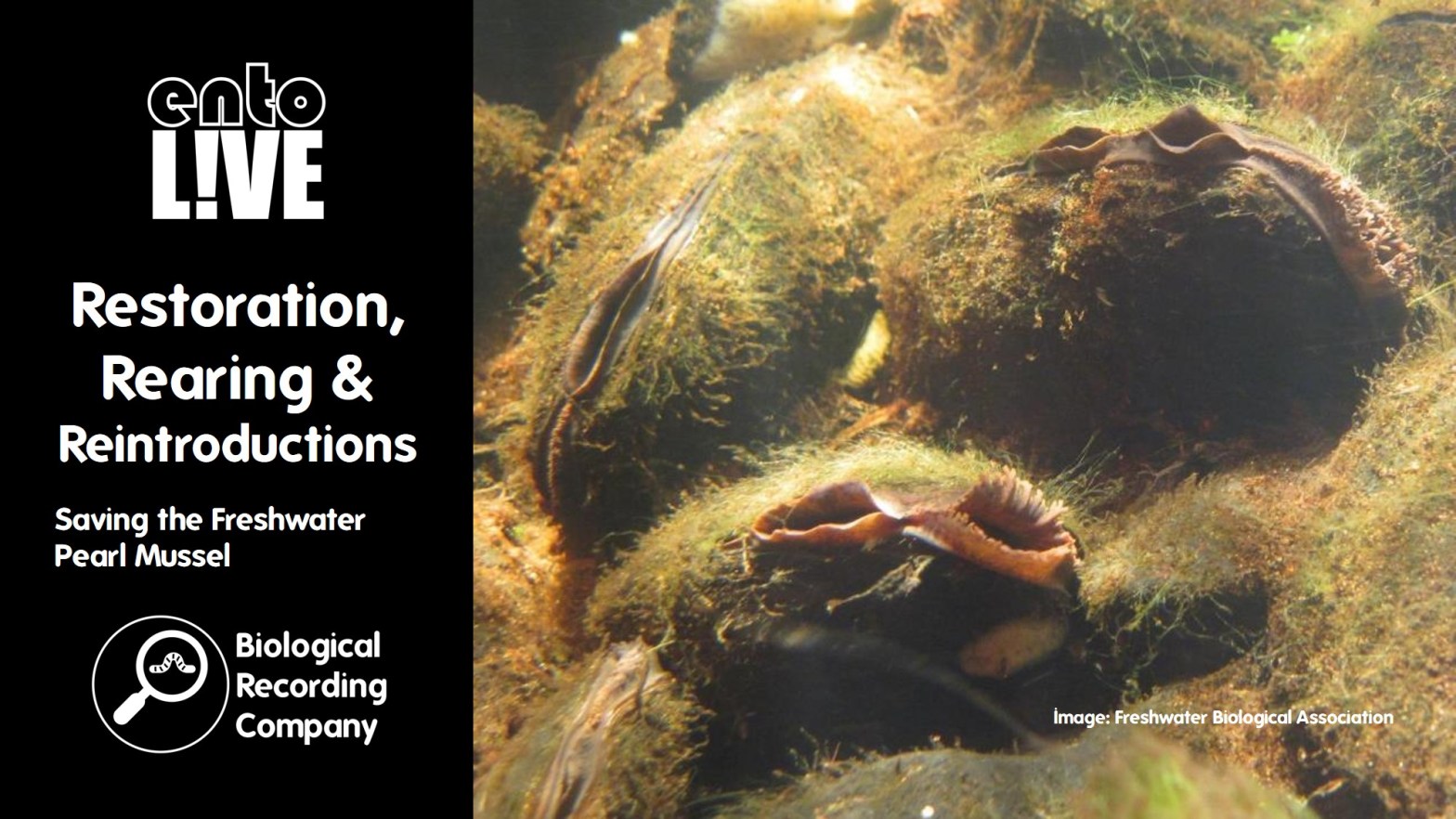
The Freshwater Pearl Mussel (Margaritifera margaritifera) is a fascinating species and a powerful ecosystem engineer in the UK’s rivers and streams. Many of the UK’s populations are in freefall with the youngest individuals in the wild being over 70 years old! Time is running out for this species. This talk will explore what the Freshwater Biological Association and partners are doing to bring this species back from the brink of extinction.
Q&A with Louise Lavictoire
Louise Lavictoire is the Head of Science at the Freshwater Biological Association, leading an enthusiastic team of people working on species recovery and citizen science projects. Louise has worked on freshwater mussels for over 15 years trying to better understand their biology and limitations to inform their conservation and restoration in the wild.
- What do the mussels feed on?
They are filter feeders and mostly eat algae, but what they filter out is hotly debated – they may also take some bacteria. They also filter out small bits of clay or sediment out of the water column and sediment it out into the gravel around them. - What do you feed the juveniles in captivity?
We feed them on a mix of commercially available algae, which we get from the USA. It’s a mix of Nannochloropsis (a small alga that is about 1-2 microns) and ‘shellfish diet’ (a mix of 5 or 6 marine algae). If we’re not augmenting the feeding we use filtered lake water from Windermere. - Is there a reason why some Freshwater Pearl Mussel exclusively use trout and why some exclusively use salmon?
We were part of a UK-wide study in 2009 where we took samples from each of our English populations and compared them with Scottish and Welsh populations. The findings were that each population is specific and should be treated as a separate conservation unit. So we would only stock the River Irt with juveniles derived from the River Irt population. It is different for the River Kent population (for which we have a LIFE project – LIFE R4ever Kent) as we only have 3 mussels left in the entire population and so we are looking at which other English population would be most suitable as a donor for captive breeding and the local fish population, based on genetic similarity and use of the same host fish species. - Is there significant genetic diversity between populations in different catchments that we need to maintain for any restocking/restoration?
We were part of a UK-wide study in 2009 where we took samples from each of our English populations and compared them with Scottish and Welsh populations. The findings were that each population is specific and should be treated as a separate conservation unit. Sowe would only stock the River Irt with juveniles derived from the River Irt population. It is different for the River Kent as we only have 3 mussels left in the entire population and we are looking at which population would be most suitable as a donor for captive breeding and the local fish population, based on genetic similarity and use of the same host fish species. - What do we know about the recent populations discovered in a loch in Scotland?
I’m not sure if the population includes juveniles – which is the issue with most of our mussel populations as they are ageing populations with no new juveniles. The recent find in Scotland points very much to the fact that the habitat conditions are good enough for them to survive in slow-flowing waters which are still fairly pristine. If the oxygen concentrations are high enough and the substrate is relatively free of silt so that the juveniles that are dropping there are dropping into clean substrate, it would be fantastic news. We’d need further surveys to know more detail. However, the habitat conditions must be fairly pristine for mussels to be surviving there. They’re also known from Irish loughs too. - Is there any reason they are associated with low-calcium environments?
I’m not sure if we know the answer to this. It does seem odd when you consider the size and thickness of their shell. However, they are absolutely not calcium tolerant and high lime concentrations can kill them. - Have you experienced mortality due to the patch on the exterior of the shell above the hinge perforating?
We haven’t seen this. I’ve read in scientific papers that part of the shell (the umbo) can get worn away in fast-flowing waters and that mussels can plug it themselves with sand. This could be more pronounced in rivers that are more acidic.
Further info
- LIFE R4ever Kent project: https://r4everkent.co.uk/
- Video of mussels and fish: https://www.youtube.com/watch?v=qPhFJUVa2vc&list=PLBCF8F795289C1093
- Video of glochidia: https://www.youtube.com/watch?v=QGkrt7wmQCM&list=PLBCF8F795289C1093&index=15
entoLIVE
entoLIVE webinars feature guest invertebrate researchers delving into their own invertebrate research. All events are free to attend and are suitable for adults of all abilities – a passion for invertebrates is all that’s required!
- Donate to entoLIVE: https://www.gofundme.com/f/entolive-2026
- Upcoming entoLIVE webinars: https://www.eventbrite.com/cc/entolive-webinars-74679
- entoLIVE blog: https://biologicalrecording.co.uk/category/entolive-blog/
- entoLIVE on YouTube: https://youtube.com/playlist?list=PLuEBNUcfMmE95Re19nMKQ3iX8ZFRFgUAg&feature=shared
entoLIVE is only possible due to contributions from our partners and supporters.
- Find out about more about the British Entomological & Natural History Society: https://www.benhs.org.uk/
- Check out the Royal Entomological Society‘s NEW £15 Associate Membership: https://www.royensoc.co.uk/shop/membership-and-fellowship/associate-member/

More on freshwater biology




 Biological Recording
One thought on “Restoration, Rearing and Reintroductions: Saving the Freshwater Pearl Mussel”