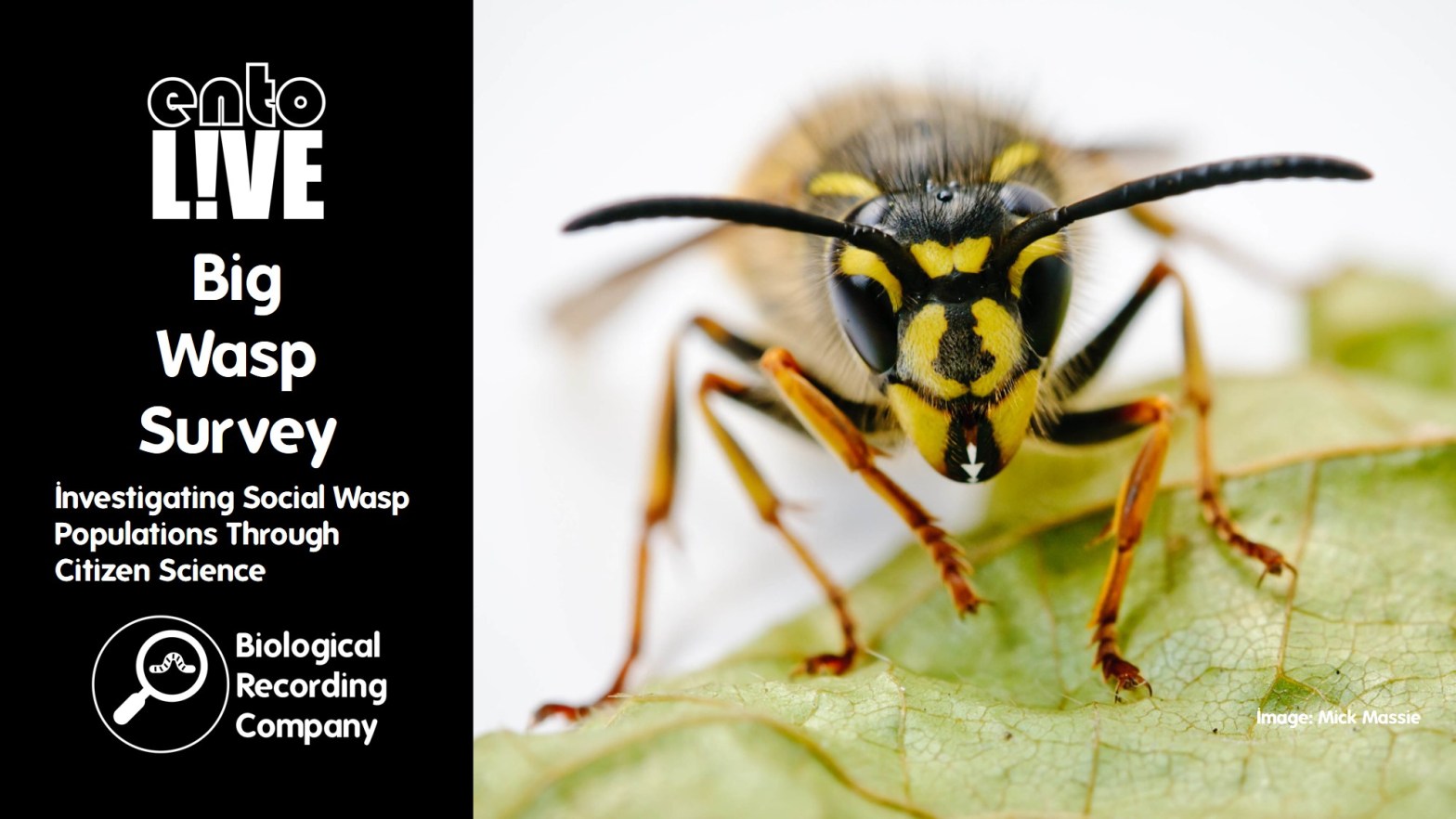
Big Wasp Survey is a citizen science initiative co-founded by Prof Seirian Sumner (University College London) and Prof Adam Hart (University of Gloucestershire). Members of the UK public sample vespine wasps in their local area, and submit their data. BWS has been running for 5 years, and it’s giving us a really good view of the diversity and distribution of vespine wasps in the UK, as well as insights into what influences citizen scientists to participate year after year.
Q&A with Prof Seirian Sumner
Seirian Sumner is a professor of behavioural ecologist at UCL (University College London). She uses a combination of field ecology and molecular biology to understand insect behaviour, with a particular fondness of wasps. She co-founded Big Wasp Survey in 2017, and published her first popular science book in 2022 – Endless Forms, why we should love wasps.
- How do I sign up to get involved?
to take part, you need to register through the Big Wasp Survey website and follow the instructions there. This year, we are inviting you to trap wasps in 2 separate sessions, one in July-August and one in the usual August-September slot, as you add traps, make you select which session the trap is part of. You can find full details on the How To Take Part webpage. - Do Big Wasp Survey records feed into NBN Atlas?
At the moment our data hasn’t been submitted. We are working on our database at the moment and hope to make it publicly available in the future. At the moment we’re running it with no budget so capacity can be a little bit of an issue. We’re always happy to share the data if requested from us directly and can share spreadsheets of the annual data while we work on the database. - Do you have to kill social wasps for confident species identification?
Firstly, check out the article written by Adam Hart and me in The Conversation that responds directly to this question. The problem with wasps is that it is really difficult to identify them. Even separating the common ones can be tricky, with the facial markings that distinguish Vespula germanica from Vespula vulgaris showing a lot of variation in reality. This means that photo of the face is often not enough to separate them as you also need to look at several points on the thorax and head. It is the same for other schemes that try to investigate the diversity and distribution of insect species, such as the government-funded UK Pollinator Monitoring Scheme that involves putting out pan traps that collect and kill specimens. We are very mindful of the fact that the traps are lethal, so it is about surveying for as short a period as possible to gather the minimum data that you need and timing the survey to take place at the point in the colony cycle when the loss of individuals will have the lowest impact. It’s also worth putting the survey in the context of what is happening in the wider towns and cities that it takes place within: how many wasps are being killed by pest controllers for example? A single colony contains tens of thousands of wasps. If you compare the number of specimens taken through our survey, our impact really is negligible in comparison/ - Is there no way of creating non-fatal traps and then photographing them for identification?
Even if it was possible to catch wasps and identify them humanely using photographs, most of our participants would not have had the equipment, skills or experience to effectively get close-up photos of wasps. We also don’t do a big publicity drive each year as we don’t need a large number of samples and we’ve added a cap to the number of traps within a given postcode to ensure that an area isn’t over-sampled and wasps collected unnecessarily. - Are only wasps trapped and what happens to any other organisms that are caught?
The beer traps do mainly attract wasps, but there is unfortunately also bycatch – particularly flies. We’ve sorted out the bycatch by taxonomic group and are very happy for anyone interested in those groups to take the specimens and identify them as we simply don’t have the capacity to get them identified. It can be quite trap-specific, so we think it may be to do with where the trap is hung. - What identification resources would you recommend for identifying wasps?
You can find our guidance, including ID videos and the Big Wasp Survey ID Flow Key, in the Identification section of the BWS website. It’s designed for beginners and focuses on the species of wasp targeted by the Big Wasp Survey. - Are records outside of the survey useful and do you collect them from iRecord?
The data that we gather needs to be from registered traps where the survey methodology has been followed. This enables us to compare results. However, ad hoc records of wasps are still really useful so you should continue to submit these. The national recording scheme for wasps is run by the Bees, Wasps and Ants Recording Society and they can advise on the best means of submitting these records.
Literature references
- Sumner et al (2018) Why we love bees and hate wasps: https://resjournals.onlinelibrary.wiley.com/doi/pdf/10.1111/een.12676
- Sumner et al (2019) Big Wasp Survey Summary Update: https://www.bigwaspsurvey.org/wp-content/uploads/2019/11/Big-Wasp-Survey-Summary-Report-2019_final.pdf
- Sumner et al (2019) Mapping species distributions in 2 weeks using citizen science: https://resjournals.onlinelibrary.wiley.com/doi/full/10.1111/icad.12345
Further info
- Big Wasp Survey website: https://www.bigwaspsurvey.org/
- Check out the BWS to find out how to get involved with the Big Wasp Survey: https://www.bigwaspsurvey.org/taking-part/
- Check out ‘Endless Forms: Why we should love wasps’ by Prof. Seirian Sumner: https://harpercollins.co.uk/products/endless-forms-why-we-should-love-wasps-seirian-sumner?variant=40174390870094
- Learn more about recording wasps on the BWARS website: https://www.bwars.com/
entoLIVE
entoLIVE webinars feature guest invertebrate researchers delving into their own invertebrate research. All events are free to attend and are suitable for adults of all abilities – a passion for invertebrates is all that’s required!
- Donate to entoLIVE: https://www.gofundme.com/f/entolive-2026
- Upcoming entoLIVE webinars: https://www.eventbrite.com/cc/entolive-webinars-74679
- entoLIVE blog: https://biologicalrecording.co.uk/category/entolive-blog/
- entoLIVE on YouTube: https://youtube.com/playlist?list=PLuEBNUcfMmE95Re19nMKQ3iX8ZFRFgUAg&feature=shared
entoLIVE is only possible due to contributions from our partners and supporters.
- Find out about more about the British Entomological & Natural History Society: https://www.benhs.org.uk/
- Check out the Royal Entomological Society‘s NEW £15 Associate Membership: https://www.royensoc.co.uk/shop/membership-and-fellowship/associate-member/

More on citizen science

 Biological Recording