
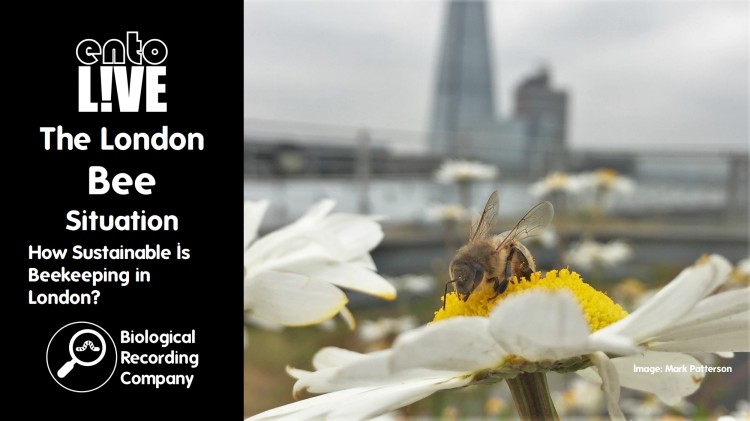
For more than 10 years London has seen an unprecedented rise in beekeeping across the city’s urban landscape. This talk will look at how sustainable beekeeping is in London and how it can impact other pollinators. In recent years well-meaning intentions have led to unsustainable actions.
Mark Patterson is an ecologist and beekeeper in London and an active recorder of wild bees. Through his consultancy Apicultural he works with local authorities, London businesses and community organisations to help the capital’s pollinators.
Q&A with Mark Patterson
- Does 1 colony equal 1 hive?
A colony is 1 queen and the workforce. The hive is the box that houses the colony, so we do tend to use the two words interchangeably as they both refer to 1 superorganism. A collection of hives/colonies is referred to as an apiary. - Which plants benefit the most from which pollinator species?
Some pollinators are polylectic, meaning that they are generalists that feed from many different plants. Others are oligolectic, meaning that they are ‘fussy eaters’ and will only feed from a small number of plants (for example only feeding from flowers within one family of plants). Where you have a pollinator species that will only feed on a flower (i.e. a single species), these are referred to as monolectic. The monolectic species are the ones that are most at threat from competition by honeybees because they are unable to find food if their food source has been depleted by a nearby hive. So different plant species will benefit from different species. Many of the great nectar sources for bees are actually things that are considered weeds, such as thistles. Some invasive plants, such as Himalayan Balsam, can also be rich nectar sources for bees and their popularity with pollinators can be one of the reasons that they spread so easily. You’ll find guidance on planting for pollinators on my website. - What sort of monitoring is going on nationally on this issue?
Generally speaking, the biggest increase in beekeeping is in urban centres so it is big cities that are attracting the most attention. This increase in urban hives is largely being powered by commercial outfits that run ‘Sponsor a Beehive’ initiatives to “help save the planet” – which is complete beewashing and really just lining somebody’s pockets! For example, there are very few people living within the square mile, but there are a lot of beehives as they are on commercial properties. this issue is not limited to the UK or even Europe – we’re seeing it globally. For example, there are now concerns that there are too many hives in New York, Washington and Atlanta in the USA. - Is there any control on who can become a beekeeper and do you need to register?
In some cities in Europe and the USA there are strict regulations and control of beekeeping. For example, in New York and Washington DC in the USA you would need to apply for a licence to keep bees – this would be limited to keeping a maximum of 4 hives on a residential or commercial unit and the hives would need to be a minimum distance from the boundary of your property to minimise the impact on your neighbours. You would also be required to provide a source of water for them, manage them for pests and diseases and keep them in framed hives that can be checked by inspectors. However, in the UK there are no controls (apart from on the import of bees and relating to notifiable diseases) and anyone can set up as a beekeeper without a need to register. It is as easy as ordering a beehive and a box of bees to be delivered to their house with no requirement for training or registration. I would personally support mandatory registration and restrictions on beekeeping. Some local beekeepers’ associations, like London Beekeepers Association, are very good at encouraging their members to voluntarily register their hives in the areas that they cover – but this varies greatly between different areas and regions. - Has the number of hives within the UK not declined since the early 20th century?
I have not seen any real evidence to support the rumoured million hives in the late 1800s/turn of the century. Figure 1 below was generated by Jeff Ollerton from a number of sources relating to the number of bee hives in the UK. It shows there are as many bees today in the UK as there were in the 1950s. Figure 2 from the Food and Agriculture Organisation of the United Nations clearly shows global hive numbers are increasing.


Literature references
- London Beekeepers Association (2020) The London Bee Situation: An LBKA outline report: https://drive.google.com/file/d/1-Y3XCP50RCDy_9jq_oCB8VI6FOQtUns9/view
- Casanelles Abella and Morretti (2022) Challenging the sustainability of urban beekeeping using evidence from Swiss cities: https://www.nature.com/articles/s42949-021-00046-6
- Goulson (2019) Insect Declines & Why They Matter: https://www.flipsnack.com/devonwildlifetrust/insect-declines/full-view.html
- Greater London Authority (2018) London Environment Strategy: https://www.london.gov.uk/sites/default/files/london_environment_strategy_0.pdf
- MacInnis et al (2023) Decline in wild bee species richness associated with honey bee (Apis mellifera L.) abundance in an urban ecosystem: https://peerj.com/articles/14699/
- Renner et al (2021) High honeybee abundances reduce wild bee abundances on flowers in the city of Munich: https://link.springer.com/article/10.1007/s00442-021-04862-6
- Ropars et al (2019) Wild pollinator activity negatively related to honey bee colony densities in urban context: https://doi.org/10.1371/journal.pone.0222316
- Stevenson et al (2020) The state of the world’s urban ecosystems: What can we learn from trees, fungi, and bees?: https://nph.onlinelibrary.wiley.com/doi/10.1002/ppp3.10143
Further info
- Do Managed Honey Bees compete with Wild Bees for Floral Resources? https://www.apicultural.co.uk/do-managed-honey-bees-compete-with-wild-bees-for-floral-resources
- Bumblebees of the UK online course: https://courses.biologicalrecording.co.uk/courses/bumblebees
- London Beekeepers’ Association: https://www.lbka.org.uk/
- Api:Cultural: www.apicultural.co.uk
entoLIVE
entoLIVE webinars feature guest invertebrate researchers delving into their own invertebrate research. All events are free to attend and are suitable for adults of all abilities – a passion for invertebrates is all that’s required!
- Donate to entoLIVE: https://www.gofundme.com/f/entolive-2026
- Upcoming entoLIVE webinars: https://www.eventbrite.com/cc/entolive-webinars-74679
- entoLIVE blog: https://biologicalrecording.co.uk/category/entolive-blog/
- entoLIVE on YouTube: https://youtube.com/playlist?list=PLuEBNUcfMmE95Re19nMKQ3iX8ZFRFgUAg&feature=shared
entoLIVE is only possible due to contributions from our partners and supporters.
- Find out about more about the British Entomological & Natural History Society: https://www.benhs.org.uk/
- Check out the Royal Entomological Society‘s NEW £15 Associate Membership: https://www.royensoc.co.uk/shop/membership-and-fellowship/associate-member/

More on bees
 Biological Recording
3 thoughts on “The London Bee Situation: How Sustainable Is Beekeeping in London?”