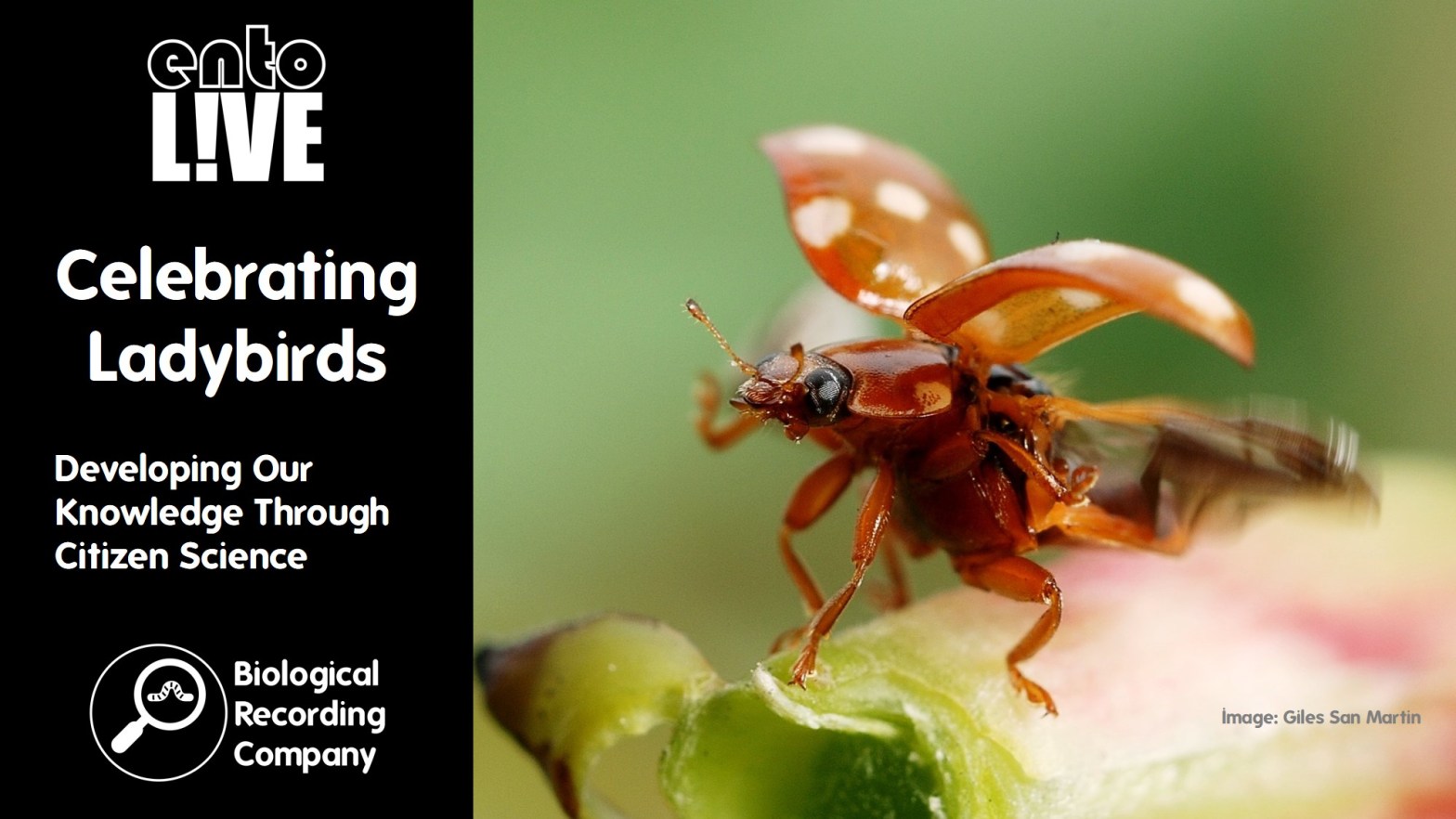
Ladybirds are much-loved insects. Our understanding of the ecology of these beautiful beetles has been in part from the contributions of many citizen scientists. Helen will provide some insights into the diverse and intriguing life histories of ladybirds.
Q&A with Prof Helen Roy MBE
Professor Helen Roy MBE is an ecologist at the UK Centre for Ecology & Hydrology. She is fascinated by the ways in which environmental change affects the interactions between insects and other species. Biological invasions have been the focus of much of her research. Helen leads many collaborative national and international research projects. She is leading research for the EC on enhancing understanding and awareness of invasive alien species. Helen leads a Defra-funded project to produce a comprehensive information portal on non-native species in Great Britain which also includes annual reports on the status and trends of invasive alien species and the development of an alert system for people to report sightings of concern.
Over the last few years she has had the privilege of working with the UK Overseas Territories to predict and prioritise invasive non-native species. Her research on invasive non-native species has received international recognition and she is currently leading a global assessment on invasive non-native species for the Intergovernmental Panel on Biodiversity and Ecosystem Services. Helen also enjoys science communication and public engagement with research which led to her interest in citizen science. She has a passion for ladybirds and has led the UK Ladybird Survey, including tracking the spread of the invasive alien ladybird, Harmonia axyridis, alongside Peter Brown (Anglia Ruskin University) for more than 15 years. Helen is a previous President of the Royal Entomological Society. Helen was awarded an MBE in 2018 in recognition of her contributions to biodiversity science.
Do you have any tips for photographing small inconspicuous ladybirds that won’t stay still?
I’ve got a great tip, but the credit needs to go to Richard Comont. Put the ladybird into a clear plastic bag and put the bag with the ladybird onto some frozen peas to slow them down. If you then carefully hold the sides of the bag down to restrict the movement of the ladybird you should be able to get a photo. You won’t get the most beautiful photo through the bag but it should be good enough to help with ID. If you’re out and about at times of day when ladybirds are a little less active, such as early in the morning, then it can be easier to get a photo.
Where do Harlequin Ladybirds (Harmonia axyridis) originate from?
Harlequin ladybirds originate from quite a large area within Asia. I’ve seen them at home in China, but they still cause problems in their native range, feeding on other ladybirds and forming quite large aggregations in buildings which can be a bit of a nuisance.
Have there been any studies on ladybird migrations?
There was some research by Jason Chapman using vertical-looking radar to assess insect dispersal and migration. It is tricky to separate species using this approach but it is possible to distinguish large ladybirds, such as the Harlequin and the 7-Spot, from other insects and measure the height and speed at which they fly. It was incredible to see how fast and high they fly. So while they are not migrating, some ladybirds do make quite long-distance dispersal, particularly when aphids may be running in short supply.
Check out Will Hawkes entoLIVE on fly migration to learn more about insect migration
Do the chemicals in flea treatments for pets impact ladybirds?
That’s a very good question and not something that I know much about. We do know that chemicals designed to kill one type of insect often have an impact on other insects, such as neonicotinoids on bees. However, I’m not personally familiar with any research regarding the impacts of those ‘spot-on’ flea treatments on insects. Declines in the population and distribution of insects are often due to a number of factors, such as climate change and biological invasions interacting, and it can be difficult to attribute which are the most important. We definitely need more research on the interactions amongst these causes of change.
When people find Harlequin Ladybirds (Harmonia axyridis) should they treat them as a pest and remove them?
They are so widespread that removing them will not make a difference to the overall population. We advise people to just leave them be, particularly as they can easily be confused with other species. Please do submit your records through iRecord. It’s easy to make the assumption that records of really common or widespread species are not very valuable, but they contribute to long-term datasets that are really useful. If they are being a nuisance and crowding indoors during the winter, you can move them into a shed or similar. It’s remarkable that now they are almost everywhere (except Australia, the Arctic and the Antarctic) – we even found them on St Helena in the middle of the Atlantic Ocean.
Do we know why there can be so much variation in the patterns of some species of ladybird?
There are a number of theories and thoughts. For example, all ladybirds contain distasteful chemicals that act as a defensive mechanism, but the 2-spot ladybird is less unpleasant tasting than others and it is thought that the melanic form may be trying to mimic other ladybird species that taste more unpleasant to avoid being eaten. A second theory is around thermal aspects. For example, melanic forms may warm up more quickly. I’ve personally observed that the melanic form appears to be more active earlier in the day and the brightly coloured ladybirds take longer to warm up but this just anecdotal.
How can we help prevent more declines in native ladybird species?
We’ve recently been working on a collaborative paper with ladybird experts from around the world to give a conservation roadmap for ladybirds globally. Thinking locally, leaving some patches wild and providing a variety of microhabitats within green spaces is really useful as different species need different things. Leaving some of the pest insects on plants is also important so that the ladybirds have something to eat. As we go into the winter months it is important to leave the leaf litter on the ground so that ladybirds and other invertebrates have somewhere to shelter. However, the recording that many people do is also really important, as it helps us understand trends and then make evidence-based decisions on what actions need to be taken to protect ladybirds and other wildlife. So please do submit your ladybird sighting to iRecord!
Literature references
- Comont et al (2014) Ecological correlates of local extinction and colonisation in the British ladybird beetles (Coleoptera: Coccinellidae): https://link.springer.com/article/10.1007/s10530-013-0628-3
- Farrow et al (2022) The Rare Five-Spot Ladybird Coccinella quinquepunctata (Coleoptera: Coccinellidae) Surviving in an Unstable Habitat: https://www.frontiersin.org/articles/10.3389/fcosc.2021.759038/full
- Grez et al (2017) In the shadow of the condor: invasive Harmonia axyridis found at very high altitude in the Chilean Andes: https://resjournals.onlinelibrary.wiley.com/doi/10.1111/icad.12258
- Hui et at (2016) Defining invasiveness and invasibility in ecological networks: https://link.springer.com/article/10.1007/s10530-016-1076-7
- Outhwaite et al (2019) Annual estimates of occupancy for bryophytes, lichens and invertebrates in the UK (1970-2015): https://catalogue.ceh.ac.uk/documents/0ec7e549-57d4-4e2d-b2d3-2199e1578d84
- Purse et al (2013) Landscape and climate determine patterns of spread for all colour morphs of the alien ladybird Harmonia axyridis: https://onlinelibrary.wiley.com/doi/10.1111/jbi.12423https://onlinelibrary.wiley.com/doi/10.1111/jbi.12423
- Roy et al (2012) Invasive alien predator causes rapid declines of native European ladybirds: https://onlinelibrary.wiley.com/doi/full/10.1111/j.1472-4642.2012.00883.x
- Terry et al (2022) Thinking like a naturalist: Enhancing computer vision of citizen science images by harnessing contextual data: https://besjournals.onlinelibrary.wiley.com/doi/full/10.1111/2041-210X.13335
- van Klink et al (2022) Emerging technologies revolutionise insect ecology and monitoring: https://www.sciencedirect.com/science/article/pii/S0169534722001343
- Werenkraut et al (2020( Citizen science reveals the distribution of the invasive harlequin ladybird (Harmonia axyridis Pallas) in Argentina: https://link.springer.com/article/10.1007/s10530-020-02312-7
Further info
- Field Guide to the Ladybirds of Britain & Ireland: https://www.bloomsbury.com/uk/field-guide-to-the-ladybirds-of-great-britain-and-ireland-9781472935694/
- Coleopterists Society of Britain and Ireland: https://www.colsoc.org/
- UK Beetle Recording website: https://coleoptera.org.uk/home
- Submit your ladybird records to iRecord: https://irecord.org.uk/
entoLIVE
entoLIVE webinars feature guest invertebrate researchers delving into their own invertebrate research. All events are free to attend and are suitable for adults of all abilities – a passion for invertebrates is all that’s required!
- Donate to entoLIVE: https://www.gofundme.com/f/entolive-2025
- Upcoming entoLIVE webinars: https://www.eventbrite.com/cc/entolive-webinars-74679
- entoLIVE blog: https://biologicalrecording.co.uk/category/entolive-blog/
- entoLIVE on YouTube: https://youtube.com/playlist?list=PLuEBNUcfMmE95Re19nMKQ3iX8ZFRFgUAg&feature=shared
entoLIVE is only possible due to contributions from our partners and supporters.
- Find out about more about the British Entomological & Natural History Society: https://www.benhs.org.uk/
- Learn more about the Nurturing Nature project: https://cranbornechase.org.uk/chaseandchalke/nurturing-nature/
- Check out the Royal Entomological Society‘s NEW £15 Associate Membership: https://www.royensoc.co.uk/shop/membership-and-fellowship/associate-member/

More on biological recording




 Biological Recording