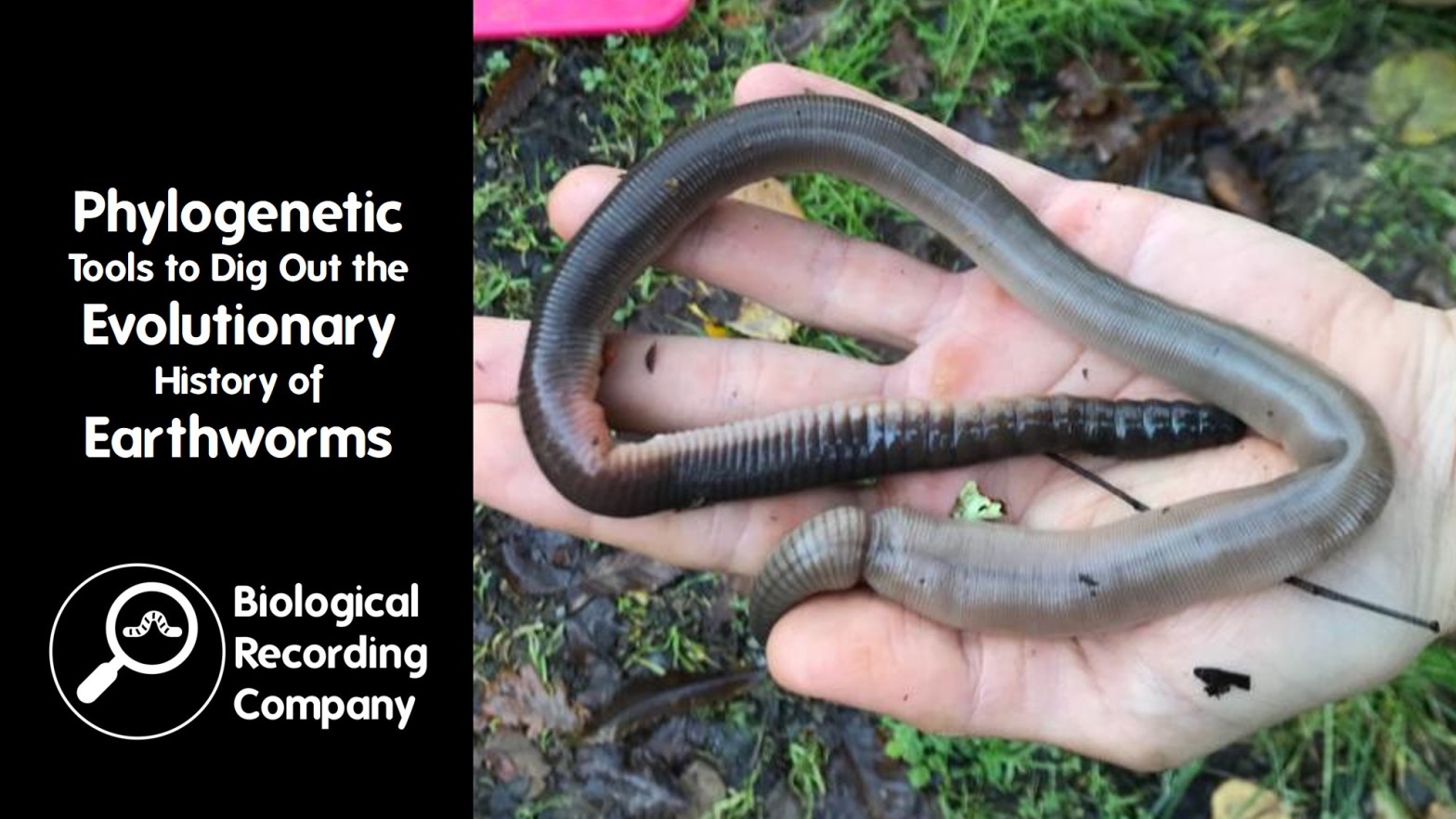
The morphology of earthworms is as obscure as their habitat, and this complicates our understanding of their evolutionary relationships and historical biogeography. Dr Daniel Marchán reviews different applications of genetic tools to shed light on these big questions, with an emphasis on the rare, endemic and threatened species.
Dr Daniel Fernandez Marchán is an earthworm researcher integrating the fields of molecular phylogenetics, morphology and ecological methods (as ecological niche modelling). His research is focused on the systematics of hormogastrid (Oligochaeta, Hormogastridae) and lumbricid earthworms (Oligochaeta, Lumbricidae).
Q&A with Dr Daniel Marchán
- How can we distinguish morphologically identical species where we don’t have access/funds for genetic analysis of specimens?
When species are separated genetically, it is good practice to go back and re-examine the morphology to see if a difference can be found. For example, with Lumbricus terrestris and Lumbricus herculeus it was found that L. herculeus was smaller on average than L. terrestris. With Lumbricus rubellus, it has been found that the different lineages have different positions of the genital papilla. There are still instances where we can’t find differences in the morphology, and in these cases, we will need to rely on genetic barcoding (it is getting cheaper) and emerging technologies that may enable identification in the field. - Why do the specimens of some endogeic species (particularly Allolobophora chlorotica and Aporrectodea caliginosa) appear greener when found in soils prone to waterlogging?As far as I am aware, the colouration in Allobobophora chlorotica is related to the lineage of an individual earthworm. The green lineages prefer wetter soils and the pink lineages prefer drier soils. I’ve not seen green forms of Aporrectodea caliginosa but differences in colour in this species could also be due to cryptic lineages, but it could also be due to phenotypic plasticity. We do see more green pigmentation in earthworms that prefer wetter soils, such as Allolobophora molleri which is found in western Spain and is only found close to rivers, to help improve them take up more oxygen from water.
- Is there a genetic relationship between earthworm species that are able to display autotomy behaviour where they can drop their tail as a predator defence mechanism?
We don’t really know which species can and cannot use autonomy as a defence mechanism, so it is not possible to answer this question with confidence at this point in time. We know so little about earthworms so there are still lots of studies on the behaviour of different species that are needed to build up this kind of information. My guess would be that it is not related to phylogeny as I have observed a single species in the genus Scherotheca displaying autotomy readily, whereas other species within this genus do not appear to undertake this behaviour.
Literature references
- Marchán et al (2023) Understanding the diversification and functional radiation of Aporrectodea (Crassiclitellata, Lumbricidae) through molecular phylogenetics of its endemic species: https://doi.org/10.1016/j.ejsobi.2023.103559
- Marchán, D. F., Novo, M., Fernández, R., De Sosa, I., Trigo, D., & Cosín, D. J. D. (2016). Evaluating evolutionary pressures and phylogenetic signal in earthworms: a case study-the number of typhlosole lamellae in Hormogastridae (Annelida, Oligochaeta). Zoological Journal of the Linnean Society, 178(1), 4-14. DOI: 10.1111/zoj.12410
- Marchán, D. F., Fernández, R., de Sosa, I., Cosín, D. J. D., & Novo, M. (2017). Pinpointing cryptic borders: Fine-scale phylogeography and genetic landscape analysis of the Hormogaster elisae complex (Oligochaeta, Hormogastridae). Molecular Phylogenetics and Evolution, 112, 185-193. DOI: 10.1016/j.ympev.2017.05.005
- Marchán, D. F., Fernández, R., de Sosa, I., Sánchez, N., Cosín, D. J. D., & Novo, M. (2018). Integrative systematic revision of a Mediterranean earthworm family: Hormogastridae (Annelida, Oligochaeta). Invertebrate Systematics, 32(3), 652-671. DOI: 10.1071/IS17048
- Marchán, D. F., Novo, M., Sánchez, N., Domínguez, J., Cosín, D. J. D., & Fernández, R. (2020). Local adaptation fuels cryptic speciation in terrestrial annelids. Molecular phylogenetics and evolution, 146, 106767. DOI: 10.1016/j.ympev.2020.106767
- Marchán, D. F., Fernández, R., Domínguez, J., Díaz Cosín, D. J., & Novo, M. (2020). Genome-informed integrative taxonomic description of three cryptic species in the earthworm genus Carpetania (Oligochaeta, Hormogastridae). Systematics and biodiversity, 18(3), 203-215. DOI: 10.1080/14772000.2020.1730474
- Marchán, D. F., Jiménez, S., Decaëns, T., & Domínguez, J. (2021). Systematic revision of Gatesona (Crassiclitellata, Lumbricidae), an endemic earthworm genus from the Massif Central (France). PLoS One, 16(9), e0255978. DOI: 10.1371/journal.pone.0255978
- Marchán, D. F., Csuzdi, C., Decaëns, T., Szederjesi, T., Pizl, V., & Domínguez, J. (2021). The disjunct distribution of relict earthworm genera clarifies the early historical biogeography of the Lumbricidae (Crassiclitellata, Annelida). Journal of Zoological Systematics and Evolutionary Research, 59(8), 1703-1717. DOI: 10.1111/jzs.12514
- Marchán, D. F., Decaëns, T., Domínguez, J., & Novo, M. (2022). Perspectives in Earthworm Molecular Phylogeny: Recent Advances in Lumbricoidea and Standing Questions. Diversity, 14(1), 30. DOI: 10.3390/d14010030
- Marchán, D. F., James, S. W., Lemmon, A. R., Lemmon, E. M., Novo, M., Domínguez, J., Díaz Cosín, D. J. & Trigo, D. (2022). A strong backbone for an invertebrate group: anchored phylogenomics improves the resolution of genus-level relationships within the Lumbricidae (Annelida, Crassiclitellata). Organisms Diversity & Evolution, 22(4), 915-924. DOI: 10.1007/s13127-022-00570-y
- Navarro, A. M., Pinadero, S. J., Decaëns, T., Hedde, M., Novo, M., Trigo, D., & Marchán, D. F. (2023). Catch-All No More: Integrative Systematic Revision of the Genus Allolobophora Eisen, 1874 (Crassiclitellata, Lumbricidae) with the Description of Two New Relict Earthworm Genera. Journal of Zoological Systematics and Evolutionary Research, 2023, 5479917. DOI: 10.1155/2023/5479917
- Novo, M., Fernández, R., Andrade, S. C., Marchán, D. F., Cunha, L., & Cosín, D. J. D. (2016). Phylogenomic analyses of a Mediterranean earthworm family (Annelida: Hormogastridae). Molecular phylogenetics and evolution, 94, 473-478. DOI: 10.1016/j.ympev.2015.10.026
- Popović, F. J., Stojanović, M. M., Domínguez, J., Sekulić, J. M., Trakić, T. B., & Marchán, D. F. (2022). Molecular analysis of five controversial Balkanic species of Allolobophora (sensu lato) Eisen, 1873 (Lumbricidae, Clitellata) with emendation of the genus Cernosvitovia Omodeo, 1956. Zootaxa, 5116(3), 351-372. DOI: 10.11646/zootaxa.5116.3.3
Further info and links
- Worms of the World blog with links to other presentations: https://biologicalrecording.co.uk/2023/03/25/worms-of-the-world/
- Explore invertebrate research with the entoLIVE blog: https://biologicalrecording.co.uk/category/entolive-blog/
- Upcoming free entoLIVE webinars: https://www.eventbrite.co.uk/cc/entolive-webinars-74679
- Full list of courses and events from the Biological Recording Company: https://www.eventbrite.co.uk/o/the-biological-recording-company-35982868173
More on earthworms
 Biological Recording
One thought on “Phylogenetic Tools to Dig Out the Evolutionary History of Earthworms”