Understanding the latest scientific findings about our wildlife is pivotal to a range of biodiversity sector roles, such as volunteer biological recorders, ecological consultants, environmental educators and conservation practitioners. Yet these scientific findings are often inaccessible due to a number of reasons.
This begs the question: What is the point of scientific research if the results are not used?
“Science isn’t finished until it’s communicated. The communication to wider audiences is part of the job of being a scientist, and so how you communicate is absolutely vital.”
Sir Mark Walport, UK Government Chief Scientific Adviser (2013)
What’s the problem?
I have worked in the conservation and environmental education sectors for the past 10+ years, including setting up and managing (as a volunteer) the National Earthworm Recording Scheme and collating records from both naturalists and researchers into a national species occurrence dataset that is publicly open for all to use.
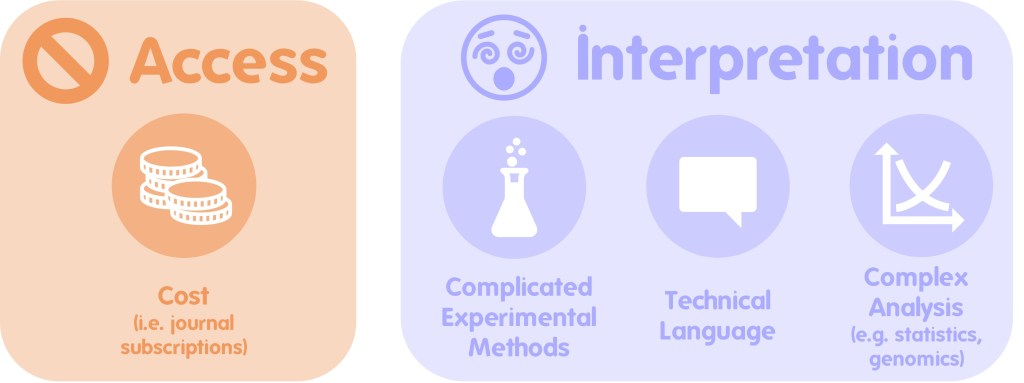
There are two main barriers that I have personally experienced:
- Access: Many scientific papers are only accessible to those with scientific journal subscriptions. Journal subscriptions are often prohibitively expensive for those working (or volunteering) in roles that don’t provide this..
- Interpretation: It can be difficult to interpret the results of some scientific outputs without specialist knowledge or skills. This can include aspects such as the use of complicated experimental methods, technical language and complex analysis (including statistical and genetic analysis).
Being able to access relevant scientific articles and interpret them would enable me to do a much better job as National Recorder for Earthworms, and there are many more naturalists like me out there that contribute to conservation, monitoring and environmental education that would also benefit from science that is more accessible.
entoLIVE – A potential solution?
I wanted to put my experience of organising and delivering virtual events to good use and design a means of breaking down the barriers to invertebrate research… so in February 2022 the idea of entoLIVE was born and I’ve been working on it in my spare time since.
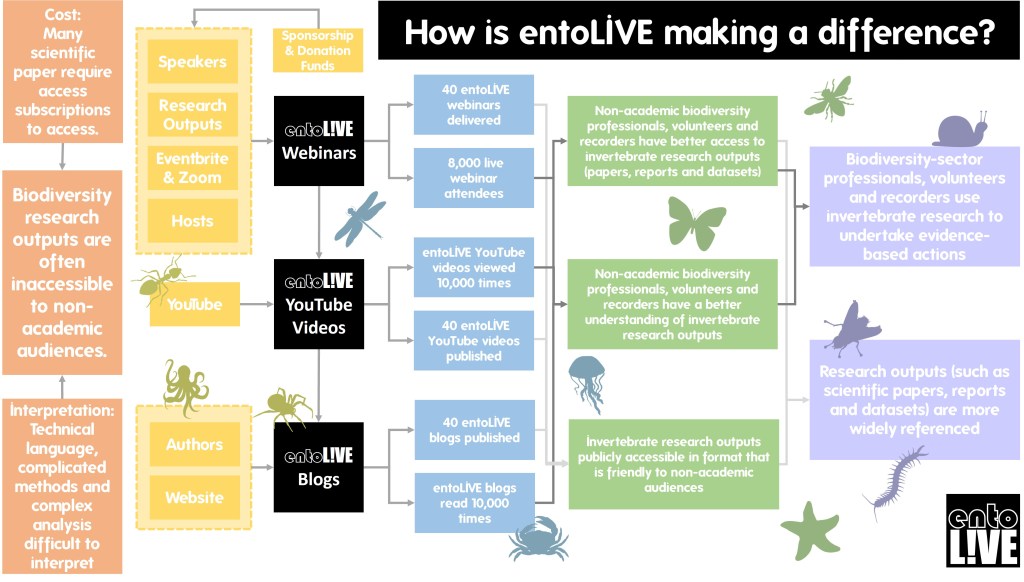
The entoLIVE webinar series showcases the research of invertebrate researchers or specialists, with each webinar focusing on specific research outputs (such as research articles, technical reports, datasets or specimen collections). Speakers are asked to present their work in an accessible manner – not shying away from the science but ensuring that graphs and stats are clearly explained.
And, of course, I couldn’t very well complain about accessibility issues due to journal costs and charge a premium so I kept the webinars free to attend so that they are accessible to all.
More than just another virtual talk series
I also wanted the entoLIVE webinar series to benefit those at the beginning of their research careers, and speaker applications from those completing their PhDs are strongly encouraged. I’m aware that those undertaking a doctorate are often doing so on a shoestring budget, so I also felt that it was important that all speakers are offered a fee for their time when presenting their work through entoLIVE.
This is the third webinar series that I’ve set up, with both the Natural History Live series (by the Field Studies Council) and the Virtual Natural History Talk series (by the London Natural History Society) achieving great engagement numbers and still going. Like these series, entoLIVE will feature speakers from a wide range of organisations, such as universities, national recording schemes and conservation NGOs.
With entoLIVE I wanted the impact to be far-reaching to give the subjects the attention they deserve, which means that the series needs to be even more collaborative – so I’m now working on bringing in partners that are involved in invertebrate research and want to officially add their name and logo to the entoLIVE family banner.
The British Entomological & Natural History Society of Britain became the first organisation to officially join the entoLIVE family when they agreed to part-sponsor the webinar series for 2023, with the Royal Entomological Society joining shortly after.
By pooling our members, followers and networks we hope to deliver webinars that achieve bookings of 500+ people for each event.
When I chose to work in the biodiversity sector, I (clearly) didn’t do it for a big fat paycheck… I did it because I believe understanding the natural world is important for conserving our planet and its wildlife. My hope is that entoLIVE helps towards understanding our invertebrates a little more and leaves those involved in invertebrate conservation a little better informed.
More on invertebrates
 Biological Recording
2 thoughts on “Making Invertebrate Science Accessible”