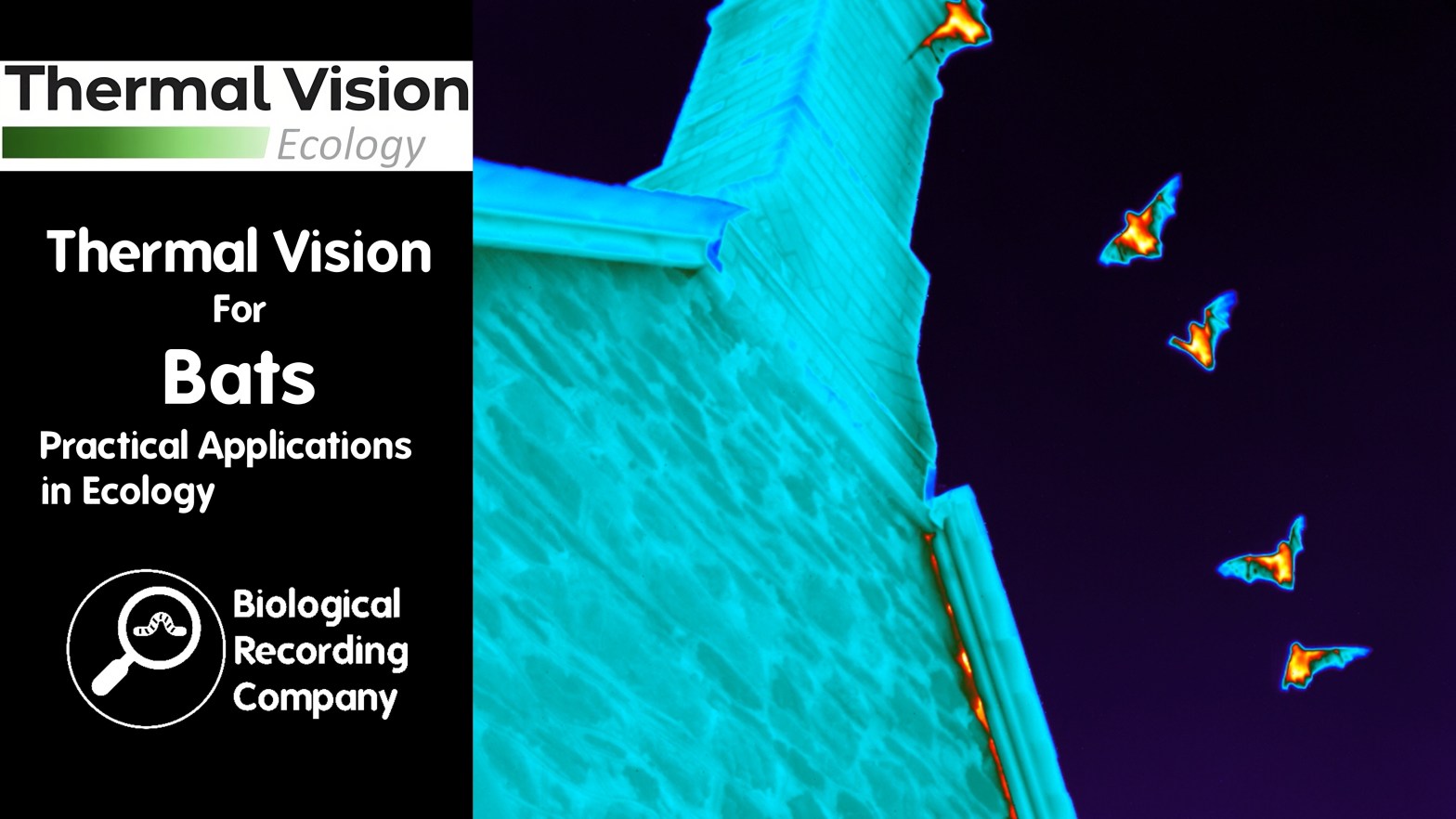
Thermal imaging is rapidly becoming a valuable tool in ecological surveying, allowing wildlife to be detected and tracked based on heat rather than visible light. In bat ecology, thermal cameras offer significant advantages for emergence surveys, enabling surveyors to identify bats leaving roosts in low light or complete darkness, reduce observer bias, and improve confidence in results.
In March 2026, in partnership with Thermal Vision Ecology, we delivered a 90-minute webinar showcasing the Thermal Ecology Toolkit and exploring how advanced thermal imaging and radiometric data are being applied in modern bat surveys, from survey planning and field deployment through to efficient post-survey analysis.
This blog contains recordings of the two presentations which made up the webinar, Q&As with the two speakers, and a reference list of links for further reading. The two presentations are:
- Introduction to Advanced Thermal Imaging for Bat Emergence Surveys with Andy Milner (Thermal Vision Ecology)
- Thermal Vision Ecology Kit: Best Practice and Guidance for Bat Surveys with Dr Liat Fernando (nee Wicks) (Thermal Vision Ecology)
📩 Contact Thermal Vision Ecology directly via enquiry@thermalvisionecology.co.uk
🦇 Find out more about the Thermal Ecology Kit here: https://thermalvisionecology.co.uk/the-thermal-ecology-kit/
Introduction to Advanced Thermal Imaging for Bat Emergence Surveys
Andy Milner (Thermal Vision Ecology)
Thermal imaging is becoming an increasingly important tool in bat emergence surveys, offering improved detection and greater confidence in survey outcomes. In this presentation, Andy introduces the fundamentals of thermal imaging and demonstrates how the Thermal Ecology Kit can be applied specifically to bat survey work.
The session will clarify the differences between infrared and thermal imaging before exploring radiometric data and its importance for accurately detecting and tracking bats as they emerge. Attendees will also learn how radiometric data can be used to automate and speed up video analysis, reducing review time while maintaining robust, repeatable results. This presentation is aimed at bat ecologists seeking to understand how advanced thermal technology can enhance emergence surveys and survey efficiency.
Q&A with Andy Milner
Andy Milner MSc is thermal imaging expert and has been supporting FLIR’s academic and R&D customers in the UK. After assisting on a bat survey in 2023, he identified problems ecologists faced that could be fixed by advanced thermal cameras. In 2024 he formed Thermal Vision Ecology which has so far supported over 100 customers across the UK.
Are there any examples of the technology being used for research rather than ecological consultancy?
Although Thermal Vision Ecology has only been around since 2024, our sister company, Thermal Vision Research has been around since 2015. As the name suggests, we specialise in research applications.
In addition to lab-based research, we have also conducted field research in plant and animal health. Most notably, we recently joined a research group in Sierra Leone to monitor the mental wellbeing of apes. We have also worked with the BBC and other studios studying animal behaviour for educational and entertainment purposes.
Research applications often require more capable cameras than those provided in the ecology kit. We are the only company in the country with access to FLIR’s full range of R&D cameras. These include their medium wave ‘cooled sensor’ cameras.
How much does it cost to use this technology for bat surveys?
We typically charge £600 +VAT per day, but due to the expense and additional experience required to use these specialist cameras, we insist on an engineer being present. This is an additional £300-600 +VAT.
We only recommend these cameras for specific scenarios. For example, we surveyed a train tunnel from 200 metres away from the nearest pedestrian bridge. This meant the track could remain in service throughout the survey.
For any unique or complex situations, we usually have the camera and lens combination that fits the application. If it is possible with a thermal camera, we can do it.
Do you offer rental and analysis outside of Great Britain?
Not at the moment. We have been reluctant to rush into it, as we want to be sure we can provide the same level of service we offer in Great Britain. We are hopeful that next year we can start providing our solution to Northern Europe. We plan to partner with other companies, so if you think you can help, please reach out.
📩 Contact Thermal Vision Ecology directly via enquiry@thermalvisionecology.co.uk
Thermal Vision Ecology Kit: Best Practice and Guidance for Bat Surveys
Dr Liat Fernando (nee Wicks) (Thermal Vision Ecology)
Successful use of thermal imaging in bat surveys relies on careful planning, effective field deployment, and structured data analysis. This presentation provides practical best practice guidance for using the Thermal Vision Ecology Kit throughout the full bat survey workflow.
Liat will cover key pre-survey considerations, including how to plan camera numbers, positioning, and coverage for bat emergence surveys. The session will then focus on on-site tips to ensure surveys run smoothly and data quality is maximised, before outlining a clear post-survey analysis workflow. Real-world bat survey case studies will be used to demonstrate how these principles are applied in practice and how thermal imaging can support confident interpretation of bat activity.
Q&A with Liat Fernando
Dr Liat Fernando (nee Wicks) has over 20 years’ professional experience as a bat specialist and has over 10 years’ experience in using thermography to detect bats, undertake research in thermoregulation and monitor the health of animals. Her perfect blend of knowledge in these areas makes her an invaluable addition to Thermal Vision Ecology as Head Ecologist. As well as managing large projects, she oversees all aspects of training, including on-site support and video-analysis.
How effective is this technology for surveying woodlands and trees compared to other survey methods?
As thermal devices do not rely on light levels, the coverage and detection distances you can get within a woodland or covering a large tree is much better than with reflected IR. Couple the camera with a wide angled lens option and you have a very effective detection tool for small fast flying mammals within woodland or emerging from a tree. It is also very effective when using the tracking and subtraction filters to more accurately determine if bats are flying through the canopy or emerging from the tree itself.
Can your system be integrated with acoustic monitoring of bats?
This is something we are working on, and we have our very own software developer currently designing an ecology focused platform which will look into doing exactly this.
Does this technology work well for other species or species groups?
This technology is also useful for nesting bird checks, ground nesting bird surveys, crossing point surveys (not just for bats but other animals). Other applications need to be tested in the field for ecology, but as a research and solution focused company we have experience in assisting with behavioural research studies on chimpanzees and animal health studied on various species groups.
Further Info
- Thermal Vision Ecology website: https://thermalvisionecology.co.uk/
- Contact Thermal Vision Ecology directly via enquiry@thermalvisionecology.co.uk
- Advanced Thermal Imaging Workshop for Ecologists (15 April 2026 @ Hestercombe House & Gardens): https://www.eventbrite.co.uk/e/advanced-thermal-imaging-workshop-for-ecologists-tickets-1983606679977
- Thermal Vision Ecology Kit: https://thermalvisionecology.co.uk/the-thermal-ecology-kit/
- FLIR Raven site mapping tool: https://flirraven.com/signin?returnUrl=%2F&pn=Raven&vn=RAVEN+Version+3.0
Contact Thermal Vision Ecology directly via enquiry@thermalvisionecology.co.uk
More for environmental professionals


 Biological Recording