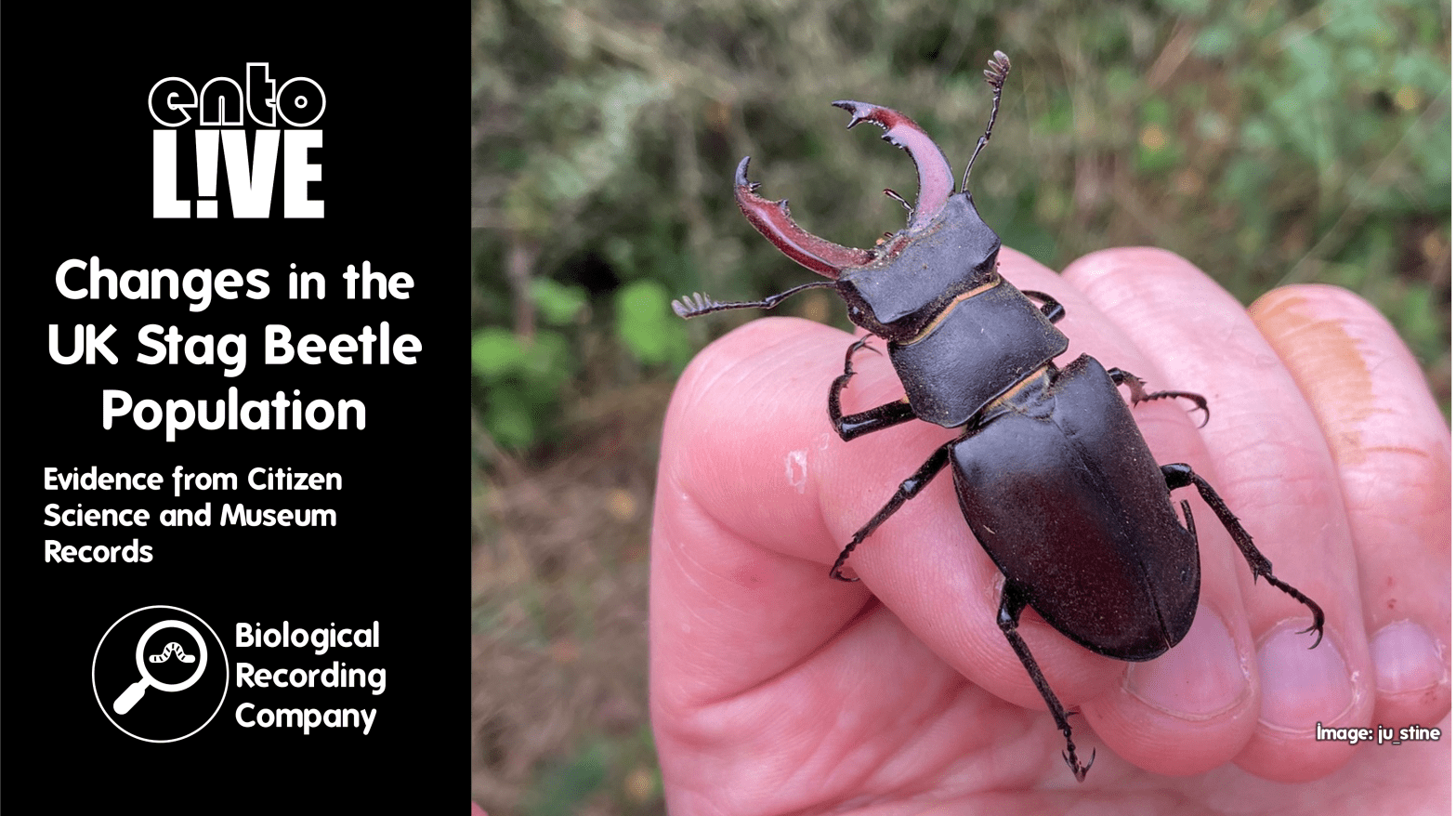
The Stag Beetle (Lucanus cervus) is the UK’s largest beetle. Males can be up to 75 mm long, including their impressive antler-like mandibles which they use to battle each other for access to females during breeding season. It is a truly beautiful species, inspiring amazement in all who are lucky enough to see one. Sadly, evidence from Europe suggests that stag beetle populations are declining across much of their range. But how are they faring in the UK? The south of England was historically recognised as a hotspot for the species. Is it still?
A team of researchers from the People’s Trust for Endangered Species (PTES), the Natural History Museum (NHM) and the University of Cambridge set out to find an answer. Distribution records of stag beetles from 1998 to 2022 were analysed and compared with historic museum records going back over a century. The core range was found to have changed little overall, but has declined in the south west of England. Counts of adult beetles recorded together, although not systematic, indicate a worrying decline in abundance across the range. Phenology was also investigated. This webinar will share the findings from this research project, and discuss what can be done to ensure the long-term survival of this charismatic species.
🎓 Check out our Beetles online course bundle: https://courses.biologicalrecording.co.uk/bundles/beetles
Q&A with David Wembridge
David Wembridge is Conservation Research and Strategy Officer at People’s Trust for Endangered Species. He leads the long-running Great Stag Hunt survey, which has collected records of stag beetles in the UK for over 25 years.
How can you differentiate the Lesser Stag Beetle from the female Greater Stag Beetle?
It can be a tricky one when you’re starting out, but once you’ve seen both it’s hard to confuse them. The easiest distinguishing feature is size; Lesser Stag Beetles (Dorcus parallelipipedus) are typically less than 3 cm in length whereas female Greater Stag Beetles (Lucanus cervus) are longer than 3 cm. As a confirmatory character, the Lesser Stag Beetle is matt black in colour, whereas Greater Stag Beetles have a lovely chestnut-red sheen to their elytra. Finally, as a more technical character, the two species also differ in the number of spurs on the middle and hind legs.
If you accidentally dig up a stag beetle grub, should you rebury it?
Short answer: yes! Ideally just return it to where you found it. Otherwise, if you cannot return the grub to the same location, it’s fine to move it to another area of soil, provided there’s some rotting wood in the soil for it to eat. In fact, if you look, you may well discover a piece of rotting wood in the soil around which you found the grub, in which case you should move this piece of wood with the larva when you relocate it. It can also help to bury the grub down into the soil a little bit (a few inches should do it). Stag beetle larvae are generally quite hardy creatures and can tolerate a bit of manhandling by the occasional gardener.
What sort of soils do you find stag beetles in?
Greater Stag Beetles tend not to be found in areas with chalky soils or heavy clay soils that can be easily waterlogged. That is because they need soil which they can easily burrow through. Most other soil types besides chalk or heavy clay seem to be generally acceptable. Soil-type is likely to be one of the key factors shaping their distribution in southern Britain.
Does the Lesser Stag Beetle also need research and conservation attention?
I don’t think we know all that much about the Lesser Stag Beetle, especially regarding population change. From a distribution perspective, though, the Lesser is certainly much more ubiquitous across the British Isles than the Greater, which suggests it’s doing relatively okay. Please continue submitting records of any Lesser Stag Beetles you find and it may be possible one day to do a similar analysis for the Lesser Stag Beetle as we’ve done for the Greater Stag Beetle.
How useful are hibernacula for the conservation of Greater Stag Beetles?
Interesting question. Whilst we encourage people to create deadwood habitats – log piles or ‘pyramids’ – we don’t know how readily or to what extent Stag Beetles use them. Nevertheless, it’s difficult to imagine hibernaculae and other features as being bad for invertebrates. Even if they’re not frequently used by Greater Stag Beetles specifically, they’ll certainly be other invertebrates that benefit from them. So – build away!
Literature References
- Wembridge et al. (2026) ‘Long‐term population changes for the UK stag beetle Lucanus cervus—Evidence from citizen science surveys and museum collections’: https://doi.org/10.1111/icad.70022
Further Info
- PTES stag beetle campaign: https://ptes.org/campaigns/stag-beetles-2/
- Great Stag Hunt webpage: https://stagbeetles.ptes.org/take-part-in-the-great-stag-hunt/
- European Stag Beetle Monitoring Network transect survey: https://www.stagbeetlemonitoring.org/
- Chafer Beetles of the UK online course: https://courses.biologicalrecording.co.uk/courses/chafers
- Longhorn Beetles of the UK online course: https://courses.biologicalrecording.co.uk/courses/longhorn-beetles
- Surveying for Beetles online course: https://courses.biologicalrecording.co.uk/courses/surveying-for-beetles
entoLIVE
entoLIVE webinars feature guest invertebrate researchers delving into their own invertebrate research. All events are free to attend and are suitable for adults of all abilities – a passion for invertebrates is all that’s required!
- Donate to entoLIVE: https://www.gofundme.com/f/entolive-2025
- Upcoming entoLIVE webinars: https://www.eventbrite.com/cc/entolive-webinars-74679
- entoLIVE blog: https://biologicalrecording.co.uk/category/entolive-blog/
- entoLIVE on YouTube: https://youtube.com/playlist?list=PLuEBNUcfMmE95Re19nMKQ3iX8ZFRFgUAg&feature=shared
entoLIVE is delivered by the Biological Recording Company in partnership with the British Entomological & Natural History Society, Royal Entomological Society and Amateur Entomologists’ Society, with support from Buglife.
The entoLIVE programme is delivered by Biological Recording Company and receives sponsorship from the following organisations:
- British Entomological & Natural History Society
- Royal Entomological Society
- Amateur Entomogists’ Society
Learn more about British wildlife

 Biological Recording