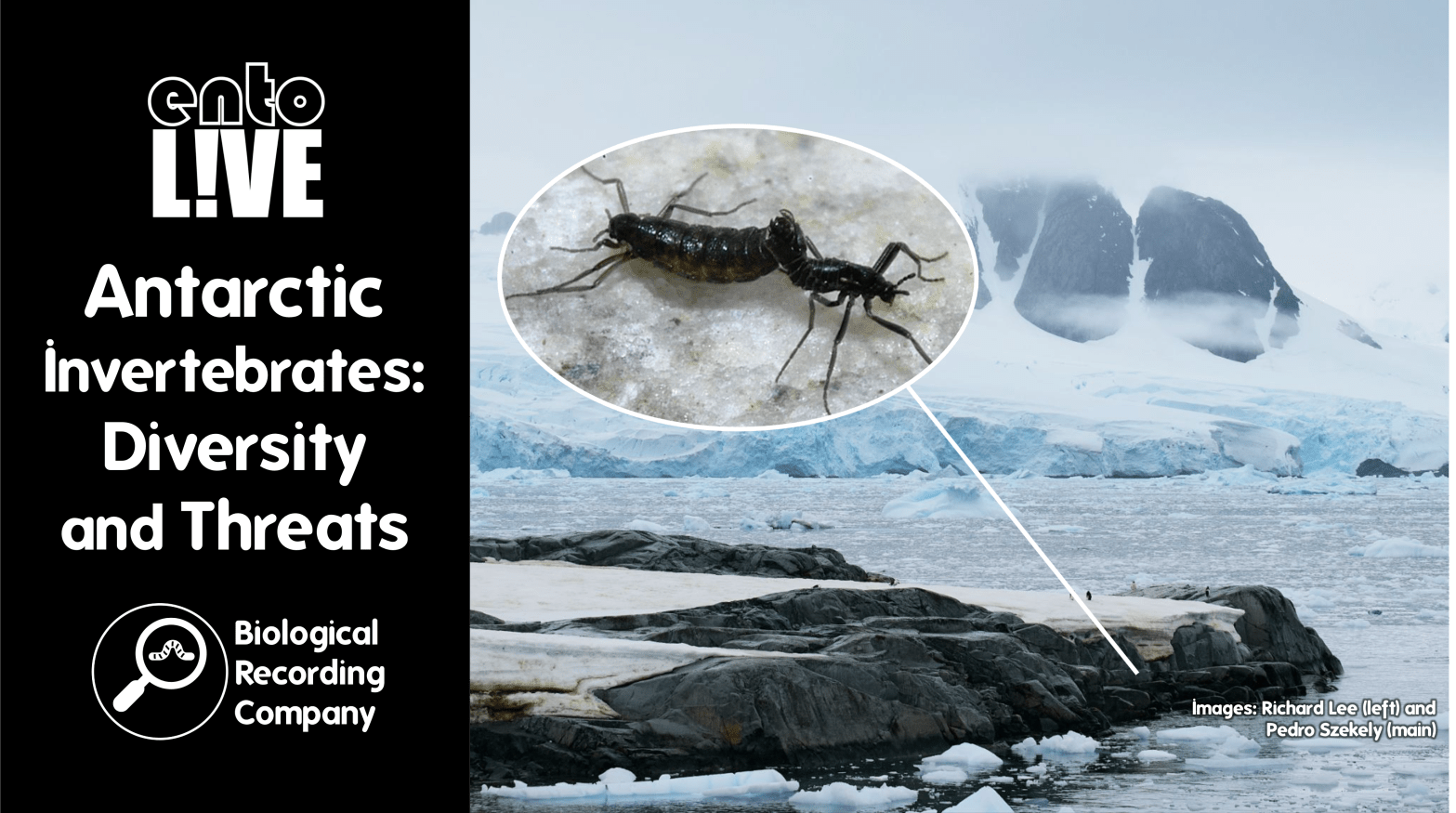
Antarctica’s terrestrial biodiversity is restricted to tiny islands of ice-free habitat surrounded by vast expanses of inhospitable ice or ocean. Today it is dominated by microarthropods and other microinvertebrates, although that has not always been the case. Antarctica’s largest invertebrates are two chironomid midges and a small number of freshwater crustaceans Evolution in isolation, long-term persistence and regionalisation typify this fauna. This has important implications for understanding the geological and glaciological history of the Antarctic region, and of the climatic and oceanographic processes influencing it. Antarctica’s terrestrial biodiversity now faces considerable challenges from growing human activity and impacts, including considerable regional climate change.
Q&A with Peter Convey
Peter Convey is a polar terrestrial ecologist with over 37 years experience working in both southern and northern polar regions. Originally an insect behavioural ecologist, he has very wide research interests relating to the polar regions, covering biodiversity and biogeography, adaptation, evolutionary history, climate and environmental change, conservation, human impacts and invasive species.
1. In the presentation you mentioned a biogeographic boundary in Antarctica called the ‘Gressitt line’. Antarctic species are seemingly never found on both sides of this line – it represents a hard division. However, with the additional pressure on Antarctica from humans, are we beginning to see any species cross the boundary?
This is a very interesting question. We have not seen any species cross the boundary yet. However, there is definitely potential for this to happen in the future. Something else I mentioned in the talk was the fairly recent realisation that Antarctica is not one uniformly connected biogeographic realm but rather a series of relatively discrete biogeographic regions. Many Antarctica species are not just endemic to Antarctica, therefore, but actually endemic to a specific smaller biogeographic region within Antarctica. Having realised this, it now becomes apparent that in addition to risks posed by the arrival of non-native species from outside of Antarctica into Antarctica, risk is also presented by the movement of species within Antarctica, from one biogeographic region to another. One potential example of such movement would be the movement of species across the Gressitt line. All of this has large operational repercussions for us as scientists working in Antarctica. Research operations often involve fieldwork spanning multiple biogeographic regions on the continent. We now need to be acutely aware of the ecological repercussions of such movement. Biosecurity measures will be needed not just upon arrival to Antarctica but also for long-distance travel internally within the continent.
2. What future biosecurity measures do you think will be needed to accommodate with increased pressure on Antarctica?
Contrary to what some might expect, the existing biosecurity measures on Antarctica for scientists are broadly quite simple. It is largely a matter of self-checking of clothing, equipment and cargo to make sure it’s all clean and hasn’t been contaminated with foreign soil, seeds, etc.. The difficulty is enforcing this. How do we make sure people are doing these checks to an acceptably thorough standard? Inevitably, some people are lazier than others with this sort of thing. One option is to shift responsibility away from individuals and towards specialist staff specifically employed to deal with biosecurity. Cruise ships are exemplary in this regard. They take biosecurity very seriously and have, for the last few years at least, employed some staff on the vessels for whom part of their role is specifically to conduct biosecurity examinations of cargo, equipment and tourists’ clothes and footwear. The ships also have very clear education on this issue for their passengers. Even when I’ve travelled on board cruise ships as a scientist I get checked just as thoroughly as the regular tourists. To answer the question then, I would be in favour for more strictly enforced checks across the board. Another element to the question concerns what type of foreign material you are controlling for. Right now the focus seems to be on controlling the introduction of foreign microbes. One of the most common biosecurity measures is the dipping of footwear in Vircon, a strong disinfectant, or an equivalent. Vircon kills microbes effectively, which is great, but it has also been shown not to work on insects (it was tested on Eretmoptera murphyi larvae, and they survived for 30 minutes!). I think the time is now to think about introducing insecticide control as part of biosecurity measures (for instance, some national operators already fumigate incoming cargo containers before arrival in Antarctica). We just need to be careful we choose an appropriate agent that actually kills the things we want to be targeting.
3. Do you find invertebrate fossils in Antarctica?
Yes – you do! That is because Antarctica didn’t always used to be just ice. Back in the Cretaceous period, for example, Antarctica was primarily forested. Just as with any other part of the world with such an ecosystem, there would have been abundant insects, some of which were fossilised. The difficulty with fossil studies in Antarctica, however, is finding the damn things! There’s two kilometres of ice over the vast majority of the continent today, making most of the geology (where fossils are found) totally inaccessible. Palaeontologists are therefore limited to search the ice-free areas, which are few and far between. We have however, found some fossils (including some invertebrates), and, circling back, it’s thanks to our finding these that we even know that Antarctica didn’t used to be all ice in the past. Fossil ferns, fossil freshwater fish, fossil freshwater invertebrates, and fossil flies have all been found, for example. These have been used to reconstruct how past environments used to look. It’s currently believed that at various points in the deep past Antarctica would have had extensive temperate rainforest and even subtropical rainforest. The bit that boggles my mind is that these developed in a region which exists in 24/7 darkness for part of the year!
4. Have any Antarctic species been introduced outside of Antarctica?
Not that I know of! But there have been species introduced within Antarctica (i.e. from one part of the continent to another). The classic example of that would be the midge Eretmoptera murphyi, which I discussed in the talk. One might assume that northwards migration of species out of Antarctica into the Southern Ocean islands, for example, would be unlikely, presuming Antarctic species to be too specially adapted to the Antarctic conditions to survive elsewhere. However, there have been some rather good molecular studies, particularly from Chilean scientists, showing that northwards migration of Antarctic species, at least in the marine context, is at least possible. Such migrations have occurred in the deep past at least, if not recently.
5. Have there been any instances of Antarctic ecosystems surviving mostly unfazed with the addition of a non-native species? Or do non-native species always cause havoc?
This is a very sensible question. In invasion biology it’s often useful to think about a ‘rule of 10s’. Say you look at a certain part of the world and identify 100 species which could potentially get there. Of those, as per the laws of invasion biology, around 10 of those are likely to establish. And when we say establish we mean the species lands, it grows, it survives, and that’s it – it stays in one spot. We might call such species persistent aliens or persistent non-natives. These species don’t have a lot of impact. Of those 10 species which establish, however, one might well become invasive – reproducing, expanding its distribution, interacting with the native community with adverse outcomes. It is these which are the species we need to worry most about. It is, however, also a feature of invasion biology that some species remain ‘persistent’ for sometimes many years before switching to ‘invasive’, a risk that needs recognising and that is then compounded by climate change. All that is to say, most species that get to a new place aren’t going to cause a great amount of damage, if any at all. A proportion, however, will. There are currently 18 non-native invertebrate species known from the Antarctic Peninsula region. Most of those are known from single location. Of those 18, two are arguably now true invasives. So in our case the ‘rule of 10s’ isn’t exactly accurate, but it’s a broad ‘rule of thumb’ in the global context.
Literature References
- Bartlett et al. (2020) ‘An insect invasion of Antarctica: The past, present and future distribution of Eretmoptera murphyi (Diptera, Chironomidae) on Signy Island’: https://resjournals.onlinelibrary.wiley.com/doi/pdfdirect/10.1111/icad.12389
- Convey and Peck (2019) ‘Antarctic environmental change and biological responses’: https://www.science.org/doi/full/10.1126/sciadv.aaz0888
- Davies et al. (2026) ‘The Antarctic Peninsula under present day climate and future low, medium-high and very high emissions scenarios’: https://www.frontiersin.org/journals/environmental-science/articles/10.3389/fenvs.2025.1730203/full?utm_source=&utm_medium=7628
- Tichit et al. (2026) ‘Expansion of invasive carabids across elevation and habitats on sub-Antarctic South Georgia’: https://nora.nerc.ac.uk/id/eprint/541135/
- Convey et al. (2020) ‘Refuges of Antarctic Diversity’: https://www.sciencedirect.com/science/chapter/edited-volume/abs/pii/B9780128179253000100
- Terauds et al. (2012) ‘Conservation biogeography of the Antarctic. Diversity and Distributions’: https://onlinelibrary.wiley.com/doi/10.1111/j.1472-4642.2012.00925.x
- Pugh and Convey (2008): Antarctic terrestrial life – challenging the history of the frozen continent? https://onlinelibrary.wiley.com/doi/abs/10.1111/j.1469-185X.2008.00034.x
- Chown and Convey (2007) ‘Spatial and temporal variability across life’s hierarchies in the terrestrial Antarctic’: https://royalsocietypublishing.org/rstb/article-abstract/362/1488/2307/58262/Spatial-and-temporal-variability-across-life-s?redirectedFrom=fulltext
- Short et al. (2022) ‘An ancient, Antarctic-specific species complex: large divergences between multiple Antarctic lineages of the tardigrade genus Mesobiotus’: https://www.sciencedirect.com/science/article/pii/S1055790322000422
- Lee et al. (2017) ‘Climate change drives expansion of Antarctic ice-free habitat’: https://www.nature.com/articles/nature22996
- Chown et al. (2012) ;Continent-wide risk assessment for the establishment of nonindigenous species in Antarctica’: https://www.pnas.org/doi/10.1073/pnas.1119787109
- Contador et al. (2020) ‘Assessing distribution shifts and ecophysiological characteristics of the only Antarctic winged midge under climate change scenarios’: https://www.nature.com/articles/s41598-020-65571-3
- Hughes et al. (2010) ‘The protection of Antarctic terrestrial ecosystems from inter- and intra-continental transfer of non-indigenous species by human activities: A review of current systems and practices’: https://www.sciencedirect.com/science/article/abs/pii/S0959378009000764
Further Info
- Peter Convey British Antarctic Survey profile: https://www.bas.ac.uk/profile/pcon/
- British Antarctic Survey: https://www.bas.ac.uk/
entoLIVE
entoLIVE webinars feature guest invertebrate researchers delving into their own invertebrate research. All events are free to attend and are suitable for adults of all abilities – a passion for invertebrates is all that’s required!
- Donate to entoLIVE: https://www.gofundme.com/f/entolive-2025
- Upcoming entoLIVE webinars: https://www.eventbrite.com/cc/entolive-webinars-74679
- entoLIVE blog: https://biologicalrecording.co.uk/category/entolive-blog/
- entoLIVE on YouTube: https://youtube.com/playlist?list=PLuEBNUcfMmE95Re19nMKQ3iX8ZFRFgUAg&feature=shared
entoLIVE is delivered by the Biological Recording Company in partnership with the British Entomological & Natural History Society, Royal Entomological Society and Amateur Entomologists’ Society, with support from Buglife, Field Studies Council and National Biodiversity Network Trust.
The entoLIVE programme is delivered by Biological Recording Company and receives sponsorship from the following organisations:
- British Entomological & Natural History Society
- Royal Entomological Society
- Amateur Entomogists’ Society
Learn more about British wildlife
 Biological Recording